
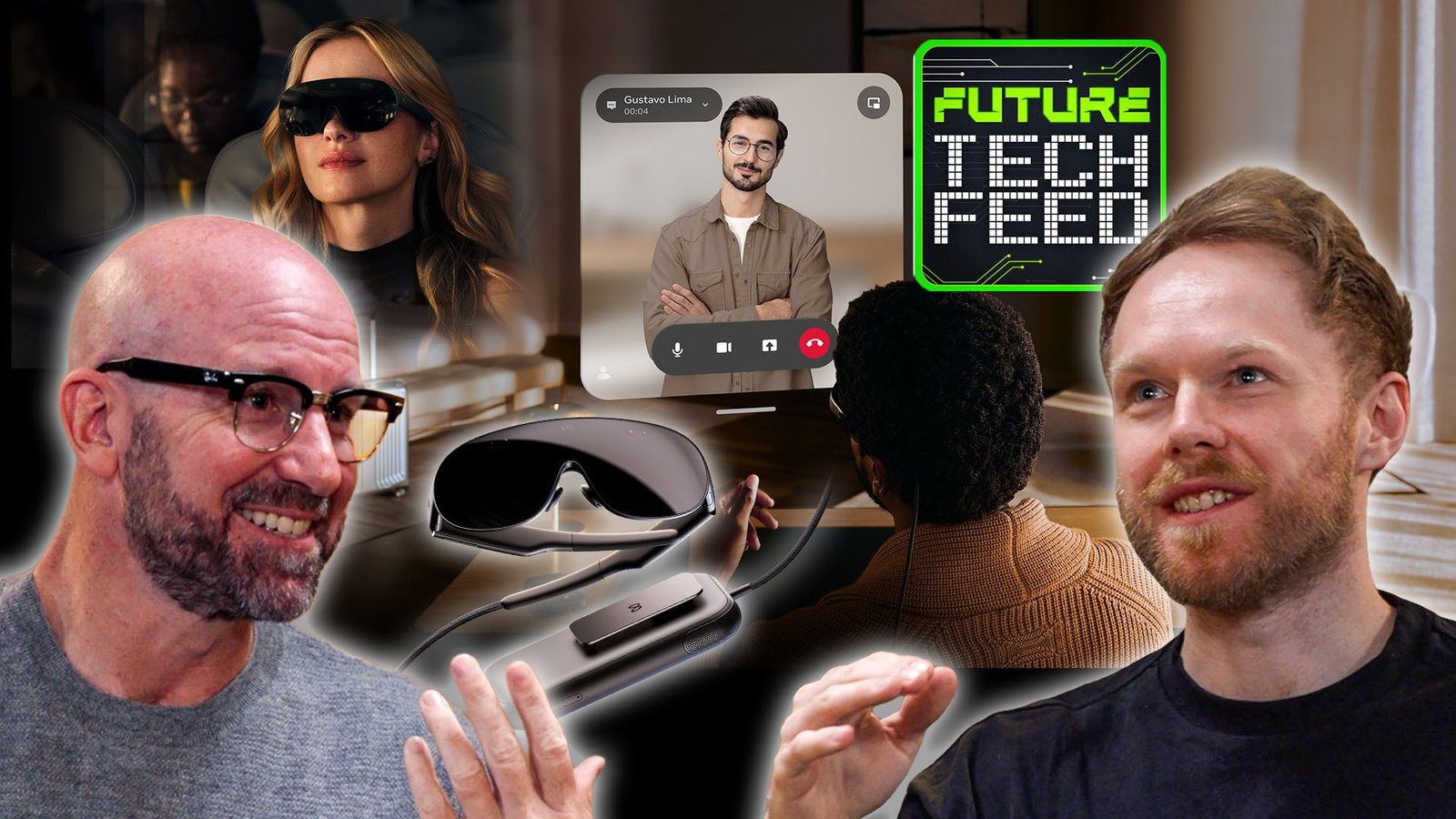
META has just reinvented virtual reality with a new headset that looks like a big pair of sunglasses.
I tried them earlier this week and I couldn’t believe my eyes – and it left me brimming with questions, and I knew exactly who had the answers.


Andrew ‘Boz’ Bosworth is Meta’s chief tech officer and the man in charge of the company’s future-gazing Reality Labs division.
And he’s responsible for two of this week’s big gadgets, including the new Meta VR Glasses.

But when I sat down with him at Meta HQ in California during the Meta Connect conference, I wanted to ask about the new Ray-Ban Meta Audio glasses first (Watch on YouTube / The Sun’s Video Hub).
That’s because they were the first of Meta’s smart specs to not feature a camera.
“We started this project maybe a year and a half or two years ago,” Boz told me.
“When the number one most-used feature on the Ray-Ban Meta glasses has been audio.
“And in retrospect it made sense, you know – it’s a tremendously popular use-case.
“People are listening to music, they’re listening to podcasts, they’re doing calls, and it’s such. Popular feature.”
Binning the camera on this specific model has meant that Meta is able to make some serious upgrades.
So it beats the regular specs on price, weight, battery life, while retaining the speakers, microphones, and AI chat.


“While we love what the camera can do for people, it comes with a real cost in terms of literally cost, and as well as weight and battery life,” Boz said.
“And so if you’re willing to take a pair of glasses and say, let’s just focus on the audio features.
“Not only are you gonna get the same great audio, but now you’re gonna get longer battery life, you’re gonna get lighter weight, and you’re gonna get a lower cost.”
Of course, the privacy-minded will be looking at these specs with a feeling of vindication.
Meta’s camera-toting glasses have plenty of fans, but also no shortage of critics who fear being secretly filmed by sinister strangers.
The good news is that Meta has been doing significant work on blocking the ability for rogue users to disable the camera light, which shines while recording as an alert mechanism to people nearby.
“The very, very first generation of camera glasses we ever put out there had the light on them,” Boz told me.
“Every single generation we’ve ever done since has had the light to indicate when there’s recording.


“Because it’s not just about do you feel like you look good in the glasses and that you like the functionality.
“But it’s about the people around you. Do they feel comfortable with it? We’ve known that from the beginning.”
He continued: “There are some bad actors out there who are trying to tamper with the light,”
“So in the second generation of the glasses, we put in tamper detection.
“So if the light is covered, we can detect it and disable the camera.
“Well people were trying to circumvent that – it’s a bit of a cat-and-mouse game, but I think we’ve got the upper hand now.”
Not only has Meta upgraded the tamper detection, but also its own policies.
Boz revealed how the company is able to crack down more harshly on people misusing the specs.
“We’ve dramatically improved our tamper detection, and we’re willing to take a much stronger step against people who attempt to do that kind of thing,” Boz said.
“So we can disable the camera on the glasses permanently.
“And we can take down any content that they put up on social media that comes from a tampered pair of glasses.
“And, in fact, we can take their accounts down.”
He went on: “There are always gonna be people who are attempting to circumvent the systems,”
“And it’s incumbent upon us to take every avenue we can to ensure that the promises that we built the product with remain intact.
“So that consumers can feel comfortable and confident when they wear them around.”
Anyway, the far bigger news from Meta Connect were the Meta VR Glasses.


They function in much the same way as regular VR headsets, showing you movies on giant screens, immersing you in video games, allowing you to work on virtual desktops and so on.
But where they differ significantly is the fact that they are much smaller – they can’t really even be called a headset.
They look like a pair of oversized sunglasses, which is impressive.
And the visual quality is stunning – I watched an NBA game and, more enticing still, a scene from The Avengers.
I was blown away.
“We worked with content creators, you know, we worked with James Cameron,” Boz told me.
“We worked with people who have spent their careers in immersive content and producing the most compelling experience that they can.”
He continued: “We were just obsessed with every detail that we could get in terms of how to maximise the quality of the experience,”
“I think a lot of times with the VR products, people are measuring the speeds and the feeds so to speak. Like, what’s the number of pixels? It’s not just that.
“It has do to with the optics as well. It has to do with the lenses and the design of the lenses, and how can we get them comfortable very close to your eye.
“To be both this lightweight – about a hundred grams – and also give you a really immersive feeling of cinema.”
Boz said that Meta is working with Lucasfilm and Disney to bring immersive entertainment to the glasses.
And it can give people a chance to watch content – including IMAX movies – as the filmmaker intended at home.
“When they build something that’s filmed in 3D or that’s filmed immersively, there is a limited number of places that humans can experience that,” Boz explained.
“And a lot of times, it isn’t the same experience that you’re gonna get if you watch it on your TV at home.
“And it’s something lost there from what the filmmaker intended, from what the story could be.


“And I think this is an opportunity to kind of restore that for people.”
Meta has been producing VR headsets for a while under the Quest banner.
And while they had many uses, they ultimately came to be seen primarily as a gaming device.
Boz reckons the appeal of the Meta VR Glasses will be broader.
“You kind of come for the gaming, the cinema is dynamite, and the fact that they’re so small and so portable,” Boz said.
“You know it’s suddenly this thing that you are absolutely gonna bring when you travel.
“It’s the kind of thing I would have loved to have had in my dorm room as a college kid when we didn’t have a. TV.
“Or even just being in an environment where you don’t get to control what’s on the TV. This is a great option for those folks.
“The sneaky surprise will be people who use it for productivity.
“We’ve built surface touch typing, and so it’s just an incredible ability to control your windows and productive environment with AI, and also do it anywhere with almost no setup required.”
The typing, in particular, really shocked me.
I couldn’t believe how easy it was to tap away at the virtual keyboard.
In fact, I was able to touch type at close to full speed, not even looking at the keyboard, which I would’ve thought impossible.
Boz reckons he’s not half bad at it either.
“I, at one point, held the record for fastest typing in there,” the Meta CTO revealed.
“CFO Susan Lee came in and knocked me out of the thing. So don’t ever mess with an Excel jockey when it comes to typing speed.”


He went on: “Actually the trickier thing the team did is such a tremendous job on: the touchpad is even harder.
“Because how do you know when my fingers are touching the trackpad – or just above it – when it doesn’t actually exist?
“It took us a long time to crack that, and they’ve done a tremendous job of it.”
Unsurprisingly, the Meta VR Glasses are being widely compared to another premium pair of goggles: the Apple Vision Pro.
Meta VR Glasses seems to have the upper hand on several levels, including size, weight, and price (at $1,299, which is about a third of the price of Apple’s headset).
But one feature missing from Meta’s specs is Apple’s EyeSight feature, which renders your eyes on the outside of the headset.
Boz tells me that Meta actually considered the feature, but decided it wasn’t worth the drawbacks.
“Even before Apple Vision Pro came out, we had played with that same idea of a screen that showed the eyes on the outside,” Boz explained.
“And the thing, it adds a lot of weight and cost to your device.
“That I’m just not sure is a tremendous value in practice – and so for us, we just decided again to be quite rigid with this device.
“And focus on making it the most comfortable, lightweight and yet cost-effective solution we could to delivering these great experiences.”
These glasses are seriously small for what’s on offer.
Much of that gain has been achieved by offloading the computing power, storage, RAM, and battery into a small puck that you can keep in your pocket.
So how much smaller can these glasses really get?
“There’s only so many ways you can bend light and generate light,” Boz explained.
“And so if you want to have, for example, a super wide field of view, that requires you generating a lot of pixels and focusing those into the retina.
“And that requires a lot of heavy glass.
“So there’s trade-offs around field of view. We’re still quite happy where we landed on that.
“But I think you can help some of that by getting the optics closer to the eye, which we’ve done with these.”
He continued: “There’s also just thermal trade-offs.
“Offloading it to the computer device has allowed us to really push the processor a lot harder than we ever could when the device was on people’s heads.
“When the processor was sitting right next to their faces, you couldn’t put a fan there because it would ruin the audio experience.
“So here, you’ve got an ability to do active cooling.
“So you can actually take even the same processor and get more power out of it.


“Having said that, there’s still physics involved in terms of how hot can it be even in your pocket before it’s actually too hot to be in your pocket.”
These glasses do, in some ways, replace your need for a phone, laptop, and TV in certain circumstances.
They’re unlikely to totally replace the phone for everyone in the short term, but Boz thinks they function as a pretty decent laptop rival.
“We’ve always had this idea that…you and I probably both carry a laptop and a phone,” he said.
“And we use them for different things – and they continue to coexist quite happily in an ecosystem together.
“And what I joke with people is: I bet you’ve been on your phone typing some email.
“This is not a phone email. I gotta put this down. I need my tabs. I need to be having full power. There’s got to be a level above that.
“So I don’t know we ever thought that VR specifically was gonna be a replacement for phones.
“We saw VR as an adjunct, and maybe the type of thing that could start to challenge laptops over time.”
He continued: “I do think that the work that we’re doing in AI and with agents is definitely gonna be very disruptive to at least the idea of mobile phones as we know them now.
“As these kind of series of app silos that don’t work together.
“I think that is in a tenuous position now.”
Now you likely know that Meta spent tremendous amounts of time and money working on the idea of a metaverse.
This is a shared virtual space where vast worlds interconnect, allowing people to work, play, and socialise online with more realism than ever before.
But the metaverse hits roadblocks in terms of hardware limitations – and these glasses provide another leap.
So I asked Boz how the new Meta VR Glasses tie into Meta’s grand vision for a metaverse.
“What’s the old saying? The future is here, it’s just not evenly distributed,” he told me.
“I think, you know, for people who put the VR glass on and you try the full-body holograms, it is a very transportive experience.
“It does feel like you are in a conversation with somebody in a very personal and direct way.
“And likewise, when you’re having these shared experiences, they feel profound.
“They feel like shared experiences whether you’re watching content, watching a basketball game, or are in a VR game together.”
Boz continued: “But right now it’s very hard to get into that mode.
“So there’s really always been two concepts for the metaverse, one of which was make it more ubiquitous and pervasive.
“So like how do we bring it to everyone, everywhere?


“And that’s through augmented reality, ideally over time And then also, how do you make it so that when people are in a headset, they’re having the most engaged and rich experience possible?
“So we’re kind of working it from both ends.”
He went on: “The real unexpected development of the last several years was AI.
“We always imagined that holograms were gonna come before AI, and it turns out we got the sequencing wrong.
“Which is better news than you might expect because AI is one of the things that makes these so much more valuable.
“It makes them so much more useful.
“It makes form factors like audio-only glasses so much more capable in terms of getting things done.
“So for us right now, we’re leaning very hard into: let’s maximise these devices for their ability to help you with AI, while also making them fully supportive of the kind of social and immersive experiences that we’ve always imagined for VR.”
(Watch the full interview on YouTube / The Sun’s Video Hub).