
Why a Case of Slime Could Be the Most Valuable Masters of the Universe Item on eBay
Sometimes, despite collectors’ best efforts, it becomes a simple fact that toys weren’t designed to last decades after their original manufacture. Glue degrades on stickers, leaving them to peel. Plastic degrades, causing figures to develop a sticky, oily sheen. Foam in Kenner Star Wars playsets gradually turns to dust, slowly rendering the task of assembling a “complete” Death Star a fool’s errand. Time and the elements gradually unravel the surprisingly-delicate chemical processes behind our favorite vintage toys. There’s no better proof than the going rate for vintage canisters of Slime, a toy Mattel brought to market in 1976.
The byproduct of a simple chemical process, “Slime” is exactly what it sounds like: a gooey, malleable, oozing substance that fascinates kids and aggravates parents trying to clean it from the carpet. Though it had been on the market for a decade by 1986, Mattel reintroduced Slime in a way that made it more collectible than ever: they added it to their Masters of the Universe line, incidentally creating a grail item for collectors decade later. Sealed slime canisters routinely sell for $200 or more, but sealed cases of Slime like this one on eBay now, are rare enough that the seller can virtually name their price. For this seller, that price is $30k.
Where Mattel’s “Slime” Came From (And How It Got to Retail Shelves)
Slime is the simple offspring of a chemical reaction between borax (sodium tetraborate) and guar gum (polysaccharide) – also used as a thickener and stabilizer in baked goods, sauces, and ice creams. The reaction that creates Slime is stable, though oxidization eventually hardens and dries Slime out. This meant that kids had to be careful to put their Slime back in its container after using it, or that their parents had to resign themselves to buying more. This is also why, after forty or more years, the only Slime that’s still viable is sealed: even the slow introduction of oxygen to an opened and resealed container dries it out over enough time.
It was an instant success when it came to market in 1976, appealing to every kid’s innate desire to play with something gross. The simple chemical process to make Slime couldn’t be patented, leading to dozens of copycat brands on the market. To keep the product fresh, Mattel leaned in to the gross-out nature of the toy, mixing in rubber bugs, worms, or even eyeballs with their Slime. Mattel would also introduce Slime in different colors, a gimmick Kenner took to its extreme with their Real Ghostbusters “Ecto-Plazm” (Slime by another name) in 1987.
Mattel even made a Slime board game in 1979. The game was themed around a small town invaded by a Slime Monster of unknown origin – though given the clear influence of 1958’s The Blob over the game, it feels safe to say the monster is alien. Players were trying to beat each other to the town’s armory, where a landmine could be secured that might destroy the slime-spewing menace. Using a spinner, the monster would be moved around the board with the players. If a player was unlucky enough to land on a spot directly below the monster, they would be covered in slime.
The History of Slime in Masters of the Universe

By 1985, Masters of the Universe was in its fourth year on shelves. Interest in the line was starting to wane, and Mattel responded by introducing a new faction of villains for He-Man and his Heroic Warriors to battle: the “Evil Horde,” led by the ruthless Hordak. The Evil Horde villains boasted some of the most creative designs Mattel’s team produced for the line, bolstered by all-new playsets and vehicles.
During one brainstorming session, designer Ted Mayer hit on an idea: bring Slime to Masters of the Universe. He sketched a playset, the Slime Pit, that would let kids dump a canister of Slime onto a captive Masters of the Universe action figure. After a little market research, Mattel decided the toy was a fantastic idea, and brought it to shelves for 1985.
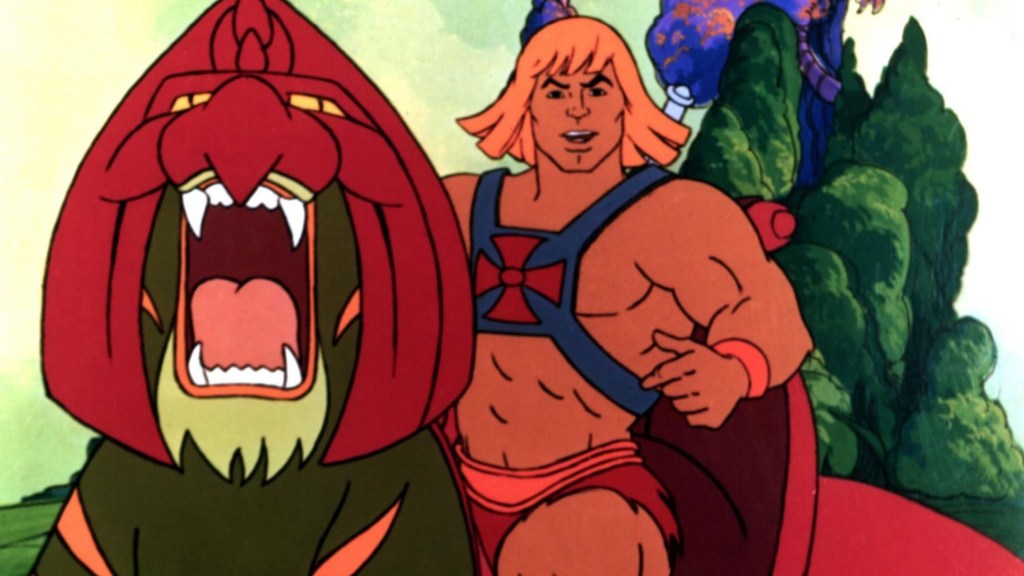
The Slime Pit came packaged with one canister of specially-branded Masters of the Universe Slime, which was also sold individually in cases of forty-eight. The packaging brands the Slime a weapon of the Evil Horde, and demonstrates it in use against Skeletor’s minion Beast-Man. In a nice touch of attention to detail, Mattel sculpted a dedicated lid for the Masters of the Universe Slime sculpted with the grim visage of Hordak. For a time, Mattel even offered Slime as a mail-away item, with a cannister coming free with proof of purchase from any two He-Man figures.
The Slime Pit playset was simple, but the gimmick of dumping Slime on your action figures was intoxicating. The toy itself was simple: a plastic, dinosaur-like skull mounted atop a “stone” wall spewed Slime onto any He-Man figure trapped beneath it by its skeletal claw. The directions are careful to warn kids that “there are a few Masters of the Universe character which … simply won’t and should never go near” Slime. Characters with fur or flocking Grizzlor, Moss-Man, and Pantho are forbidden, as are those with internal mechanisms like Kobra Khan, and “any battery-powered vehicle.”
In-universe, the Slime Pit’s included mini-comic explains that any character who is “Slimed” falls under the mental control of the Evil Horde. Even He-Man is susceptible, becoming a Toxic Avenger-like mutant monster when subjected to the Slime Pit.
Why He-Man Collectors Still Love the Slime Pit

The Slime Pit was an instant favorite with kids, also making it a favorite with these same kids as they aged into the collectors of today. The toy’s straight-forward gimmick is a beloved symbol of the gleeful, simple fun that Masters of the Universe represented then and and now.
Most collectors are satisfied that owning a sample of the Slime itself is impossible – but others can’t resist a challenge. The best way to increase demand for a toy is telling collectors that owning one is “impossible.” The thrill of that hunt, the challenge of tracking a rarity down, and the bragging rights that come when you finally have one are as intoxicating to a grown-up collector as dumping Slime on Buzz-Off was to their ten-year-old self. So while the $30k asking price on the still-sealed case of Slime is steep, the uniqueness of such an item is sure to tempt the He-Man fan who has everything.
How much would you pay for a can of Slime? Leave a comment below and join the conversation now in the ComicBook Forum!