A Fan Favorite DC Villain’s Golden Age First Appearance Makes a Rare High-Grade Auction Appearance
No matter what era or medium got you into DC Comics, you knew Solomon Grundy. He’s been a perennial threat to virtually every super-hero and team in the pre and post-Crisis on Infinite Earths comic book universes. Maybe you grew up seeing Grundy as a charter member of the Super Friends’ Legion of Doom, or as a tragic foe to the DC Animated Universe (DCAU)’s Justice League. More recently, you might have frantically mashed buttons as he walloped you in Batman: Arkham or Injustice. It all started in one comic, published toward the end of DC’s brief, beloved Golden Age: All-Star Comics #61.
Cover dated October 1944, All-Star Comics #61 is one of the Overstreet Price Guide’s picks for the top hundred comics of the Golden Age – selected for a combination of value, significance, and rarity. The CGC (Certified Guarantee Company) lists only ninety-six copies in existence in graded condition. Only some two dozen confirmed sales have occurred within the past fifteen years, with the record-breaker coming in 2021, when Heritage sold a one-of-a-kind near-mint 9.6 graded copy for $138k. If you’re interested, the seller is entertaining offers of $276k for the book. While the sample Hakes is auctioning next week isn’t near-mint, its 7.0 very fine condition is also exceptionally rare, typically selling for $25-30k.
How Solomon Grundy Became One of DC’s Most Enduring Villains
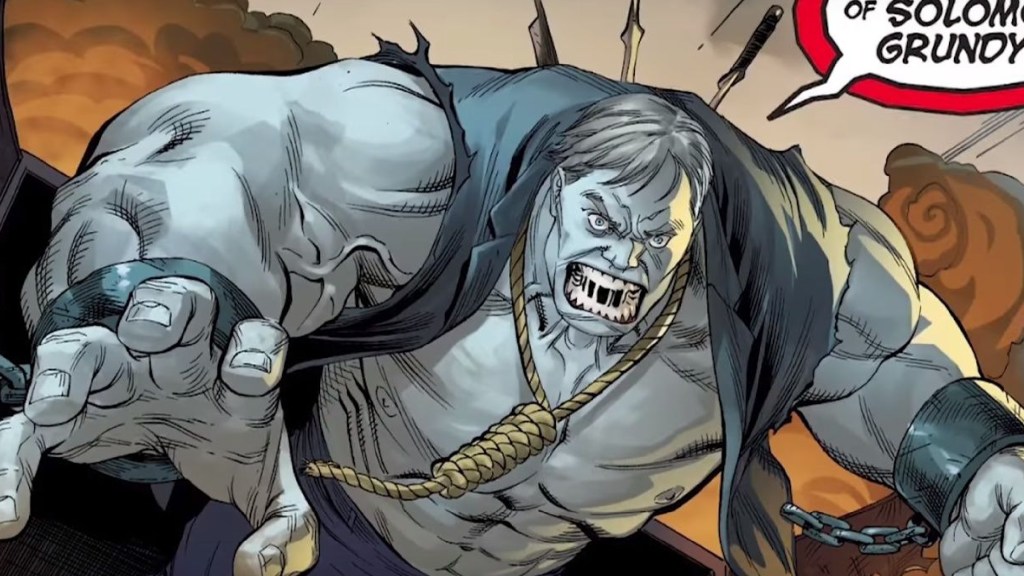
All-American Comics #61 introduces Grundy rising from “Slaughter Swamp” on the outskirts of Gotham City. Grundy is found by a group of criminals, who give the amnesiac zombie the name of “Solomon Grundy” after he shares with them that while he can’t recall his name, he can recall that he was born on a Monday. This references an old nursery rhyme that was better known at the time of the issue’s publication, since becoming a minor point of confusion for younger fans of the character. Witnessing Grundy’s immense, superhuman strength and invulnerability, the criminals elect to make Grundy boss of their gang.
With Grundy leading them, the criminals pull off several successful heists, attracting the attention of Alan Scott, the Golden Age Green Lantern (who had himself debuted in the pages of All-American Comics four years prior). Grundy bests Green Lantern twice in battle, his invulnerability extending to an immunity to Green Lantern’s power ring. Grundy is only defeated after being thrown in front of a train, after which Green Lantern is able to deduce something of his foe’s origins.
During one of their encounters, Green Lantern notices a ring on Grundy’s finger, identical to one worn by a businessman named Cyrus Gold who was murdered in Slaughter Swamp decades prior. Green Lantern guesses (correctly, apparently) that Gold’s decomposed body combined with rotting wood and other detritus to create Grundy, who eventually reanimated and rose from the swamp – recalling the origins of later characters like Swamp Thing and Man-Thing. This is also used to explain Grundy’s immunity to the power-ring, which in the Golden Age was vulnerable not to the color yellow, but to wood. All of this is hastily explained in the issue’s closing two panels, giving the suggestion that the writers recognized they were running out of space and needed to resolve the plot quickly and neatly.
As one of the few Golden Age DC villains who could pose a legitimate physical threat to a team of super-heroes, Grundy became a favorite foe for writers to employ against the Justice Society of America. This also made him a natural choice for Gardner Fox to resurrect during the 1960s reemergence of the Golden Age heroes, with Grundy returning to DC in the pages of Showcase #55 after an almost two-decade absence. Showcase #55 is itself highly collectible, with the “first Silver Age appearance” of Golden Age characters like Grundy the closest most fans can get to owning their debut. He went on to battle the Justice Society and Justice League regularly during this era, even fighting both teams combined to a stalemate in Justice League of America #91.
In the 1970s, Grundy emerged as one of the pre-Crisis DC Universe’s only legitimate physical threats to Superman, sometimes analogous in power level to Marvel’s Incredible Hulk. During this era, Grundy is also given a more sympathetic, Hulk-like characterization, a simple-minded creature easily manipulated into crime and mayhem by scheming villains like the Parasite.
Following Crisis on Infinite Earths, Solomon Grundy would be reintroduced to DC’s rebooted continuity during Batman: The Long Halloween, and appeared in the 1990s primarily as a foe to the Caped Crusader. Post-Crisis, Grundy’s origins were also tied with the Parliament of Trees, the otherworldly beings also responsible for the creation of Swamp Thing.
How Video Games, Animation, & TV Have Raised Solomon Grundy’s Profile

Solomon Grundy’s prominence in the bronze age made him a natural choice for membership in Challenge of the Super-Friends’ Legion of Doom. It cemented his inclusion in the DCAU Justice League’s Injustice Gang, a tribute to the Legion of Doom and the comics Secret Society of Super-Villains. The DCAU characterization borrows from the late-bronze age tragic Grundy, sacrificing himself to save Earth from the eldritch horror Ichthultu.
Grundy’s powers also make him a natural video game opponent: he’s an invulnerable, hard-hitting tank. In Batman: Arkham City, the Penguin keeps him chained in the Iceberg Lounge’s basement, using him to dispose of prisoners like Batman in one of the game’s most memorable (and toughest) boss fights. He’s also included in the playable roster for Injustice: Gods Among Us.
Beyond these, Grundy has made dozens of other live action, animated, and video game appearances, some of the most of any DC villain. In terms of villains introduced in the Golden Age, his popularity is surpassed only by characters like the Joker or Lex Luthor. Grundy’s first appearance is even more valuable than Luthor’s, with the $138k sale of the near-mint copy crushing the $84k sales record for Luthor’s 1940 debut. All-American Comics #61 is a holy grail item for collectors who grew up seeing Solomon Grundy’s striking design (largely unchanged in eighty years), impressive powers, and surprising heart in comics, cartoons, and video games. Already at a price of $17.5k with days left to bid, Heritage’s ultra-rare high grade copy might break records again.
Is Solomon Grundy one of your favorite DC villains? Leave a comment below and join the conversation now in the ComicBook Forum!