Every Star Wars Special Edition Change Made By George Lucas & How Controversial They Were
George Lucas has never treated Star Wars as a finished product. He tweaked dialogue and sound mixes on the original trilogy throughout its theatrical run in the late 1970s and early 1980s, long before home video gave fans a fixed version to compare against. The habit became impossible to ignore in 1997, when Lucas brought A New Hope, The Empire Strikes Back, and Return of the Jedi back to theaters for their 20th anniversary as the Special Editions, the first time he used modern effects technology to alter scenes across all three films at once.
Dozens of the 1997 changes were small enough that casual viewers barely noticed them, such as a bigger Death Star explosion with a visible shockwave ring, a softened line of Han’s dialogue with Greedo, or Luke’s cave scream on Hoth swapped from a witty one-liner to a plainer exclamation. Other changes were far more meaningful, altering scenes, restoring cut footage, or replacing musical numbers outright, and those are the ones that generated the lasting arguments fans still have about whether Lucas improved his own trilogy or damaged it.
10) Cloud City Gets New Windows and Establishing Shots in The Empire Strikes Back

Bespin’s Cloud City existed largely as static matte paintings in the 1980 theatrical cut of The Empire Strikes Back, with solid walls standing in for what should have been open views of the floating city outside. Industrial Light and Magic reworked roughly thirty interior shots for the 1997 Special Edition, digitally removing those walls and replacing them with windows revealing a fully rendered CG cityscape behind the actors. The approach sequence got its own overhaul too, with a computer-generated Millennium Falcon now escorted by cloud cars through an aerial view of Cloud City at dusk, replacing a shot that previously cut straight from a distant establishing view to the ship’s landing.
Because the additions touched only backgrounds and never altered blocking, dialogue, or performance, the update read as environmental polish rather than revisionism. Reaction settled quickly into consensus, with viewers and critics alike singling out Cloud City as the best executed redone sequence across all three 1997 Special Editions, seamless enough that casual audiences often couldn’t identify exactly what had changed.
9) The Wampa Gets Its Full Reveal in The Empire Strikes Back
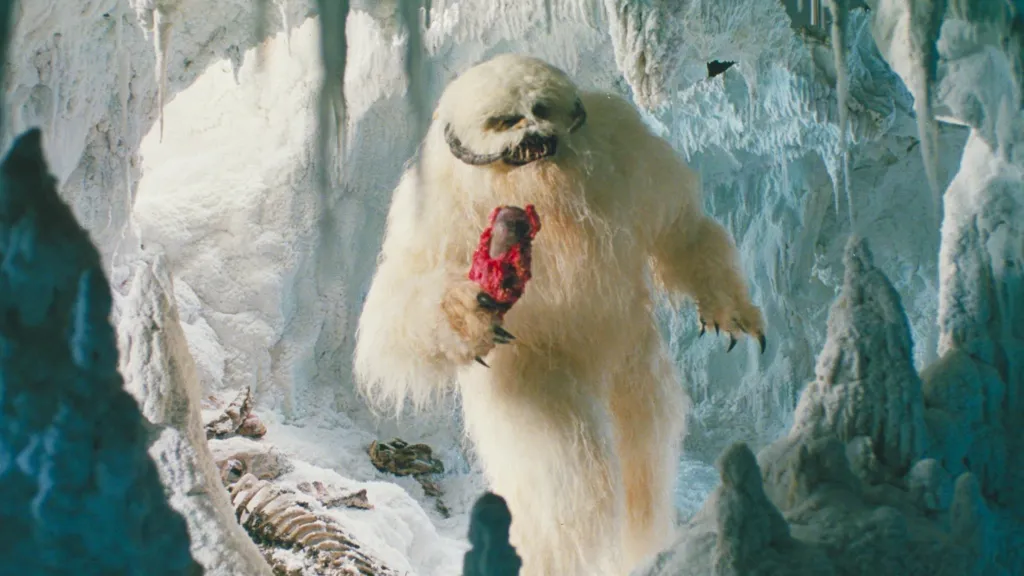
Luke Skywalker’s (Mark Hamill) capture by the Wampa on Hoth was shot almost entirely in fragments in 1980, limited to an extreme close-up of the creature’s face and a few rapid cuts before Luke severs its arm and escapes. The restriction was driven by how difficult it was for an actor on stilts to move convincingly inside the Wampa costume. A new Wampa suit was built for the 1997 Special Edition, letting Lucas reshoot the sequence in full with wide shots of the creature stalking its ice cave, feeding on a carcass, and later howling in pain over its severed limb. The goal was to make the creature read as more vile and threatening rather than simply filling screen time.
Reaction stayed mild by Special Edition standards. Some viewers argued the original’s restraint, built on suggestion and quick glimpses, generated more dread than the fuller reveal ever could. Others found the new footage a straightforward improvement that finally gave a memorable Hoth threat its due screen presence.
8) Mos Eisley Gets Crowded With New Creatures and Vehicles in A New Hope
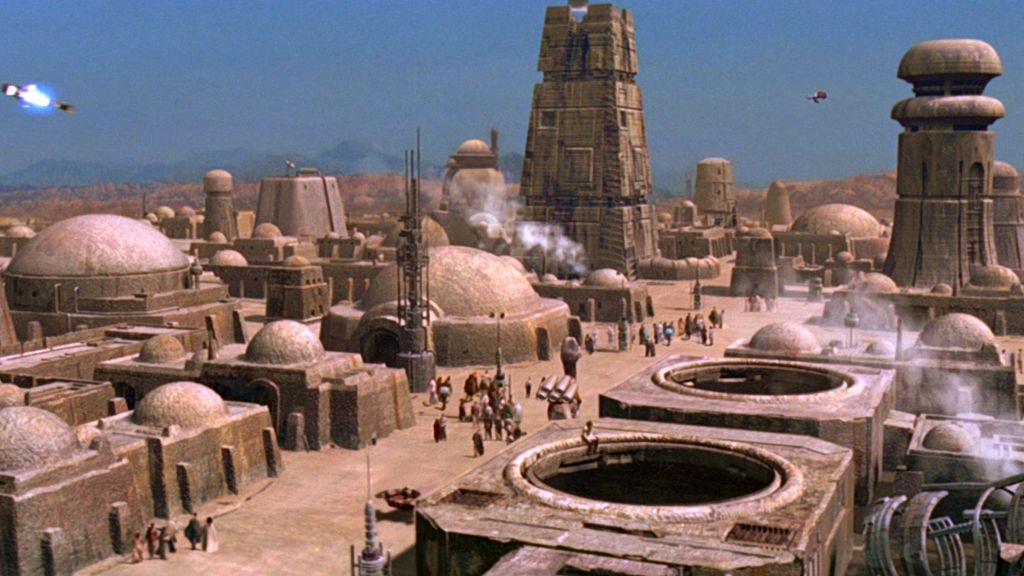
Luke’s landspeeder rolls into a noticeably emptier Mos Eisley in the 1977 cut of Star Wars, a spaceport built mostly from a handful of standing sets and background extras. The 1997 Special Edition digitally populated the same streets with dinosaur-like rontos, scurrying rodents, additional droids, and a cameo of Dash Rendar’s ship, the Outrider, an Easter egg imported from the 1996 multimedia project Shadows of the Empire. One added beat even shows a Jawa thrown from its ronto mount as a swoop bike passes too close, and a CGI dewback now stands tethered outside Chalmun’s cantina alongside the stormtroopers questioning Luke and Obi-Wan Kenobi (Alec Guinness).
The Mos Eisley additions extended nearly every exterior shot of the spaceport, giving the place the scale its reputation as a wretched hive of scum and villainy had always implied. Not everyone liked the changes, though. Fans of the Expanded Universe enjoyed spotting the Outrider, and the extra creatures gave the town texture it previously lacked. Yet, several fans criticized the compositing for looking dated even in 1997 and for cluttering shots that were originally built around Luke and Obi-Wan.
7) Luke and Biggs Reunite in A New Hope

Biggs Darklighter (Garrick Hagon) exists almost entirely offscreen in the 1977 cut of Star Wars, reduced to a single mention at the Lars family dinner table before reappearing without introduction as one of the Rebel pilots in the Death Star trench run. Lucas restored a brief reunion scene at the Yavin 4 rebel base for the 1997 Special Edition, showing Luke Skywalker and Biggs greeting each other warmly before the battle briefing. The added scene gave weight to Biggs’s death minutes later in the trench run, letting audiences know Luke was suffering the loss of an old friend rather than an anonymous pilot.
Many longtime Star Wars fans viewed the cut scene restoration as a welcome bonus that had circulated for years through novelizations and behind-the-scenes documentaries before finally appearing onscreen. A smaller group of critics noted the scene sits awkwardly without the deleted Tatooine setup that originally justified it, making the reunion feel like an emotional beat imported from a different cut of the film. Even so, the change drew little of the sustained backlash aimed at Lucas’s more invasive rewrites.
6) Sarlacc Pit Gets a Beak and Tentacles in Return of the Jedi

The Sarlacc that consumes Boba Fett (Jeremy Bulloch) in the 1983 cut of Return of the Jedi is little more than a sand-covered mouth ringed with teeth, an intentionally vague design that left most of the creature’s true shape to the audience’s imagination. The 1997 Special Edition added a computer-generated beak and a set of grasping tentacles that emerge from the pit and drag Fett down more visibly than the original single shot allowed.
The change gave the Sarlacc a more specific anatomy, a redesign later carried into Expanded Universe material that explored the creature’s biology. However, while some fans welcomed the added menace, others preferred the original’s restraint, arguing that leaving the Sarlacc mostly hidden beneath the sand made its offscreen digestion process, one that famously takes thousands of years, feel more unsettling than any visible monster design could. The change remains a frequent talking point among fans debating which Special Edition creature updates actually improved the trilogy.
5) “Victory Celebration” Replaces “Yub Nub” in Return of the Jedi
“Ewok Celebration and Finale,” better known to fans by the nickname “Yub Nub,” was the song that scored the destruction of the second Death Star in the 1983 cut of Return of the Jedi, echoing a modest bonfire party in the Ewok village on the forest moon of Endor. Lucas replaced the track entirely for the 1997 Special Edition, swapping in “Victory Celebration,” a new orchestral composition by John Williams, and pairing it with additional cutaway shots showing citizens celebrating the Empire’s defeat on Cloud City, Tatooine, and Coruscant.
The change widened the scope of the Rebellion’s victory beyond the Ewok village, giving audiences their first glimpse of how ordinary citizens across the galaxy reacted to the trilogy’s outcome. Longtime fans of the tribal drum song missed its scrappy charm, though, arguing the new score oversold a story that worked better because of its intimacy. Viewers encountering the trilogy for the first time in 1997 generally had no such attachment, and saw the new cutaways as a genuine improvement that made the ending feel like a galaxy-wide victory.
4) Han Solo Finds an Entire Hangar of Stormtroopers in A New Hope

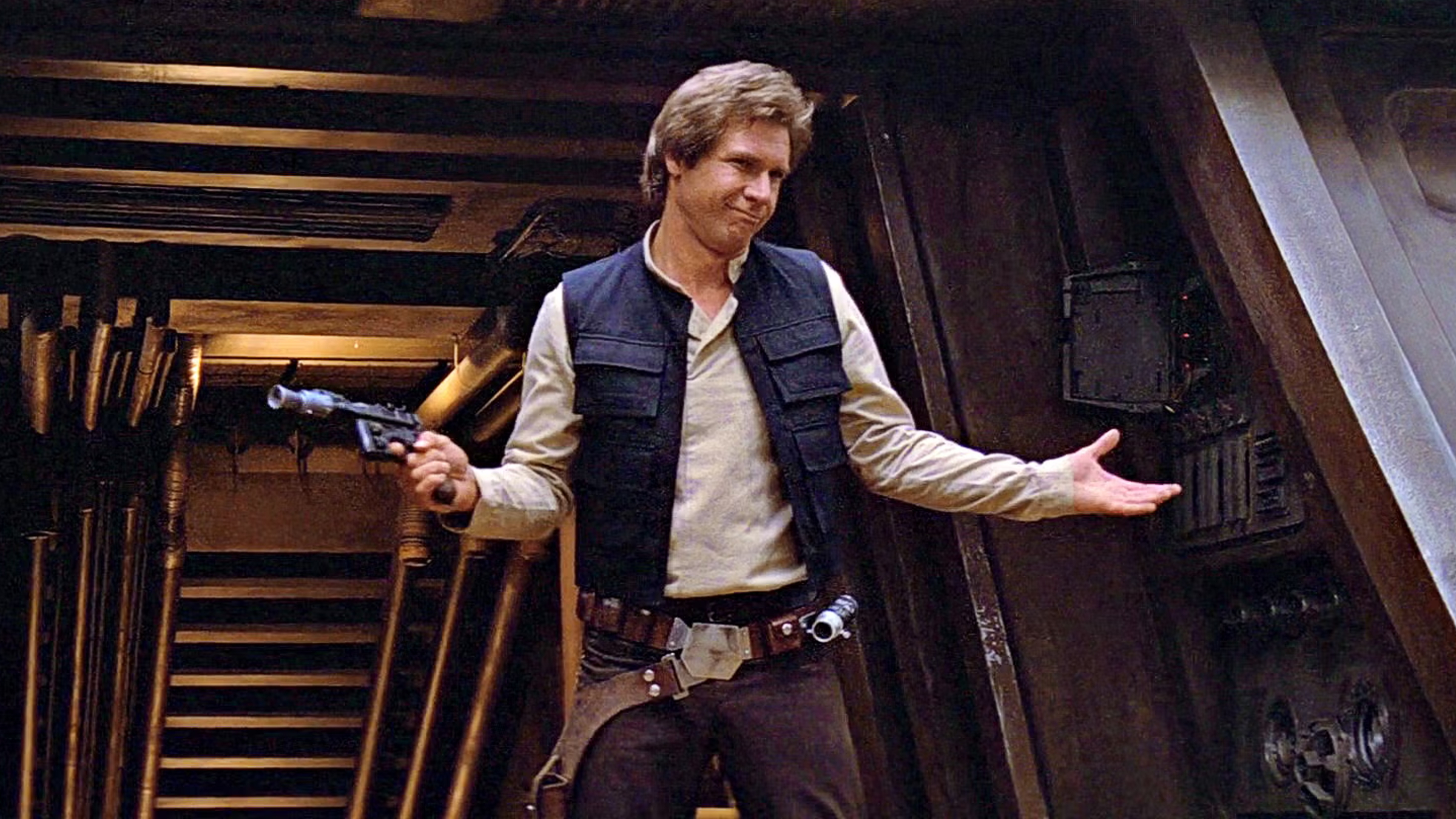
In the 1977 cut of Star Wars, Han Solo (Harrison Ford) sprints down a corridor pursued by a single squad of stormtroopers, turns a corner, and finds another squad waiting for him, a small sight gag. The 1997 Special Edition replaced that beat with a much larger reveal, having Han turn the same corner into a hangar bay packed with an entire company of stormtroopers before he scrambles back the way he came. The new version changes the joke considerably, exaggerating the obstacle waiting for the captain of the Millennium Falcon.
Star Wars fans were not amused. While the scene matched the Empire’s overwhelming reach, the new hangar full of troopers reads as excess for its own sake. The change is frequently cited alongside Lucas’s other maligned Special Edition additions that swapped a simple and effective scene for something bigger and splashier, just to underline the movies’ epic scale.
3) Jedi Rocks Replaces Lapti Nek in Return of the Jedi
Return of the Jedi has a second song replaced in 1997. “Lapti Nek” plays inside Jabba’s throne room throughout the 1983 theatrical cut, performed by the Max Rebo Band with Sy Snootles voiced by Annie Arbogast on lead vocals. Lucas cut the number entirely for the Special Edition and replaced it with an up-tempo new song called “Jedi Rocks,” performed by an expanded band that added a large-mouthed backup singer alongside a fully computer-generated Sy Snootles with far more articulated facial movement than the original puppet allowed.
The new sequence runs noticeably longer than “Lapti Nek” and shifts the tone of Jabba’s palace from menacing to cartoonish just before one of the film’s darker moments, the feeding of a slave dancer to the Rancor. Understandably, the reaction was largely unfavorable and has stayed that way for decades. Fans found the rhythm and blues style number tonally mismatched with the criminal underworld setting, and the CGI models built for the new performers have aged poorly.
2) A Digital Jabba the Hutt Confronts Han Solo in A New Hope

Budget and effects limitations of the era forced Lucas to cut a sequence featuring Jabba the Hutt before Star Wars reached theaters. However, Lucas still laid the groundwork for the sequence, with Declan Mulholland standing in for Jabba the Hutt during a 1977 shoot, wearing a shaggy fur coat with the intention of digitally replacing him with an alien creature once the necessary technology existed. The 1997 Special Edition finally finished the scene, erasing Mulholland from the footage and inserting a computer-generated Jabba the Hutt voiced by Ben Burtt, so that Han Solo confronts the crime boss face to face in the Mos Eisley docking bay before escaping with Luke Skywalker and Obi-Wan Kenobi.
The scene restored a piece of Lucas’s original vision for the film and gave Jabba a presence in the trilogy’s first installment years before his full debut in Return of the Jedi. Yet, while the intention might have been good, fans pointed to the clunky execution of the scene, with Ford visibly adjusting his performance around a character who wasn’t physically present during filming. The scene is also redundant, since it repeats information about Jabba’s bounty that Greedo (Paul Blake) had already delivered minutes earlier in the same film.
1) Greedo Shoots First in A New Hope

In the original 1977 cut of Star Wars, Han Solo draws a hidden blaster and kills Greedo without warning moments after the bounty hunter threatens to bring him in dead or alive on behalf of his employer. The 1997 Special Edition re-edited the confrontation so that Greedo fires first at near point-blank range and misses, before Solo returns fire in what plays as self-defense. Lucas has said publicly that he always intended Solo to act only in self-defense and viewed the original cut as making the character look like a needless killer. Fans disagreed, arguing the change fundamentally softened Han’s introduction as a morally ambiguous smuggler willing to shoot first to survive in a dangerous galaxy.
Reaction to the scene took the spotlight even before the film’s wider re-release, with early screening audiences singling out the moment as the most jarring change in the entire Special Edition. The backlash became the symbol of Special Edition overreach, giving rise to the battle cry “Han shot first” as a shorthand for resistance to unwanted franchise revisionism that has endured on t-shirts, bumper stickers, and letter-writing campaigns aimed at Lucasfilm for nearly three decades.
Which 1997 Special Edition change do you think Lucas should have left alone? Leave a comment below and join the conversation now in the ComicBook Forum!