Video Inspiration: Farther, Faster, and Safer with Ab Jenkins and Pennzoil You Should Know
Pennzoil has been a much-appreciated BaT Partner for several years now. In that time, they’ve sponsored our video Success Stories, supported our events, and even made a generous oil change rebate offer available to every member of the BaT community. Today, we’re recounting an episode in the company’s 113-year history when they put their product to the ultimate test by subjecting it to the mercy of Ab Jenkins, the father of salt flats racing, who set over 500 speed records over the course of a career that lasted until he was 73. Long May We Drive, indeed!

Image: Just a Car Guy
To tell the story of Ab Jenkins, one must first tell the story of the Bonneville salt flats. Over 14,000 years ago, Lake Bonneville—long held in by the mountains defining its shoreline—overflowed its margins. For several years, the massive basin disgorged its volume into the Pacific Ocean via the Snake and Columbia rivers.

Image: Petersen Digital Archive
The lakebed, once relieved of its watery burden, rebounded upwards, and as the moisture evaporated from the resulting crust it left, in its lowest points, a level deposit of salt and mineral deposits approximately 12 miles long, five miles wide, and up to five feet thick. And then, for thousands of years, very little happened…until the mid-1800s, when the area became a refuge for Mormons seeking safety after the murder of their founder Joseph Smith—a remote and barren place where the burgeoning religious community could be left alone.

From this community came David Abbot “Ab” Jenkins. Born to a family of Welsh immigrants 1883, he came of age right along with automobiles and motorcycles, and explored the salt flats on his Excelsior motorbike as a young man. He purchased his first car in 1902 or 1903, but it would be another 20 years before he set his first record at age 43, when he drove a stock Studebaker Sherriff touring car from New York to San Francisco in 86 hours and 20 minutes, beating the fastest transcontinental trains by a full six hours. He then collaborated with Studebaker in an official capacity, and when Pierce Arrow came under Studebaker ownership, Ab was tapped to improve the tepid performance of their new V12. Working with factory engineers, Jenkins saw the mill tuned up to 175 horsepower, and took to the salt to prove its mettle; an unofficial 24-hour record of 112.9 mph was set in 1932. His subsequent 117.77 mph run in 1933 stood as an official after being certified by AAA.
And in 1934, Jenkins returned to Bonneville with a specially prepared Pierce-Arrow wearing a boattail body hammered from aluminum sheet metal. For much of his career, his efforts were underwritten by Pennzoil, who we can thank retroactively for sparing no expense in producing the documentary of this 24-hour top speed record attempt. Titled Farther, Faster, Safer, the video comes to us via Mac’s Motor City Garage (a blog worth reading) and is held in the Prelinger Archives of San Francisco. Further materials come from the archives of Hot Rod Magazine (which, like Bring a Trailer, is owned by Hearst).

ISC Images and Archives via Motorsport Magazine
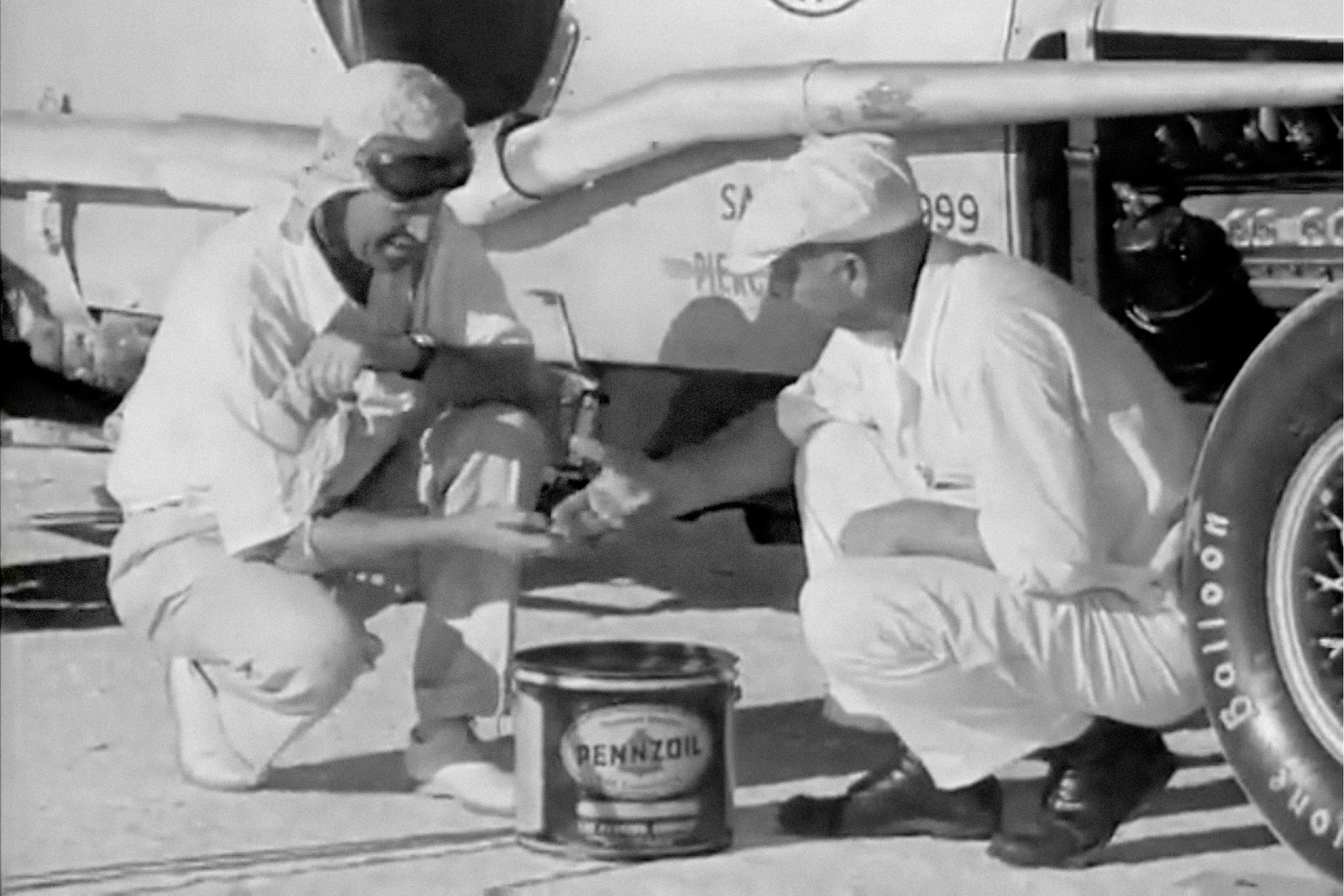
A week of preparations saw a 10-mile oval groomed onto the salt surface. The American Automobile Association set up a base camp with tents, communication and timing equipment, and everything else needed to support the run. On August 17, when Jenkins sped off from the starting line camp, the temperature was near 100 degrees Fahrenheit. Over the next 24 hours, he would stop only for fuel, tires, and refreshments (no coffee—just a stick of gum and some OJ and milk) averaging speeds around 132 mph while underway. A typical pit stop took around three minutes. Messages were relayed to Ab on a chalkboard, and his written replies were crumpled up and tossed out of the cockpit for workers to retrieve. By the end of his run, he had completed 3,053 miles at an average speed of 127.208 mph, including stops.
Jenkins’ obsession with speed and endurance was matched by his obsession with safety, recounted in this career retrospective from the April 1952 issue of Hot Rod. He worked to promote Bonneville as a safer alternative to the sands of Ormond Beach, where drivers were limited to the thin strand between the ocean and the waterfront hotels, occasionally dodging pier supports. By the mid-1930s, outright land speed records were approaching 300 mph, a mark finally broken in 1935 by Sir Malcolm Campbell and his Bluebird. Beach racing, in far too many instances, had proven to be a lethal endeavor. The year after Jenkins set the record documented in the video, he invited John Cobb over from England (where speed records were conducted at Brooklands and on the Pendine Sands in Wales), and hosted him personally at his home as Cobb prepared to break Jenkins’s record in his 24-liter Napier-Lion.

Jenkins’ association with Pennzoil continued further into his career, as he became a test driver for Auburn and then Duesenberg, where he helped to develop the Auburn 851 Speedster and the Duesenberg SJ (each Auburn Speedster came with a plaque engraved with his signature certifying the car to be capable of 100+ miles per hour). The oil company sponsored his Duesenberg Special, and he continued to use their product even as he began to put airplane engines into his racers. The first, built by Duesenberg over an SJ chassis, was nicknamed the “Mormon Meteor.” This name would stick, and was given to his next two purpose-built streamliners, the Mormon Meteors II and III. He would continue to drive on the salt—sometimes solo, and sometimes with his son Marv—until the very end of his life. Two months after a final record-breaking attempt in 1956, he collapsed from a heart attack while on a Pontiac promotional tour. The company’s new fuel-injected Bonneville model was named in his honor.

Image: Fuel Curve
There are many stories in which Pennzoil played a supporting role, both famous and obscure. Rick Mears’ Pennzoil-sponsored car won at Indianapolis in 1984 and 1988. Aerobatic pilot Art Scholl wowed crowds in his Pennzoil Super Chipmunk monoplane. There is the curious phenomenon of the giant “Super Snoopy” DC-7 pylon racer, BaT member Eddie Hill’s twin-engine Double Dragon rail dragster, and so many more. There’s a rich history to explore, so what should we write about next? Let us know in the comments. (And go get your oil rebate if you haven’t yet!)