This Week’s Weird and Wonderful—March 6, 2026 — Explained
“May you live in interesting times,” said British statesman Joseph Chamberlain, though the saying is often attributed as an ancient Chinese curse. And at the end of another week in which it seems the world has been moving at 3x speed, we have come to offer you a brief respite from the madness—an escape into the world of petroliana obscura. Here you will find a small collection of unique vehicles that we consider “interesting” in a better sense, that is to say: fascinating and enjoyable. Of course, this is just a fraction of those that caught our eye, and an even smaller fraction of the ~900 auctions currently live on the site.

Enjoy this week’s selection of Weird and Wonderful BaT auctions, and let us know what else you think should be on our list!
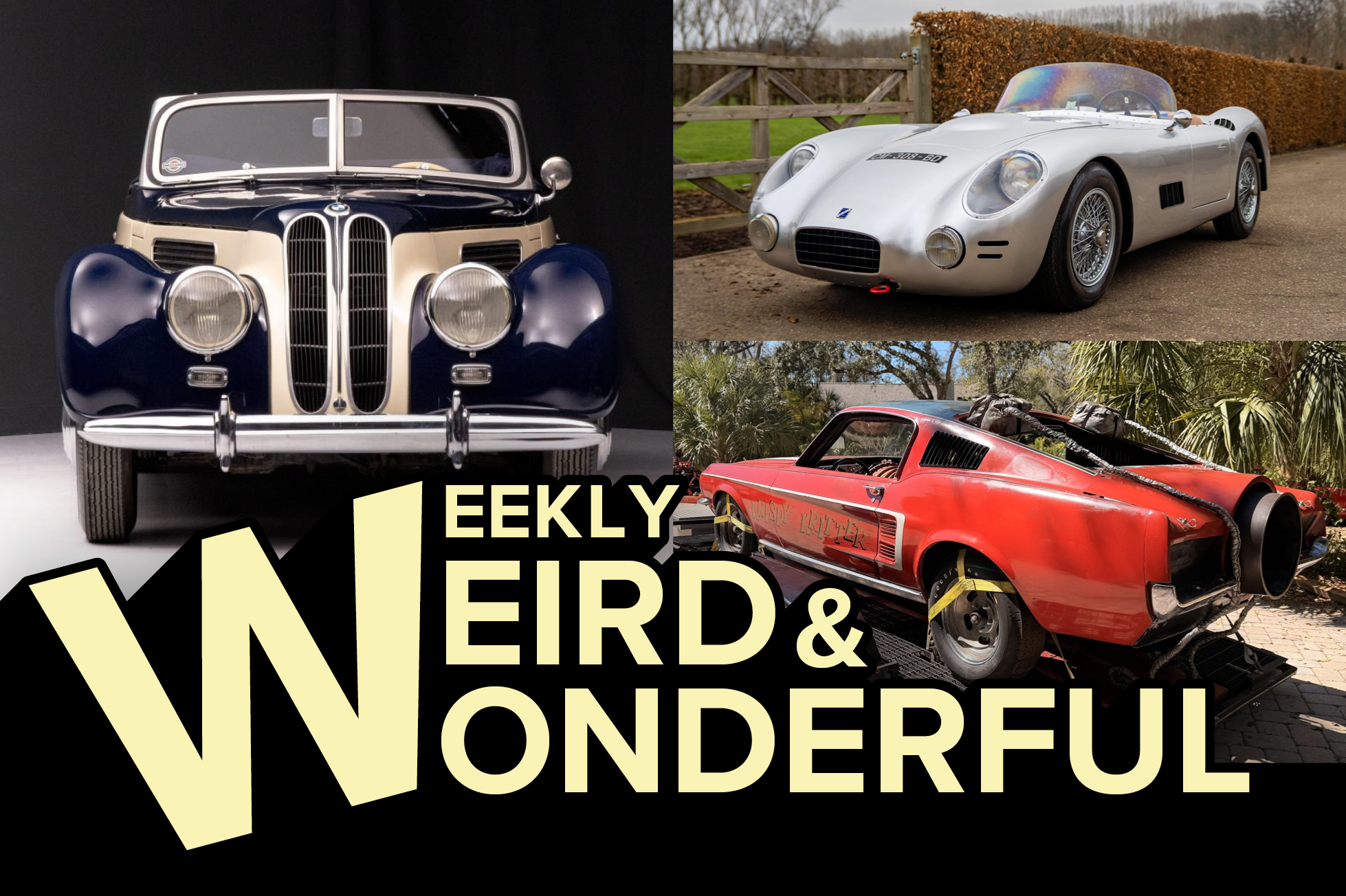
Westinghouse J34-Powered 1967 Ford Mustang Fastback “Krispy Kritter” Drag Car Project


Looking at the cockpit of the “Krispy Kritter,” it’s a wonder that the whole car doesn’t look [sic] “krispier.” The driver is relegated to a seat approximately one cheek wide (and padded for comfort) next to a J34 turbojet engine that once blew out 3,000 lb of thrust while spinning 11,000 rpm. The engine was a surplus item that once powered a Navy F2H Banshee fighter, and the Mustang was a body-in-white purchased through the local Ford dealer by Pittsburgh madman Ted Trischle. Reports of a 300+ mph quarter-mile run have been bandied about, but there are very few pictures of the car in period. @LowMileageClassics has direct experience with the Kritter, so perhaps he can expand on what he has posted in the comments.

Eventually, the Krispy Kritter made its way to Florida, where there are more individuals eager to drive a second-hand jet dragster, per capita. Thankfully the seller has made no attempts to fire it up. We’ve listed it as a project, but bidders, please don’t take that as encouragement to get it running again. The documentation that comes with the car is astonishing, particularly Trichle’s very important notes for achieving sub-lethal operation.
Talbot-Lago T14 America Barquette Dupont


By the 1950s, Talbot had accumulated a long and successful history in endurance racing. The Franco-British company, part of STD Motors Limited (Sunbeam, Talbot, and Darracq), fell on hard times in the 1930s, and director Antonio Lago purchased the struggling Paris operation, which then turned out some of the most beautiful cars of the prewar era. But Talbot-Lago never found solid footing after the war, despite their continued success at Le Mans in the 1950s. The brand was sold to Simca and shuttered by 1959. That makes this car a continuation, of sorts. In the 1980s, Talbot experts Dominique and Marc Dupont built a small handful of cars using leftover chassis, and new aluminum bodywork was fabricated to faithfully replicate the Maserati-powered Talbot-Lago Sport 2500 Le Mans prototypes that competed in 1956. Under the bonnet is a BMW OHV V8 of the type that were fitted into the road-going T14 America coupe—both cheaper and more powerful than the Maserati Grand Prix engines in the factory racers.


Becoming part of the Soviet bloc was a raw deal for many European nations, but for several years after WWII, the BMW factory in West Germany could only make pots and pans while their former facility in the East German town of Eisenach turned out a full line of automobiles and motorcycles based on prewar designs.

When the Bavarians finally mounted a legal challenge to the unlicensed use of their name in the early 1950s, the East Germans lethargically rebranded by lopping off the front of the ‘B’ and changing the blue roundel to Red. EMWs were a little too sexy and sporty for a people under constant state surveillance, and shortly after this example was built, the factory re-tooled to build decidedly un-sexy and un-sporty Wartburgs.
1913 Pope-Hartford Model 31 Four-Passenger Phaeton


The first Pope-mobile dates back to the 1930s, and while it never carried a supreme pontiff, a gold-and-white phaeton might’ve suited il papa well. This Model 31 was built by Pope-Hartford, a part of Colonel Albert A. Pope’s sprawling Pope automobile conglomerate that once included Pope-Tribune, Pope-Toledo, Pope-Robinson, Pope-Waverley, and Pope-Hartford. By the time of his passing in 1909, Co. Pope had lost all of his brands but one—Pope-Hartford, and the entry-level Model 31 was one of three models offered by the company in 1913. Power came from a 300ci “long stroke” four-banger that made 40 horsepower, which was notably robust for the era. This four-passenger Phaeton participated in tours with the Horseless Carriage Club for years, and seems like it’s still happy to putter about in its old age.
1916 Detroit Electric Model 54A Brougham


It’s tempting to think of early 20th-Century electric cars as a temporary fad, but Detroit Electric built more than 10,000 cars over three decades, and attracted famous and infamous owners like Thomas Edison, Clara Ford (Henry’s wife), J.D. Rockefeller, Elvira “Grandma” Duck (Donald’s grandmother), and suspected axe-murderer Lizzie Borden. The Model 54A here is a sophisticated luxury vehicle with a fully enclosed gondola-style cabin with curved glass, aluminum body panels, and five forward speeds.
Incredibly, the car still runs, and seems as roadworthy as anything from 1916 is likely to be. Operating it from the rear seat with tiller steering and throttle controls sounds daunting, but based on the lengthy driving video above, it’s more intuitive than it sounds.


Usually the comments are where we go to learn more in a BaT listing. This time, however, the real meat is in the gallery, which features a 20-page history and assessment by esteemed motorcycle historian Ian Falloon. There we learn that the 20 or so Ducati 900 NCR TT1 bikes were different in almost every respect from the 900 SS production bikes that allowed the model to be homologated for competition in the recently-formed Isle of Man TT Formula 1 category.

NCR was a factory-associated builder run by ex-Ducati race mechanics Girgio Nepoti and Rino Caracchi. Their 900 TT1 bike used a revised frame and narrower fork, and featured custom castings and millings all around. Even the crankcase and heads were revised (from a 750cc “round case” engine) and re-cast. The resulting bike developed 92 horsepower from 864cc, and carried Mike Hailwood to a storybook comeback win at the 1978 Isle of Man TT, after 11 years away from the event. This example, however, has not been raced, but has been on display since new. It was delivered to its original owner in Brooklyn, and later made its way to Michigan and Connecticut, collecting several concours awards before returning to Brooklyn years later, where it is now being represented by ace motorcycle seller moto.borgotaro.
1972 Dodge Demon 340 Sunroof and 1970 Dodge Challenger Convertible 340 4-Speed


Mopar muscle was at its peak in the early 1970s, and this week we have two unique 340-powered Dodges from that era. First up is a 1972 Dodge Demon (a name that would be exorcised from Dodge’s lineup in 1973) from the final year for the small-but-mighty 340ci V8. This A-Body Mopar is here because it has one of the rarer options for the model—a factory sunroof! Only 95 examples were ordered with a vinyl roll-back panel installed by American Sunroof Company (ASC). And for those who keep tabs, the Mopar Sunroof Registry knows of just six remaining, and this one is the sole example outfitted with air conditioning.

The second car is special for having no roof at all! The E-Body Challenger debuted in 1970, and this example features the optional A66 340 Performance Package—essentially making it an R/T without the badging. The convertible bodystyle was somewhat rare, with around 4,000 built, but only 66 of these were specified with a 340ci V8 paired with a four-speed gearbox. It underwent a restoration sometime in the 1990s and was repainted in single-stage color called Sublime. It’s currently being offered by @1600veloce, which also means that the presentation is sublime, as well.
1950 Chevrolet Fleetline Deluxe and 1956 Ford Customline Tudor from The Fate of The Furious

These two cars are featured in the first driving scene from F8: The Fate of the Furious, which depicts Dom Toretto (Vin Diesel) racing his cousin’s clapped-out Chevy Fleetline against local driver/loan shark Raldo (Celestino Cornielle) and his Ford Customline Tudor through the streets of Havana, Cuba. The Ford looks to be the better car, but, per Dom, “the only thing that matters is who’s behind the wheel.”
Armed with a turbocharger, a bottle of NOS, and a homemade hack involving a pop tab and a vacuum line, Toretto takes the Chevy—on fire, in reverse, no brakes—across the finish line first by inches, then heroically swerves into a seawall to save innocent bystanders, rolling out of the cockpit just before impact. Whew. We don’t recommend trying to reenact this scene, but if you must, using the actual cars from the movie is the only place to start.
2023 Hennessey Venom F5 Roadster


The Venom F5 was born from John Hennessey’s determination to build the fastest production car on Earth, and the end result is absolutely absurd in every good way. At the core is an LS-based, twin-turbocharged 6.6L “Fury” V8 that cranks out a brutal 1,817 horsepower. This roadster is the second example we’ve listed, and it’s number five of the 30 planned units. In keeping with its rocket-like qualities, the key fob is formed from metal sourced from an actual spacecraft, apparently. We can’t imagine what it’s like having the wind whip through your hair at 300 mph.
1990 Lamborghini LM002 LM/American


The bulky Rambo Lambo was in production for a brief five years, from 1986–1990. The LM/American was the LM002’s parting shot for the US market, which Chrysler facilitated due to their acquisition of the raging bull in 1987. Unveiled in Detroit in 1990, the US-bound version featured OZ alloy wheels, front and rear chrome bumpers, and sculpted side skirts. These trucks could be ordered in either white or black, and this example went all in with a Miami Vice-esque white-on-white scheme. It’s one of 60 examples ultimately made, and received $32k in service after it was acquired by its current owner in 2018.
Honorable Mentions

If you’ve ever driven a Ford Ranger and wished it was more like a jetski but not one that goes in the water, the Thoroughbred Stallion trike is for you.
c.1920s American National Packard-Style Electric-Powered Pedal Car


The American National Company specialized in children’s pedal cars equipped with a host of real car features such as real steel, a horn, a folding windshield, a “fat man” steering wheel, a license plate, and dual headlights. More premium cars like this example featured electric motors for actual drivability. Batteries not included.
1968 Alfa Romeo Giulia 1300Ti “El Taxi Perdido”


This 1968 Alfa Romeo Giulia 1300Ti was nicknamed “El Tax Perdido” (The Lost Taxi), but longstanding BaT aficionados certainly haven’t forgotten about it. It first graced the site as a BaT Exclusive in 2008 and was subsequently purchased by its current owner. The Alfa later appeared at multiple events covered by BaT in 2009, 2010, 2011, and 2013, and most recently showed up at the 2025 Concorso Italiano in Seaside, California. We love seeing the many commenters, including our own Co-Founder Randy Nonnenberg, sharing their experiences with the mighty Alfa over the years.

If you no longer go for a crash that exists…
Thanks for checking out this edition of the Weekly Weird & Wonderful! Follow this page to get updates when new installments post, and tell what caught your eye or what you think we’ve left out!