
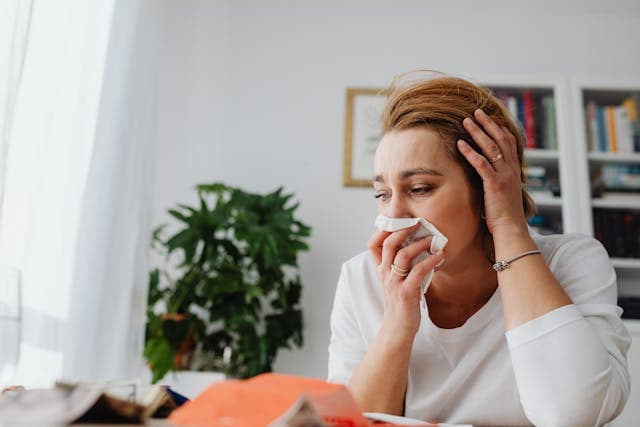
I used to joke that my body was a drama queen—one sniff of perfume and it would call for a full production. Then fibromyalgia showed up and turned the volume to eleven. Suddenly I wasn’t just sensitive to dust or pollen; I was sensitive to existence: candles, detergents, the neighbor’s cologne, even the polite waft from a bakery.
If you’re reading this, you already know the weird humiliation of having to pre-apologize for your own nervous system. This piece is for the people who live with that: the ones learning to read their triggers like road signs and to ask for a little room without feeling guilty.
What Do We Mean By Allergies And Chemical Sensitivities?
You and I use these phrases almost interchangeably, but they’re not identical. Here’s how to think of them without getting trapped in lab-coat language.
Allergies are the immune system’s classic overreactions — antibodies, histamines, sneezing, hives, the usual suspects. It’s like your immune system getting a text that says “Fire!” when someone merely lights a candle.
Chemical Sensitivities (sometimes called Multiple Chemical Sensitivity or MCS) are more about your nervous system and whole-body reactivity. Think less antibody, more alarm system with a faulty motion sensor. A tiny whiff of a household cleaner might ripple into headache, nausea, joint pain, and something you can’t easily measure: that sinking, exhausted feeling that follows.
With fibromyalgia in the mix, these two worlds blur. Your immune system, nervous system, and pain-processing circuits are all talking to each other in ways that make simple triggers become heavy hitters.

Why People With Fibromyalgia React More
Okay, here’s the short, honest version: fibromyalgia rewires the way your body perceives the world.
- Your Alarm System Is Hypervigilant. The nervous system in fibro is like a smoke alarm connected to the neighbor’s kitchen—sensitive and quick to scream. Smells, lights, sounds, and chemicals can all register as threats.
- Pain Pathways Are Primed. The pathways that translate stimuli into pain signals are already turned up. So what would be a mild irritant for someone else becomes full-blown pain for you.
- Autonomic Nervous System Dysregulation. This is the “automatic” system (heart rate, digestion, sweating). When it’s off balance, your body’s response to stressors (including chemicals and allergens) becomes exaggerated.
- Immune System Cross-Talk. There’s a miscommunication between immune cells and nervous system cells. Cytokines and inflammatory mediators can amplify sensitivity.
- Central Sensitization. This is a fancy term for when the brain and spinal cord keep amplifying pain and sensory signals long after the initial trigger is gone.
So when someone says, “It’s only a little perfume,” your body replies, “Hold my tea,” and proceeds to overreact.
Common Triggers: A Handy Table You Can Scan While Panting
| Trigger Category | Examples | Typical Reactions (What We Feel) |
|---|---|---|
| Fragrances & Perfumes | Perfume, cologne, scented candles, room sprays | Headache, nausea, dizziness, heart palpitations, anxiety |
| Household Chemicals | Bleach, ammonia, oven cleaners, multipurpose sprays | Throat irritation, coughing, skin rash, worsening pain |
| Personal Care Products | Shampoos, lotions, deodorants, makeup | Rashes, itching, facial flushing, breathing tightness |
| Building Materials & Furnishings | New carpet, paint fumes, varnish, off-gassing furniture | Brain fog, fatigue, headaches, sinus issues |
| Foods & Additives | Preservatives, MSG, artificial sweeteners, sulfites | Flare in pain, digestive upset, migraine, fatigue |
| Environmental Allergens | Pollen, dust mites, molds, pet dander | Nasal congestion, sinus pressure, itchy/watery eyes, cough |
| Weather & Air Quality | Humidity changes, pollution, wildfire smoke | Joint pain, chest tightness, headache, fatigue |
| Medications & Supplements | Certain antibiotics, NSAIDs, topical meds | Allergic reactions, GI upset, symptom amplification |
Short, useful, and obvious once you read it, right? Keep a copy of this table on your phone or print it and tape it to your cupboard. It helps to have proof for yourself on days when you doubt your instincts.
Signs That A Reaction Is Allergy vs. Chemical Sensitivity (Quick Checklist)
- Allergy Likely If: hives, clear itching, sneezing fits, runny nose, eyes watering, localized swelling. Classic immune response.
- Chemical Sensitivity Likely If: widespread pain flare, sudden exhaustion, brain fog, weakness, unwellness without visible allergic signs. Nervous system + systemic response.
Sometimes you’ll have both. Sometimes you’ll get the itch and the fog. That’s the worst — two shows on at once.
Why The Overlap Feels So Personal (And A Little Unfair)
It’s a little like being tuned to the wrong radio station. While most people have a dial set to “regular sensitivity,” our dial is set to “hyper-attentive.” That means:
- Everyday exposures add up like interest on a debt: one small trigger on Monday + another on Tuesday = a meltdown by Wednesday.
- You may have sensitization over time. Repeated low-level exposures can lower your threshold for reactions.
- Stress, lack of sleep, and hormonal changes can make everything worse. The system that monitors and responds to threats is emotionally and physically expensive to run.
- Micro-inflammation — tiny, chronic inflammatory signals — keep the furnace of sensitivity lit even when no obvious trigger is around.
This is why pacing, environment, and small lifestyle changes matter — more than one dramatic fix ever will.
How To Figure Out Your Triggers (Without Going Nuts)
Testing is messy, and not every test tells the whole story. Here are practical approaches that actually help in day-to-day life.
- Start A Trigger Journal
- Log time, location, what you smelled/touched/ate, and symptoms. Be specific. “Morning, office, new coworker perfume; headache and chest tightness within 20 minutes” beats “felt bad at work.”
- Track for at least 4 weeks to detect patterns. We’re pattern-detectors; evidence helps reduce doubt and shame.
- Layered Elimination
- Don’t try to remove everything at once — your life will become a sad Pinterest board. Instead, remove one category (e.g., fragrances) for two weeks and see what changes.
- Reintroduce slowly and note responses.
- Create Mini Experiments
- Swap a product for a fragrance-free alternative and see what happens. Keep other variables constant (sleep, stress) for a few days.
- Work With A Clinician When Necessary
- Allergy testing (skin prick or blood tests) can help identify classic allergies.
- For MCS, tests are less helpful; clinical history and pattern recognition matter more.
- Important: be your own historian. Bring your journal to the appointment.
- Beware False Leads
- Sometimes a flare that looks like a reaction is actually a stress response or flare from overexertion. Use the journal to help differentiate.
At The Doctor’s Office: How To Ask For What You Need
Doctors may not always “get” this. Here’s how to present it in a way that’s practical and not exhausting.
- Bring your trigger journal and highlight repeat patterns. Concrete data is magnetic.
- Say: “When X happens, I experience Y consistently within Z minutes/hours.” That’s less likely to be dismissed than “I react to everything.”
- Ask for both allergy testing (if you have classic symptoms) and a plan for managing systemic flares (pain clinic referral, autonomic testing, or a rheumatology consult).
- Be ready to say what helps you (rest, antihistamine, moving to fresh air) and ask for written plans for acute reactions.
You’re not asking for special treatment — you’re asking for a safety plan to live with your nervous system the way it is.

Practical Home And Lifestyle Changes That Actually Help
This isn’t a magic list — but it is the “daily survival kit.” Small things piled together become a fortress.
Environmental Adjustments
- Keep rooms fragrance-free. Use unscented laundry detergent and skip the linen spray.
- Open windows when possible to reduce indoor VOC buildup. Even a short burst of fresh air can reset the room.
- Replace air filters regularly; consider a HEPA filter if you have allergies.
- Let new furniture or paint off-gas before long exposure. If you can, have new items aired outside or in a garage for several days.
Daily Habits
- Pace Your Energy. Avoid “boom and crash” days — steady activity beats enthusiasm that lands you in bed for two days.
- Sleep Hygiene: consistent bedtime, cool dark room, remove gadgets. Sleep repairs the nervous system.
- Hydration & Nutrition: small changes — reduce processed foods, read labels for additives that trigger you.
- Mind-Body Tools: gentle yoga, breathing exercises, and short walks can reduce baseline sensitivity.
Emotional And Social Strategies
- Create a few short scripts for when you need to ask for accommodations: “I’m sensitive to strong scents — would you mind not wearing perfume today?” Practice them.
- Use headphones or a thin scarf as small boundaries when needed; they’re less confrontational than a lecture.
Medications And Supplements: What We Use (Carefully)
I won’t prescribe anything here — but here’s how people commonly navigate options with clinicians.
- Antihistamines (over-the-counter): helpful for classic allergic symptoms (runny nose, itching). Some are sedating — test at low doses.
- Nasal Steroids: for chronic nasal inflammation — useful when nasal symptoms aggravate sleep and hence fibro.
- Topical Treatments: for contact rashes — avoid systemic medications when a topical works.
- Low-Dose Naltrexone (LDN): some fibro patients try it for pain modulation; discuss with your doctor.
- Supplements: magnesium, vitamin D, omega-3s — many find small benefits, but always check interactions.
- Avoid Medication Overload: more pills = more potential sensitivities; work with your doctor on simplifying where possible.
Always work with a clinician you trust, and bring your symptoms log. Never ignore a new or severe reaction—seek immediate care if breathing becomes difficult or swelling is severe.
Creating A “Safe Room” Checklist (Table You Can Use)
| Item | Why It Helps | Quick Action |
|---|---|---|
| Fragrance-Free Laundry Soap | Removes common trigger from clothing | Switch to unscented brand; wash twice if needed |
| HEPA Air Filter | Removes particulates and some VOCs | Run on low in the bedroom during sleep |
| Unscented Personal Care Items | Reduces daily exposures | Replace one item at a time to test reactions |
| Natural Light & Ventilation | Lowers chemical buildup and improves mood | Open windows for 10 minutes twice daily |
| Low VOC Paint / Natural Furnishings | Avoids off-gassing | Let new items air out before full use |
| Emergency Kit (antihistamine, inhaler if prescribed) | For acute symptoms | Keep in a visible place; notify household about location |
| Calming Corner | Reduces stress-related amplification | Pillow, soft light, breathing script posted |
This is not perfection, but it’s a plan. Plans are antidotes to chaos.
How To Handle Social Situations (Because People Will Still Wear Perfume)
Yes, they will. You can be kind and firm.
- Short Script: “I’m sensitive to strong scents — can we keep this space fragrance-free for a bit?”
- At Work: suggest a fragrance-free policy for shared spaces. Use the seduction of logic: better air = fewer sick days.
- At Family Events: arrive early to occupy a less crowded, fresher corner. Bring a portable fan or scarf for a little buffer.
- If Someone Forgets: step outside for fresh air; have a small bottle of saline nasal spray to rinse your nose if it helps.
You don’t owe a lecture. You simply owe yourself a safe, functioning body.
When Travel Is Necessary: Survival Tactics
Travel can be brutal, but it’s doable with prep.
- Book hotel rooms with non-smoking, fragrance-free requests. Call ahead.
- Bring bedding cover if you react to detergents or dust mites.
- Pack scent-free toiletries and an air purifier for the hotel room if you can.
- Choose modes of transport with ventilation options (window seat on trains, carry a mask on planes to filter scents).
- Have an escape plan: know where to step outside for fresh air, and tell your travel buddy about your triggers.
Travel takes more effort, but the joy of seeing a friend or a new place is often worth the planning.
The Role Of Stress: Why We React More When We’re Already Frazzled
Stress is not just in your head. It turns up the volume on everything.
- Stress elevates cortisol and adrenaline, which can exacerbate pain and sensitivity.
- Think of stress as adding kindling to a fire: a small trigger can ignite a bigger flare when you’re already stressed.
- Tools that reduce stress (short meditations, breaks, realistic expectations) are in fact part of medical management.
If your system is always in “red alert,” then the best intervention might not be a pill—it might be a change in how you structure your day.
Pediatric Considerations: Kids With Fibro And Sensitivities
If you’re a parent or caregiver, this is especially tender territory.
- Children may be less verbally able to explain sensitivities. Notice patterns: meltdowns after certain activities, sleep changes, eczema flares after exposure.
- School plans can help: inform teachers, request fragrance-free classroom policies, and have a plan for symptomatic episodes.
- Teach children small self-advocacy scripts (“I can’t be near perfume”) and practice them in gentle roleplay.
Protecting a child’s environment is often simpler (and more accepted) than protecting an adult’s, but it still requires diplomacy and paperwork sometimes.
Things That Don’t Help (And Why You Can Stop Feeling Bad About It)
- Telling yourself it’s all in your head. That’s gaslighting your nervous system. The sensations are real.
- Expecting instant fixes. There’s no one pill that rewires central sensitization overnight.
- Isolating to avoid exposure entirely. That’s not sustainable. We want safe engagements, not hermitage.
Beating yourself up over sensitivity makes your nervous system louder. Compassion quiets it.
FAQ
1. Is chemical sensitivity the same as an allergy?
No. Allergies are immune-mediated; chemical sensitivities often involve the nervous system and whole-body reactivity. They can overlap.
2. Can fibromyalgia cause new allergies?
Fibromyalgia doesn’t create classic allergies, but the state of central sensitization can make you more likely to notice and react to triggers you previously tolerated.
3. Are allergy tests useful?
For classic allergic symptoms (sneezing, hives), yes. For chemical sensitivities, tests are less reliable — patterns in daily life matter more.
4. Will avoiding all triggers cure me?
Avoidance can reduce flares but doesn’t “cure” central sensitization. The goal is symptom management and quality of life.
5. Can I work if I’m highly sensitive?
Often yes, with accommodations: fragrance-free policies, flexible hours, remote work options, or changing workspaces.
6. What about vaccines or medications — could they trigger reactions?
Rarely, but possible. Discuss risks and benefits with your clinician. If you have a known severe allergy, bring documentation and an action plan.
7. Is Multiple Chemical Sensitivity recognized medically?
Different practitioners view it differently. Regardless of labels, your symptoms deserve validation and practical strategies.
8. Do air purifiers help?
They can reduce particulates and some irritants. HEPA filters help with allergens; activated carbon filters help with some odors and VOCs.
9. Are there diets that fix sensitivities?
No universal magic diet. Some people benefit from identifying food triggers and reducing processed additives; others see no change.
10. How long does a flare last?
Variable. Some reactions resolve in hours; others linger days. Rest, hydration, and gentle pacing often speed recovery.
11. Can therapy help?
Yes—mind-body therapies (CBT, ACT, somatic approaches) can reduce the amplification cycle and improve coping.
12. When should I go to the ER?
If breathing becomes difficult, lips or throat swell, or you lose consciousness—seek immediate emergency care.
Long-Term Strategies: Retraining The System (Slow Work, Worth It)
Think of this as training rather than fixing.
- Consistent Sleep & Routine: predictability calms the nervous system.
- Gradual Exposure (If Tolerable): controlled, slow re-exposure to low levels of triggers can sometimes raise tolerance — but only under guidance and not if it causes major flares.
- Pain Management Program: multi-disciplinary clinics (physio, psychology, occupational therapy) offer tools to recalibrate pain processing.
- Lifestyle Optimization: steady movement, hydration, and good nutrition reduce baseline inflammation.
- Community: support groups and online communities help you learn practical hacks and feel seen.
Retraining isn’t instant, but it’s the most sustainable path.
When To Consider Specialist Care
- Reactions are severe (difficulty breathing, swallowing, fainting). Go to ER.
- Symptoms are rapidly worsening or new organ systems are involved. See your doctor.
- You’re planning significant medication changes or suspect anaphylaxis in your history. See an allergist.
- If pain and central sensitization dominate, consider a rheumatologist or pain specialist for integrated care.
How To Explain This To Friends And Family Without Sounding Defensive
Keep it short, human, and practical.
- “I get intense reactions to strong scents and some cleaners. It can cause headaches and make my pain worse. Can we keep this casual?”
- Offer alternatives: “If we’re having people over could we do unscented candles or open a window?”
- Use the “It’s how my body is” language—facts, not feelings.
People usually want to help once they understand; your job is education, not justification.
Final Thoughts (A Gentle Reality Check)
Let’s be honest: living in a world that’s drenched in scent and engineered for short attention spans is not designed for sensitive nervous systems. That’s not your fault. You’re adapting to a design problem that predates you.
You’ll have good days and bad. You’ll learn to carry small things that make big differences: an unscented bar of soap, a travel HEPA filter, a five-minute breathing practice. You’ll get better at naming your needs and asking for small adjustments.
You’ll find allies, and you’ll also find skeptics — that’s life. But with evidence (your journal), calm plans, and tiny, consistent changes, you can carve out a life where triggers matter less and choices matter more.