
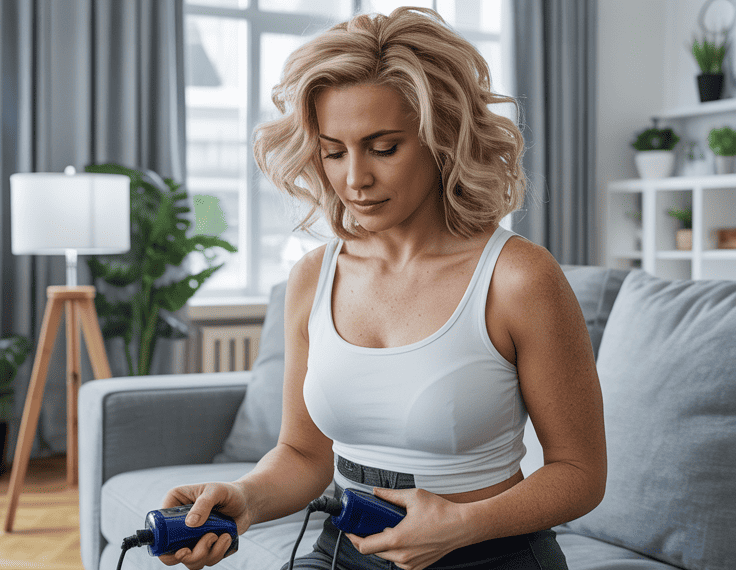
Hey there! Ever felt like your fibromyalgia pain has a personal vendetta against you? I’ve been there—staring at my kitchen wall, willing the throbbing to stop, and wondering if relief was just a myth.
Well, let me let you in on a little secret: TENS unit therapy changed the game for me.
In this friendly chat, I’ll share my top TENS Unit Tips for beating fibro pain at home. Consider this your go-to guide—minus the fluff, full of real-talk, and sprinkled with a dash of sarcasm (because why not?).

What’s a TENS Unit, Anyway?
You’ve heard the acronym thrown around, but what exactly is a TENS unit?
TENS stands for Transcutaneous Electrical Nerve Stimulation. In plain English, it’s a small, battery-powered device that zaps your skin with tiny electrical pulses. Those pulses travel along your nerves, telling your brain, “Hey, not so fast—we’ve got this!”
How It Works in a Nutshell
- Electrode Pads: You stick these adhesive pads on your skin.
- Electrical Pulses: The device sends gentle pulses through the pads.
- Pain Gate Theory: Those pulses “close the gate” on pain signals.
- Endorphin Release: Your body pumps out its own painkillers.
Ever wondered why this works so well? It tricks your nervous system into focusing on the buzz instead of the ache.
Why It’s a Fibro-Fan Favorite
- Non-Invasive: No needles. No meds. No “OMG, is this legit?” moments.
- Drug-Free Relief: Bypass that pill cabinet—FYI, I always feel a tiny bit triumphant.
- Portable: Toss it in your bag and zap away at work, home, or the dentist’s waiting room (just kidding—maybe not there). 🙂
Choosing the Right TENS Unit for Fibro Pain
Not all TENS units are created equal. Picking the wrong one is like choosing flip-flops for a marathon. Pain relief? Not so much.
Top Features to Look For
- Adjustable Intensity Levels
- Why it matters: Fibro pain varies by day. You need control.
- My take: I crank it up on flare days and dial it down for maintenance.
- Multiple Modes & Waveforms
- Burst, Modulated, and Continuous: Different strokes for different folks.
- Pro Tip: Try each mode—your nerves will “vote” for a favorite.
- Timer Settings
- Auto-Shutoff: Never worry about falling asleep mid-zap.
- Customization: 15, 30, or 60 minutes—your call.
- Dual Channels
- Why Dual? You can treat two spots at once (hello, both shoulders!).
- IMO: Totally worth the extra bucks.
Budget vs. Premium – Which Side Are You On?
- Budget Models
- Pros: Cheap, simple, no-nonsense.
- Cons: Limited features, flimsy pads.
- Premium Models
- Pros: Sleek design, advanced modes, reusable high-quality pads.
- Cons: Pricey—your wallet might protest.
Personally, I started with a basic unit (because I love a bargain), but upgrading felt like switching from dial-up to fiber-optic. Worth it.
Setting Up Your TENS Unit for Maximum Comfort
You bought the unit. Now what? Slap on pads and hope for the best? Nope. Let’s set you up properly.
Pad Placement Strategies
- Target the Trigger Points:
- Locate your tender spots—most fibro warriors know the drill.
- Place pads around, not directly on, the painful area (avoids overstimulation).
- Common Placements:
- Lower Back: Just off either side of your spine.
- Neck & Shoulders: Along the trapezius muscle.
- Hips & Glutes: Around the joint, not on the hip bone.
Skin Prep & Pad Care
- Clean & Dry: Wipe skin with alcohol, let air-dry—no lotion allowed.
- Rotate Pads: Move them every few sessions to prevent irritation.
- Replace When Needed: Pads lose stickiness (and magic) over time.
Pro Tip: Keep extra pads in the fridge for longer life—yes, really.
Crafting Your Personal TENS Routine
Consistency beats chaos. You need a plan, not random zap sessions.
Sample Daily Schedule
- Morning Warm-Up: 20 minutes on low intensity to shake off stiffness.
- Midday Maintenance: 15 minutes at moderate intensity during lunch.
- Evening Wind-Down: 30 minutes on a soothing, wave-like mode before bed.
Ever tried zapping away the day’s stress before you snooze? It’s like a mini spa sesh for your nerves.
Adapting to Flare-Ups
- Double Dosage: Two sessions back-to-back can help—but listen to your body.
- Intensity Boost: Crank it up by one notch, but avoid the “burn” zone.
- Take Notes: Keep a pain & zap diary. You’ll spot patterns and tune your routine.
Combining TENS with Other Fibro-Friendly Hacks
Why stop at one weapon? Let’s build your anti-fibro arsenal.
Stretching & Gentle Movement
- Yoga-Inspired Stretches: Cat–cow, child’s pose—simple but effective.
- Why It Helps: Increases blood flow, loosens tight muscles.
Heat Therapy Meets TENS
- Hot Packs + TENS:
- Apply heat for 10 minutes.
- Zap underneath for enhanced relief.
- Science Bit: Heat relaxes tissue; TENS blocks pain—double win.
Mindfulness & Breathing Techniques
- Rhetorical Question: Who knew that breathing could outsmart pain?
- Quick Practice: Inhale for 4 seconds, exhale for 6. Do it while zapping.

Troubleshooting Common TENS Unit Issues
Technology isn’t perfect—sometimes your TENS unit will throw a tantrum.
“My Pads Won’t Stick!”
- Fixes:
- Clean both pad and skin.
- Use electrode gel for extra tack.
- Store pads properly in the case.
“I Feel Nothing!”
- Possible Causes:
- Low battery—charge or swap.
- Intensity set too low—turn it up gently.
- Pad placement off-target—adjust and test.
“This Burns!”
- Solution:
- Decrease intensity immediately.
- Check skin for redness—skip sessions until healed.
Remember: Getting the perfect zap takes practice—don’t beat yourself up if it feels weird at first.
Real Talk: My TENS Journey with Fibro
I’ll cut to the chase: I was that skeptic who thought, “Electrical pulses? Pass me the cookie.” But one desperate night—post three cups of chamomile tea and zero relief—I reached for a TENS unit.
- First Session: Light buzz, weird but tolerable.
- Week Two: Noticeable pain dips, less reliance on OTC meds.
- Month One: Consistent routine kept flares at bay.
IMO, best investment I’ve made for my pain toolkit.
Frequently Asked Questions (FAQs)
Q1: Is TENS therapy safe for daily use?
Absolutely! You can use a TENS unit every day as long as you follow the manufacturer’s guidelines. Just double-check pad placement, keep the intensity at a comfortable level, and give your skin breaks if you notice any redness.
Q2: Can I use a TENS unit if I have a pacemaker or other implant?
Nope—best to avoid it. The electrical pulses can interfere with cardiac devices. Always check with your doctor first if you have any implanted medical hardware.
Q3: How long should each TENS session last?
Aim for 20–30 minutes per session. You can do up to three sessions daily: morning for stiffness, midday for maintenance, and evening to wind down. But listen to your body—if you feel any discomfort, cut it short.
Q4: Where should I place the electrode pads for maximum effect?
Place them around, not directly on, your tender spots. For lower-back pain, stick them just off your spine. For neck and shoulder flares, position them along your trapezius. And always prep your skin—clean, dry, and free of lotion.
Q5: Can I use TENS therapy alongside other treatments?
For sure. Combining heat therapy, gentle stretching, or mindful breathing can boost results. Just don’t overlap a hot pack and pads at the same exact spot—give yourself a minute between them.
Q6: What if the pads won’t stick or the sensation feels weak?
Try these quick fixes:
-
Wipe your skin with isopropyl alcohol before applying.
-
Use a drop of electrode gel to improve conductivity.
-
Replace old or dried-out pads—you’d be surprised how much stickiness matters!
Q7: Will insurance cover my TENS unit purchase?
It depends on your plan. Some health insurers cover prescription-grade units. FYI, you’ll usually need a doctor’s note or prescription. Definitely make that call before you splurge.
Q8: Can I use TENS therapy while sleeping?
I’d say “nah.” Falling asleep with active pads risks skin irritation or burns if you don’t notice an issue. Stick to daytime or conscious evening sessions.
Q9: Are there any side effects I should watch for?
Most folks tolerate TENS well. But keep an eye out for:
-
Skin irritation or redness at pad sites.
-
Muscle twitching if the intensity is too high.
If anything feels off, dial back the intensity or shorten your session.
Q10: How do I know which mode or waveform to use?
Experiment! Start with a continuous mode for steady relief. If you crave variety, try burst or modulated modes. Your nerves will “vote”—you’ll know the winner when the pain dulls and the buzz feels soothing.
Conclusion
There you have it—your ultimate, no-bs guide to TENS Unit Tips for conquering fibromyalgia pain at home.
From picking the right gear to crafting your personal zap routine, you’re now armed with practical steps and insider tricks.
Ready to give your nerves the shock they deserve? Go on, plug in those pads, set the timer, and let the buzz banish the ache. Your couch (and your sanity) will thank you.
Final Thought: Be kind to yourself. Fibro is tough, but so are you. Now go forth and zap away—pain doesn’t stand a chance! :/