
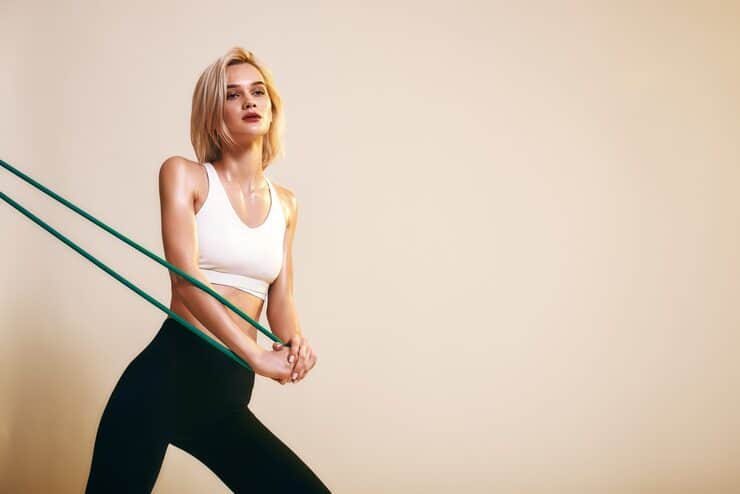
My own arms used to feel weak, soft, and annoying in the most unhelpful way, like they were refusing to cooperate with the rest of me. That frustration turned into a mission, and this tiny four-move resistance band workout became one of the easiest ways to feel stronger without needing a gym, a crowd, or a perfect schedule.
Disclaimer: This workout is for general fitness only and is not medical advice. Stop if you feel sharp pain, dizziness, or anything that feels wrong, and check with a qualified professional if you have an injury, pain condition, or health concern.

Why Resistance Bands Work So Well For Arm Strength
Resistance bands are sneaky little things, and that is exactly why they work. They make your muscles fight through the whole movement instead of letting momentum do all the work.
That means your arms, shoulders, and upper back stay under tension longer, which is the kind of pressure that helps shape strength fast. It is not magic, but it can feel pretty close when your muscles are burning and your joints are not screaming.
Bands also meet you where you are, which is why people keep coming back to them. You can make the move lighter, harder, slower, or more controlled without changing the whole workout.
That flexibility matters because strong arms are not built by random effort. They are built by showing up often enough that your muscles stop getting surprised.
What Makes This Workout So Effective
This workout works because it hits the major arm muscles from different angles. Your biceps, triceps, shoulders, and grip all get a turn at the wheel.
It also keeps the routine simple enough that you can actually finish it without turning it into a whole life event. That matters more than people like to admit, because the best workout is usually the one you can repeat.
Each move targets a different pattern of strength, and that keeps your muscles from getting lazy. Lazy muscles are like spoiled guests, and nobody needs that energy.
You are not just chasing a pump here. You are teaching your arms how to push, pull, and hold with control.
What You Need Before You Start
A resistance band and a little floor space are enough for this routine. A loop band, tube band, or long band with handles can all work just fine.
A chair or wall can help with balance if you need it. A timer or phone stopwatch is useful too, because guessing rest periods always turns into a weird little negotiation with yourself.
You will need:
- One medium resistance band
- One light resistance band if you are a beginner
- A sturdy anchor point for some moves, if available
- Water nearby
- Enough room to move your arms freely
The 4-Move Resistance Band Workout
This routine is built around four classic upper-body moves that target your arms from different sides. Do them in order, rest briefly, and repeat for a solid arm-building circuit.
Move One: Banded Biceps Curl
Stand tall with the band under both feet and hold the ends with your palms facing forward. Keep your elbows close to your ribs and curl your hands up toward your shoulders.
This move lights up the front of your arms in a very satisfying way. It also teaches you not to swing your body around like a confused windmill.
Lower slowly, because the lowering part matters just as much as the lifting part. That slow descent is where a lot of the strength work happens.
How to do it:
- Stand on the band with feet shoulder-width apart
- Grip the band with palms facing forward
- Curl upward until your hands are near shoulder height
- Pause for one second at the top
- Lower with control
Do: 12 to 15 reps
Rest: 20 to 30 seconds
Move Two: Overhead Triceps Extension
Step on the band or anchor it low, then bring both hands overhead and hold the band behind your head. Straighten your elbows until your arms reach upward, then slowly bend again.
This is the move that helps tighten the back of the arms, which is where a lot of people feel their strength lag. It is the part of the arm that whispers, “We should probably do something about this.”
Keep your ribs down and your core lightly braced so you are not turning the exercise into a back bend. The goal is arm work, not becoming a human question mark.
How to do it:
- Hold the band with both hands
- Raise your hands overhead
- Extend the elbows without locking them hard
- Lower slowly behind your head
- Keep your neck relaxed
Do: 12 to 15 reps
Rest: 20 to 30 seconds
Move Three: Band Row
Anchor the band at chest height or loop it around a sturdy post, then pull the handles toward your ribs. Squeeze your shoulder blades together at the end of the pull.
This move may not look like an arm exercise at first glance, but your arms work hard every time you pull. Stronger back muscles also make your arms look better and help your posture stop slouching like it is carrying bad news.
Rows are one of those exercises that make you feel steady and powerful at the same time. That feeling matters because strength is not just appearance, it is control.
How to do it:
- Secure the band at chest height
- Hold the handles with arms extended
- Pull toward your ribs
- Squeeze the shoulder blades
- Return slowly
Do: 12 to 15 reps
Rest: 20 to 30 seconds
Move Four: Lateral Band Raise
Stand on the band and hold the ends at your sides with your palms facing inward. Lift your arms out to the sides until they reach shoulder height, then lower them with control.
This move wakes up the shoulders, and shoulders are the frame that makes your arms look stronger. If the biceps are the show-off, the shoulders are the stage crew making the whole thing look bigger.
Do not shrug your shoulders up toward your ears. Your neck is not supposed to join the workout party.
How to do it:
- Stand on the band
- Keep arms straight but soft
- Lift out to the sides
- Stop at shoulder level
- Lower slowly
Do: 12 to 15 reps
Rest: 20 to 30 seconds
Workout Table
| Move | Main Muscles Worked | Reps | Rest |
|---|---|---|---|
| Banded Biceps Curl | Biceps, forearms | 12–15 | 20–30 sec |
| Overhead Triceps Extension | Triceps | 12–15 | 20–30 sec |
| Band Row | Biceps, back, rear shoulders | 12–15 | 20–30 sec |
| Lateral Band Raise | Shoulders, upper arms | 12–15 | 20–30 sec |
How To Structure The Workout
Do all four moves one after another, then rest for one to two minutes. Repeat the full circuit three to four times depending on your fitness level.
Beginners can start with two rounds and still get a real workout. More advanced people can add a fourth round and slow the lowering phase to make the band work harder.
The magic is not in making things complicated. The magic is in making the work consistent enough that your body cannot ignore it.
A Simple Sample Plan
This workout becomes easier to stick with when you treat it like a small habit instead of a dramatic event. Strong arms are built by repeated practice, not by one heroic burst of motivation.
Try this weekly rhythm if you want structure without overwhelm. It gives your muscles time to recover while still keeping the progress moving forward.
Sample weekly plan:
- Monday: 3 rounds
- Wednesday: 3 rounds
- Friday: 4 rounds
- Saturday or Sunday: Light stretching or a walk
That pattern keeps the workout practical and realistic. Practical workouts are the ones that survive real life.
Form Tips That Make The Workout Better
Good form makes light resistance feel serious and makes heavier resistance feel safer. It also helps you avoid cheating your way through every rep and wondering why nothing changed.
Move slowly enough that you can feel the muscle doing the work. If the band is flying around like it has somewhere else to be, the exercise is losing its purpose.
Keep these form rules in mind:
- Keep your core tight
- Move with control
- Do not shrug your shoulders
- Do not swing your body
- Breathe steadily through each rep
- Stop before form breaks down
Your muscles do not need chaos. They need clean repetition and enough tension to notice.
How To Make It Harder
Once the workout starts feeling easy, the answer is not always to do more and more forever. Sometimes the smarter move is to make each rep a little more demanding.
Use a thicker band or slow the lowering phase to increase the challenge. You can also add a pause at the hardest part of each movement so your muscles have less room to escape.
Ways to progress:
- Use a stronger resistance band
- Add 2 to 3 seconds on the way down
- Hold the hardest point for 1 to 2 seconds
- Add one extra round
- Reduce rest time slightly
Progress does not have to look dramatic to count. Quiet progress is still progress, and it tends to last longer.
How To Make It Easier
Beginners do not need to prove anything by suffering through a band too strong for them. The goal is to train the muscle, not to get into a strange argument with it.
Choose a lighter band and reduce the number of rounds if needed. Good form with a lighter band is far more useful than ugly form with a heavy one.
Ways to scale down:
- Use a lighter band
- Cut the reps to 8 to 10
- Rest a little longer between moves
- Do only two rounds
- Keep the speed controlled and comfortable
A workout that feels doable is the workout you will actually repeat. Repetition beats intensity when consistency is the real goal.
What Results To Expect
Strong arms do not appear overnight, even when the routine is short and effective. What usually shows up first is better muscle awareness, steadier endurance, and a cleaner feeling in the arms during daily tasks.
After a few weeks, you may notice that carrying bags feels easier and your arms stay less shaky during household tasks. You might also notice better posture, which is one of those sneaky bonuses that makes the whole upper body look more confident.
Visible muscle tone usually comes later and depends on many things, including food, sleep, and overall activity. But the strength foundation often arrives before the visual changes, and that is a very good sign.
Who This Workout Is Best For
This routine works well for beginners, busy people, and anyone who wants efficient upper-body training at home. It is also great for people who want low-cost workouts that do not require a lot of setup.
It can fit into a lunch break, a morning routine, or a night workout when your brain is tired but your body still needs movement. That kind of flexibility is what makes a routine real instead of theoretical.
This workout is a good fit if you want:
- Stronger arms without heavy equipment
- A short but effective home workout
- Better shoulder and arm tone
- A simple routine you can repeat
- A workout that feels manageable
Common Mistakes To Avoid
A lot of people do resistance band workouts too fast and then wonder why they only feel mildly annoyed instead of challenged. Speed can rob the exercise of its purpose.
Another common mistake is letting the shoulders rise and the neck tense up. That tension tends to spread everywhere and makes the exercise feel worse than it needs to feel.
Avoid these mistakes:
- Using a band that is too light to challenge you
- Letting your elbows flare out during curls
- Moving too quickly
- Arching the lower back during overhead work
- Pulling with momentum instead of muscle
- Skipping the lowering phase
The goal is not to look busy. The goal is to make the muscles do honest work.

Why You Will Feel This Workout Fast
Resistance bands create tension in a way that stays present through the whole motion. That means your muscles cannot hide from the load the way they sometimes can with sloppy free movement.
The burn often shows up quickly because small stabilizing muscles get involved too. That is why a simple band workout can feel far more serious than it looks.
It also helps that the exercises are layered in a smart way. Biceps, triceps, shoulders, and upper back all take turns, which gives your arms a complete challenge without turning the session into a marathon.
How To Pair This Workout With Better Results
Exercise matters, but your results get better when the rest of your habits stop working against you. Muscles need recovery, fuel, and enough water to keep rebuilding.
Try to eat enough protein across the day and sleep like it actually matters, because it does. The body loves to act cooperative after a decent night of sleep, which is rude but true.
Helpful support habits:
- Drink enough water
- Eat protein regularly
- Sleep consistently
- Walk or move on off days
- Stretch lightly after the workout
No single habit carries the whole result alone. The body usually responds best when you give it a few things in the right direction at the same time.
A Fast Finisher If You Want Extra Burn
If your arms still feel fresh and you want one more push, add a short finisher at the end. This is not required, but it can be a nice final spark.
Choose one move and do it for 30 seconds, rest for 15 seconds, then repeat two more times. This tiny burst is enough to make the workout feel complete without turning it into punishment.
Finisher option:
- Biceps curls for 30 seconds
- Rest 15 seconds
- Triceps extensions for 30 seconds
- Rest 15 seconds
- Repeat 2 rounds
That little ending can be the difference between “I worked out” and “My arms know exactly what happened.” Sometimes that is the whole point.
Why Short Workouts Still Matter
Short workouts are not lesser workouts, and people act like they are when they should not. A focused routine done often will usually beat a long routine done rarely.
This matters because busy schedules break a lot of good intentions. A workout that takes less time has a better chance of surviving a real week, and a surviving workout is the one that actually changes things.
You do not need a perfect environment to get stronger. You need a repeatable pattern and a reason to keep showing up.
FAQs
How Often Should I Do This Workout?
Three times per week is a great starting point for most people. That gives your muscles enough work to adapt without keeping them in a constant state of confusion.
If you recover well, you may do it a little more often. The key is whether your form stays good and your arms still feel ready to train.
Can Beginners Do This Workout?
Yes, absolutely, and resistance bands are often perfect for beginners. They give you a way to build strength without needing advanced equipment or a lot of space.
Start with lighter resistance and fewer rounds if needed. A beginner who stays consistent will usually beat a more intense plan that never gets repeated.
Will This Workout Tone My Arms?
It can help a lot, especially if you combine it with enough protein and regular movement. Toning is really a mix of building muscle and lowering excess body fat over time.
That means the workout is only one piece of the puzzle. A good routine gives your arms shape, but the rest of your habits help reveal it.
How Long Until I See Results?
Some people feel stronger within a couple of weeks, especially in daily tasks and posture. Visible changes often take longer and depend on consistency, recovery, and nutrition.
The first wins are usually quiet ones. Your arms start feeling steadier before they start looking dramatically different.
Can I Do This At Home Without A Door Anchor?
Yes, you can still do most of the workout without an anchor. Curls, overhead triceps extensions, and lateral raises can all be done with the band under your feet.
If you do have a secure anchor point, the rows become easier to set up. That said, the workout is still very usable even with minimal equipment.
What If The Band Hurts My Hands?
Use a band with better handles or wrap the band more comfortably in your grip. A glove or towel can also make holding the band feel less irritating.
Pain in the hands is not the goal, and you should not have to suffer through a bad grip to earn the workout. Comfort helps consistency, and consistency builds strength.
Should I Do Cardio Too?
Cardio can help overall fitness, but it is not required for this arm workout to work. The best mix depends on your goals and how much time you have.
A short walk on off days can be a great companion to resistance training. Sometimes the simplest pairing is the one that keeps you moving without draining you.
Final Thoughts
This four-move resistance band workout is simple on purpose, because simple is usually what gets done. The band does the heavy talking while you focus on clean movement, steady effort, and showing up again before your excuses get too loud.
Strong arms are not built in one dramatic session, and that is actually good news. It means every round, every rep, and every time you choose the band over the couch counts toward something real.
Your arms do not need perfection. They need repetition, patience, and a routine that makes sense on an ordinary day.