
Knee pain is one of the most common issues many people face, whether due to injury, overuse, or just the general wear and tear that comes with age.
If you’re experiencing discomfort while straightening your leg or during simple movements, yoga can be a surprisingly effective and gentle solution to help you manage and reduce that pain.
The following 7 yoga poses are specifically designed to strengthen muscles around the knee, improve flexibility, and promote healing. They will give you quick relief and help prevent future issues.
1. Child’s Pose (Balasana)
How to Perform: Child’s Pose is a deeply restorative pose that can immediately relieve knee pain. It gently stretches your hips, thighs, and ankles while relaxing the lower back and knees.
- Begin by kneeling on the floor with your knees slightly apart (about hip-width).
- Sit back on your heels and then extend your arms forward, lowering your forehead to the floor.
- Breathe deeply and hold for at least 30 seconds, then return to a neutral position.
Why It Helps: This pose gently stretches the knees and hip flexors, which can help relieve tension and tightness around the knee. The forward fold encourages relaxation and can soothe irritated knee joints, making it an excellent choice for alleviating knee pain.
Additional Tips:
- You can place a cushion or blanket under your knees for added support if your knees are sensitive.
- Focus on slow, deep breaths to relax the body and further ease discomfort.
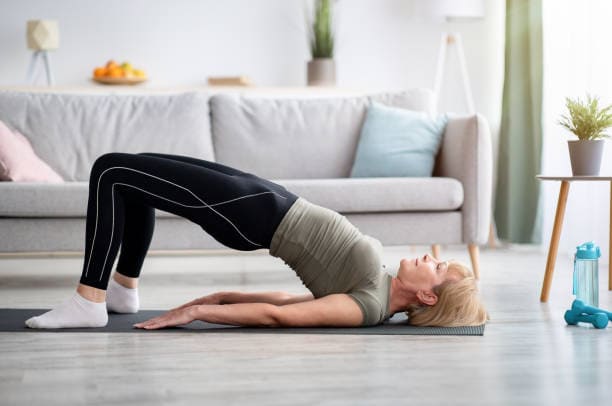
2. Bridge Pose (Setu Bandhasana)
How to Perform: Bridge Pose is a strengthening pose that targets the lower body, particularly the hips and thighs. By lifting the hips towards the ceiling, it helps to stabilize and support the knees.
- Lie on your back with your knees bent and feet flat on the floor, hip-width apart.
- Press your feet into the ground as you lift your hips towards the ceiling, keeping your shoulders and head on the floor.
- Hold for 30 seconds, then gently lower your hips back down.
Why It Helps: Bridge Pose strengthens the glutes, hamstrings, and quadriceps, which are all essential for stabilizing the knee joint. Strengthening these muscles can help relieve knee pain and prevent further discomfort, especially while straightening the leg.
Additional Tips:
- If you feel any strain in your lower back, try keeping your feet a little further from your hips.
- Engage your core to protect your lower back during the lift.

3. Warrior I (Virabhadrasana I)
How to Perform: Warrior I is an excellent pose for improving balance, flexibility, and strength. It targets the thighs, hips, and core, all of which contribute to knee stability.
- Start by standing tall and take a big step back with one leg, keeping the other knee bent at a 90-degree angle.
- Reach your arms overhead and turn your hips to face forward.
- Hold for 30 seconds, then switch sides.
Why It Helps: This pose engages the thighs and calves, helping to stabilize the knee joint. The deeper you bend into your front leg, the more you activate the muscles surrounding your knee, thus relieving pain and improving mobility.
Additional Tips:
- Ensure that your knee is aligned with your ankle to avoid additional strain on your knee.
- Modify the stance if your knee feels too tight or uncomfortable by making a shallower lunge.
4. Triangle Pose (Trikonasana)
How to Perform: Triangle Pose stretches the entire body, targeting the hamstrings, hips, and legs. It also opens up the chest and helps alleviate tension around the knees.
- Stand with your feet wide apart. Turn one foot out 90 degrees and the other foot slightly in.
- Extend your arms parallel to the floor, then reach forward with your front hand and lower it down to your shin, ankle, or the floor.
- Keep the opposite arm pointing towards the ceiling, ensuring your body is in one straight line from the back foot to the top hand.
- Hold for 30 seconds, then switch sides.
Why It Helps: This pose stretches the hip muscles and hamstrings while strengthening the quadriceps and calves. Opening the hips and stretching the legs reduces strain on the knees and improves overall flexibility, offering relief from pain.
Additional Tips:
- Keep your torso open and your chest lifted as you extend into the pose to avoid rounding your back.
- If you can’t reach the floor with your hand, use a yoga block to help you maintain proper alignment.
5. Chair Pose (Utkatasana)
How to Perform: Chair Pose strengthens the quadriceps and glutes while promoting knee stability. It can be particularly beneficial for those suffering from knee pain related to muscle weakness or instability.
- Stand with your feet together and bend your knees, lowering your hips as if sitting back in an imaginary chair.
- Extend your arms overhead, palms facing each other, and keep your spine straight.
- Hold for 30 seconds, then slowly rise.
Why It Helps: Chair Pose works the quadriceps, calves, and glutes, all of which support the knees. Strengthening these muscles helps stabilize the knee joint and alleviate pain caused by weakness or muscle imbalances.
Additional Tips:
- Do not let your knees extend past your toes during the pose. Keep them aligned with your ankles to prevent unnecessary strain.
- If you’re new to the pose, practice it in front of a mirror to check your form.
6. Reclining Hand-to-Big-Toe Pose (Supta Padangusthasana)
How to Perform: This gentle stretching pose targets the hamstrings and calves, often contributing to knee discomfort when tight.
- Lie on your back and extend one leg straight up, holding your big toe with your hand or using a yoga strap around the foot.
- Keep the other leg bent or extended flat on the floor.
- Hold for 30 seconds, then switch sides.
Why It Helps: By stretching the hamstrings and calves, Supta Padangusthasana helps release muscle tension that affects the knee joint. Improved hamstring flexibility can lead to better mobility and reduced pain when straightening the leg.
Additional Tips:
- If you can’t reach your toe, use a yoga belt or strap around your foot, ensuring your leg remains straight.
- Keep your hips square and avoid letting the raised leg fall to the side.
7. Cat-Cow Pose (Marjaryasana-Bitilasana)
How to Perform: Cat-Cow is a fluid movement between two positions that helps to improve spinal flexibility and release tension in the lower back and hips, which can also affect the knees.
- Start on all fours with your wrists under your shoulders and knees under your hips.
- Inhale, arch your back (Cow Pose), lifting your head and tailbone upwards.
- Exhale, round your back (Cat Pose), tuck your chin and draw your navel toward your spine.
- Repeat for 1 minute, moving slowly and fluidly.
Why It Helps: This sequence improves flexibility in the spine and hips, reducing the tension that might affect the knees. Loading up the entire body helps alleviate knee discomfort, particularly when straightening the leg.
Additional Tips:
- Keep your movements slow and controlled, focusing on the breath.
- Avoid overextending in either direction—keep the movement gentle and within a comfortable range of motion.
FAQs
Q: Can I do these yoga poses if I have knee arthritis? A: Many of these poses can benefit people with knee arthritis as long as they are done with caution. If you’re new to yoga or have severe knee pain, it’s recommended to consult with a healthcare provider or a yoga therapist before starting.
Q: How often should I practice these poses for knee pain relief? A: Practice these poses daily or at least several times weekly for best results. Consistency is key to building strength and flexibility around the knee joint, which can help reduce pain and prevent future issues.
Q: What if I experience pain while doing these poses? A: If you experience sharp pain, stop immediately. Mild discomfort is normal, but any sharp or acute pain indicates that you may push your body too hard. Consider using props like cushions or yoga blocks for additional support.
Q: Can these poses help with patellar tendonitis or a torn ACL? A: These poses can help alleviate mild knee pain, but if you have more serious injuries like patellar tendonitis or an ACL tear, consult with a healthcare professional for specific treatment and rehabilitation exercises. Yoga may complement your recovery but should not replace medical care.
Conclusion
Yoga is an excellent and natural way to manage knee pain and improve mobility. Incorporating these 7 yoga poses into your daily routine can strengthen the muscles surrounding the knee, improve flexibility, and reduce discomfort.
While yoga can be a great tool for pain relief, always listen to your body and consult with a healthcare professional if you’re dealing with more severe knee issues. With consistent practice and patience, yoga can help you live a pain-free and active life.
