
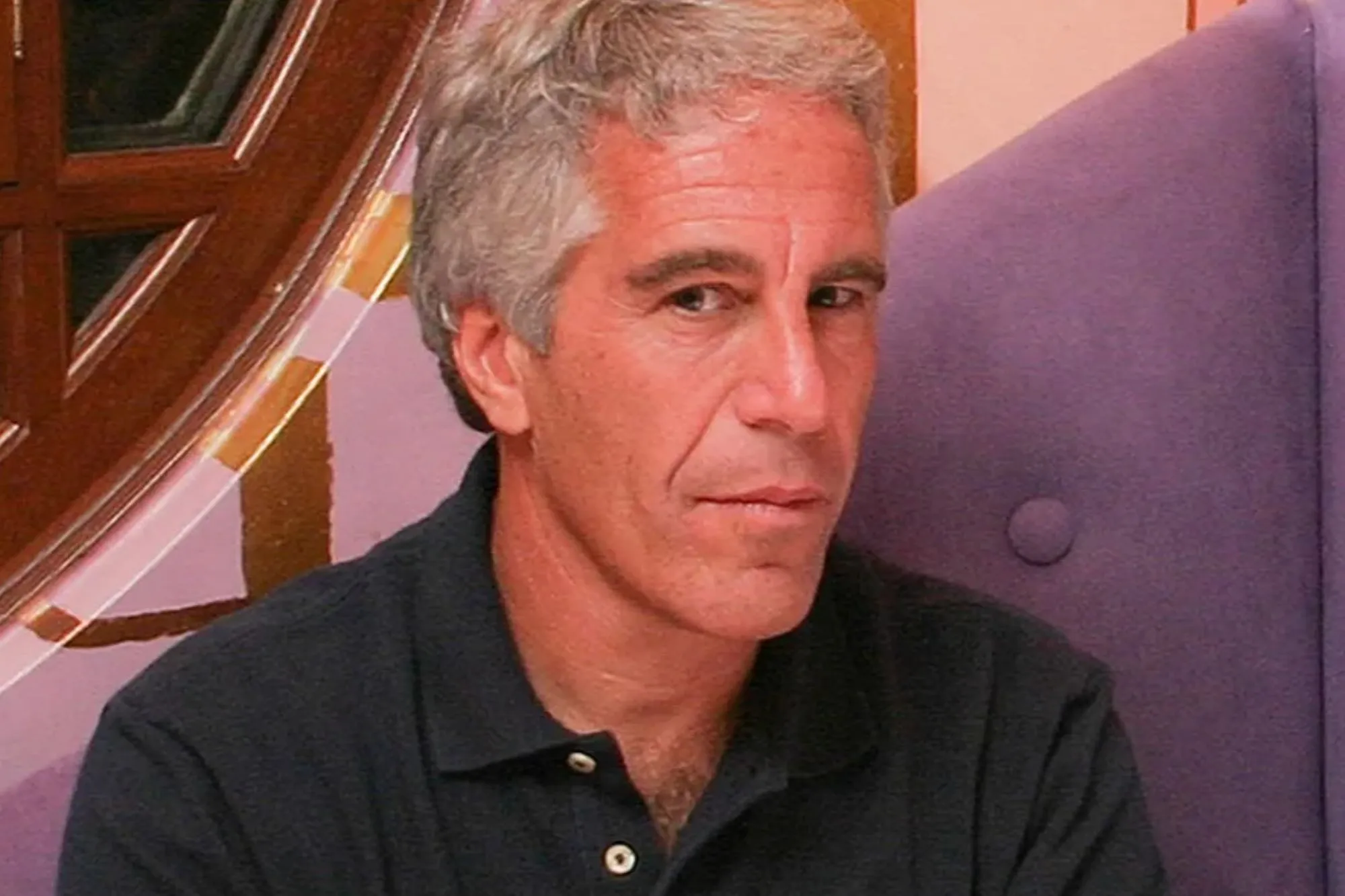

BOMBSHELL photographs from Jeffrey Epstein’s autopsy have sent shockwaves around the world and added fuel to an already-raging debate surrounding his death in prison.
A dossier of grizzly autopsy photographs, reports and snaps of the late paedophile’s cell, including the supposed noose that killed him, have led to a level of speculation unseen since the Epstein Files were released a year ago.


The public disclosure, released by the late paedophile’s brother Mark, 71, included pictures of Epstein’s bruised neck, and was timed to perfection.
It coincided with forensic scientist Dr Michael Freeman appearing on BBC Newsnight to peddle his theory that the “spectrum of injuries” either pointed to murder or a “one in 10,000 possibility” that Epstein chose “to stage his own suicide as a homicide”.
Dr Freeman said: “The evidence is most consistent with an assault, a ligature strangulation from behind and most probably using that same ligature to suspend the body from the bunk bed.”
It has been painted as the smoking gun in Epstein’s death and proof that the disgraced financier was killed by one of his elusive rich clients, who benefited from his network that sex trafficked young girls.
Dr Freeman did not inspect the body and his findings are from autopsy evidence handed over by Epstein’s brother Mark – he has long insisted the death was a killing carried out on the behalf of one of his sibling’s powerful friends.
But experts who have spoken to The Sun insist that is far from the case, arguing the theories put forward by Dr Freeman are “dangerous” and lacking in scientific rigour.
Retired Home Office forensic pathologist Dr Peter Acland, who analysed the body of House of Horrors monster Fred West, is concerned by such strongly expressed beliefs.
He tells us: “Lots more information is needed to be certain. Maybe some DNA features on the ligature itself or any extraneous DNA – belonging to someone else.
“The evidence is not as conclusive as it appears. You can easily convince yourself you have a definitive answer and go off on the wrong track.
“I’m afraid my opinion is inconclusive and it would be dangerous to come to a definitive opinion.”
Epstein’s autopsy dossier was made public this week – including some photos too graphic to publish.
They show the disgraced financier’s body with dark bruising around his neck and multiple medical reports about his injuries and cell photos.
Epstein was found seven years ago, on August 10, by panic-stricken guards at New York City’s Metropolitan Correctional Facility.
Instead of checking him every 30 minutes, in a bid to prevent a suicide attempt, they were found to have been shopping or sleeping.
Dr Freeman, who previously testified at the George Floyd murder trial, believes injuries on the predator’s neck point to strangulation taking place rather than suicide by hanging.
For him, the most damning evidence are photos showing a dark red mark around the paedophile’s throat and a dark line running up to his ear.
He found the marks “very unusual looking for a hanging on the neck” and argues their appearance is rather different from the injuries described in official reports.
According to Dr Freeman, the Y-shaped mark on Epstein’s neck caused by the ligature does not follow the pattern of a typical injury.
He argues it should be smooth and uniform, rather than deep, irregular and splitting into two branches as seen in the photo.
There was also a mark on the back of Epstein’s neck, which Dr Freeman believes was caused by being strangled with a ligature from behind.


However, Dr Acland argues this bruising can equally be caused by hanging too – not just murder.
He adds: “There will be a ligature mark angled up towards the back of neck and corresponding friction marks on the front side of neck along with possible bruising from when the victim falls back or swings back.”
Dr Freeman points to marks above the bruising from the ligature and frames them as fingernail marks caused by Epstein trying to fight off an attacker while being strangled.
But our experts have their doubts. Professor Allan Jamieson, director of The Forensic Institute, says it is a bold and “extraordinary” conclusion.
“It presupposes that these were in fact fingernail marks and not something else,” he said.
The confusion could be due to the photographs themselves, Prof Jamieson explains, as certain lighting can make injuries appear darker or more prominent than they actually are.
He adds: “Looking at photographs is never an optimal way of looking at injuries.”
Dr Acland also suggests these injuries may be petechial haemorrhages – small bleeds that appear on the skin due to pressure, such as when some has hung themselves.


He also notes there are no injuries to Epstein’s hands, which could be expected if someone was fighting off an attacker.
Referencing his concern over the certainty of Dr Freeman’s findings, he adds: “You can never say never, but also never say always.”
Dr Freeman also believes a deep bruise to Epstein’s left shoulder is indicative of an assault or him trying to fight back – but again his theory lacks substantial proof.
For it’s not known exactly when the disgraced financier obtained that injury – it possibly happened days earlier or even while guards frantically scrambled to save his life.
Drawing from photographs of Epstein’s messy cell, Dr Freeman points to so-called ‘clues’ including scattered scraps of shredded orange fabric, made using his bedsheets or towels.
He points to one piece of fabric especially, which he suggests was deliberately “discarded” and “dropped in a corner near the desk”.


Describing the ligature as “double-knotted, looped [and] narrow”, Dr Freeman paints it as the murder weapon used to strangle Epstein from behind.
“One of these knots is applied as pressure to produce this irregular abrasion at the back of the neck, we actually have a fairly good explanation for all the injuries,” he says.
But again, our experts call for caution arguing there has been no DNA discovered so far that would imply another party’s involvement.
Prof Jamieson adds: “He could be correct that the evidence is consistent with strangulation. But that’s a very different thing from saying that the only explanation is homicide.”
Even the phrase “consistent with strangulation” needs to be treated carefully, he warns, because that simply means it is “one possible version of events”.
Dr Freeman’s claims will provide yet another headache for US authorities. He is the second forensic investigator to question the suicide verdict by New York’s chief medical examiner.
While she didn’t respond to comment, Dr Barbara Simpson previously stated: “I stand firmly behind our determination of the cause and manner of death for Mr. Epstein.”
The autopsy verdict was first disputed by Dr Michael Badden, who was hired by Epstein’s brother. He insisted the injuries were “more indicative of homicidal strangulation”.
This has been disputed by the Department of Justice and FBI, who found there was nothing to contradict the ruling that Epstein died by suicide after a 2023 investigation.
They did however note that “negligence, misconduct and outright job performance failures” from the Federal Bureau of Prisons allowed Epstein to take his own life.


Questions still remain about why so little evidence exists from the day of his death.
Two cameras directly outside of Epstein’s cell malfunctioned that night and a third stored “unusable” footage. The recording system, which broke days before, hadn’t been fixed.
There are no photographs of Epstein with the noose around his neck and his body was removed from his cell – both actions go against standard protocols for preserving evidence.
In this grey area of unanswered questions, conspiracy theories have filled the void – including outrageous claims that Epstein is still alive and autopsy photos show a body double.
The uncertainty about Epstein’s final moments have encouraged people like Dr Freeman to speak with certainty when it comes to their findings. He claims to be “completely independent” and denies being a “conspiracy theorist”.
Ahead of releasing the autopsy files, which he had studied since November last year, Dr Freeman told BBC Newsnight: “Don’t take my word for it, look at it.”
To his doubters, he added: “Show me where I got it wrong, I’m wide open to that. I’m an academic, I’m quite happy to hear people’s theories that are informed.”
Yet Dr Freeman’s challenge will likely lead to the court of public opinion, populated by conspiracy-loving sleuths, drowning out the expert analysis from medical professionals.
According to Prof Jamieson, the approach by Freeman works in his favour as it shifts the burden of proof onto naysayers rather than him – something not done in the world of science.
He adds: “It’s for those proposing a theory to provide the evidence. This ‘prove me wrong’ is really not how things should work.
“I think the logic there is a bit perverse. So there are clearly reputable opinions which contradict his.
“So I think it does need to be treated with some caution and as they say, extraordinary claims require extraordinary evidence.”
While both of The Sun’s experts are open to Dr Freeman’s theories, they insist much more is needed to be able to so certainly state Epstein died of murder, not suicide.
Prof Jamieson adds: “If the evidence was so compelling, you would expect at least some consensus among all those who have properly looked at it.”