A Forgotten Witchy Tale From The 1970s Is The Feel-Good Halloween Movie You Need To Watch This Year
World War II. Child refugees. A charlatan scamming people on the street, increasingly ignored as London is devastated by the Blitz. A chaotic black market frequented by soldiers from military contingents across the globe. Veterans of the First World War, gray-haired and shaky-handed, taking up their old uniforms to defend their country. A single, solidly determined middle-aged woman burdened with the knowledge that she may be the only thing standing between England’s coasts and a full Nazi invasion. Grim as it sounds, this is no dreary wartime drama (though the accuracy to historical events and costumes is respectable) — no, this is the setting for one of Disney’s hidden live-action gems, and despite its circumstances, the events that unfold over the course of this film offer nothing short of true, honest delight.
Premiering in theatres in December of 1971 as part of the creative and stylistic upheaval that would later be known as Disney’s Dark Age, Bedknobs and Broomsticks takes what should be (and, historically, was) a truly dire situation and pairs it with a wild, unpredictable plot that can only be described as true whimsy. Featuring spot-on castings, heartfelt performances, and an ending that is best left unspoiled, Bedknobs and Broomsticks is the strange, hopeful, and strangely hopeful film we all need to be watching right now.
Bedknobs and Broomsticks feels like a slightly more mature, but no less magical, Mary Poppins
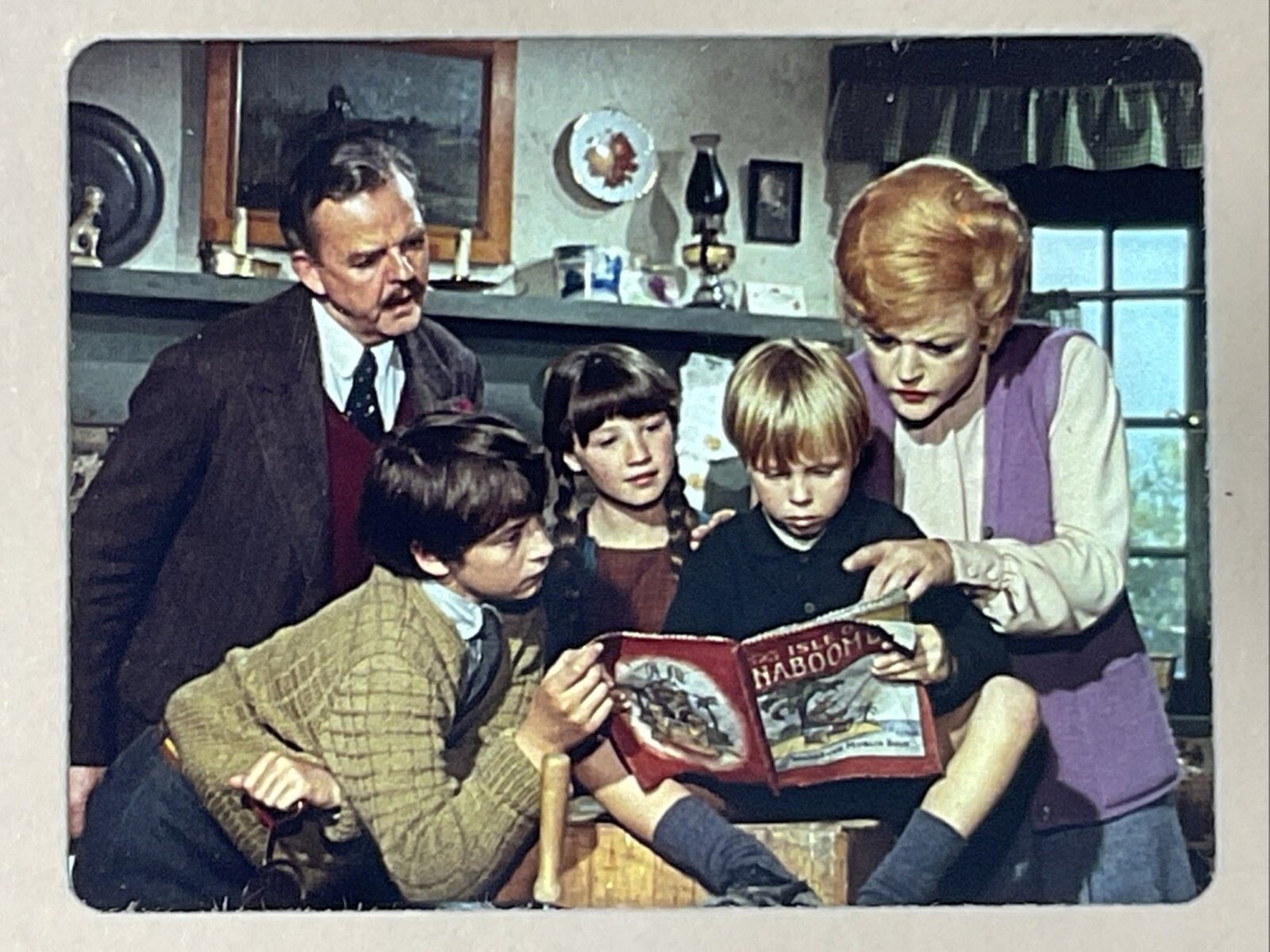
After a charming and unexpected opening credits sequence in the style of the Bayeux Tapestry, (an 11th century tapestry that famously depicts the events of the Norman Conquest and would go on to be adapted for use as British propaganda during the Second World War), the film begins at a castle-turned-museum that now serves an evacuation center where children displaced from London due to the Blitz wait to be paired with rural families. This type of evacuation was historically very real, and, at least initially, the film does not shy away from the inherent grimness of a situation where anyone with room to spare is expected to take on at least one unaccompanied refugee child.
The first crack in this gloomy tone is provided, perhaps ironically, by the elderly WWI veterans of the local area marching by in formation, making the best of their return to duty with a rousing, cheerful tune in “The Old Home Guard” (the first of many short songs in the film, composed by legendary midcentury Disney-music duo Roger B. and Richard M. Sherman). This moment of only somewhat war-embittered jollity is followed almost immediately by the introduction of quirky, practical, and patriotic middle-aged witch Eglantine Price (played to glorious perfection by the late Angela Lansbury). Price enters the scene sputtering up the road in a smoke-belching, bulky motorcycle, clad in a pastel blue beanie, matching scarf, overcoat, white leather gloves, and googles, And generally making a visual and auditory spectacle of herself as she rushes to pick up an unwieldy package later revealed to be a broomstick.
When reminded that she will be taking the film’s three protagonists— London refugees Charles, Carrie and Paul— into her care, the witch is initially deeply unhappy with the situation, responding that she is far too busy on important matters, her home is no safe place for children, and she does not do well around children herself anyway— however, of course, she is eventually convinced, and begrudgingly allows the three children the upper rooms of her cozily-fitted country home.
Viewers can be excused if, seeing a midcentury live-action Disney film where a precocious British children are given over to the care of a quirky-yet-loveable witch, they were to draw comparisons to Disney’s 1964 blockbuster Mary Poppins. In fact, Bedknobs and Broomsticks initially picked up as a backup plan if the studio was unable to maintain its adaptation rights to the Mary Poppins novel, only to spend 10 years in production purgatory after Mary Poppins was approved to film, due to the strong similarities between the two films— similarities that, as shall be covered below, extend well beyond characters or broad plot structures.
As for Mary and Eglantine themselves, however, they could not be more different. Despite her bright clothing and witchy ways, Eglantine is a practically-minded, goal-focused woman with little time for or interest in the raising of children, or chalk art, or chimney sweeps or anything so frivolous. Instead, Eglantine Price studies her spellcraft alone, in a dingy locked basement under her shed, in unceasing pursuit of a single goal— to use her magic to help England’s war effort against the Nazis.
Well-developed, endearing characters prop up a delightfully convoluted plot
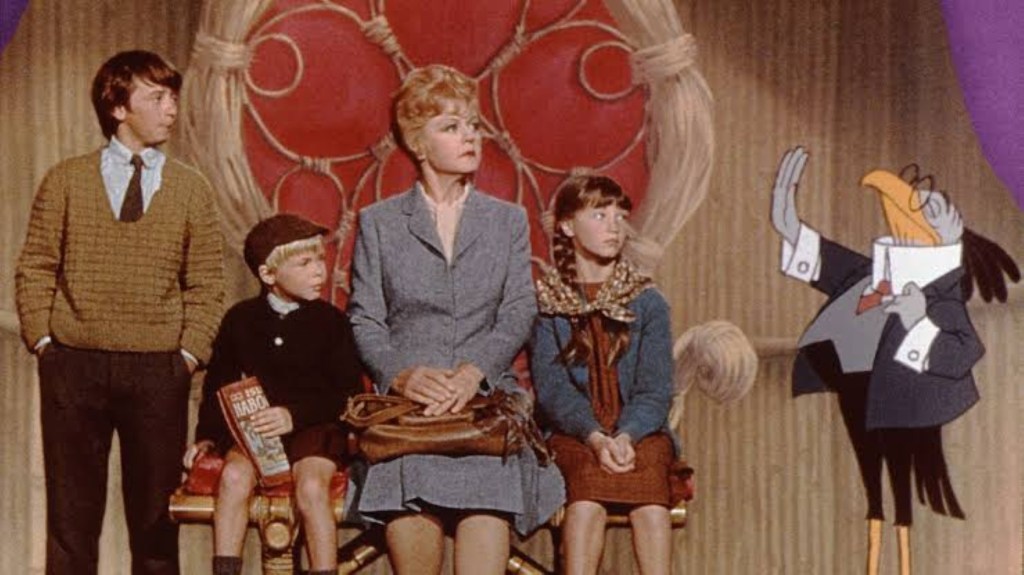
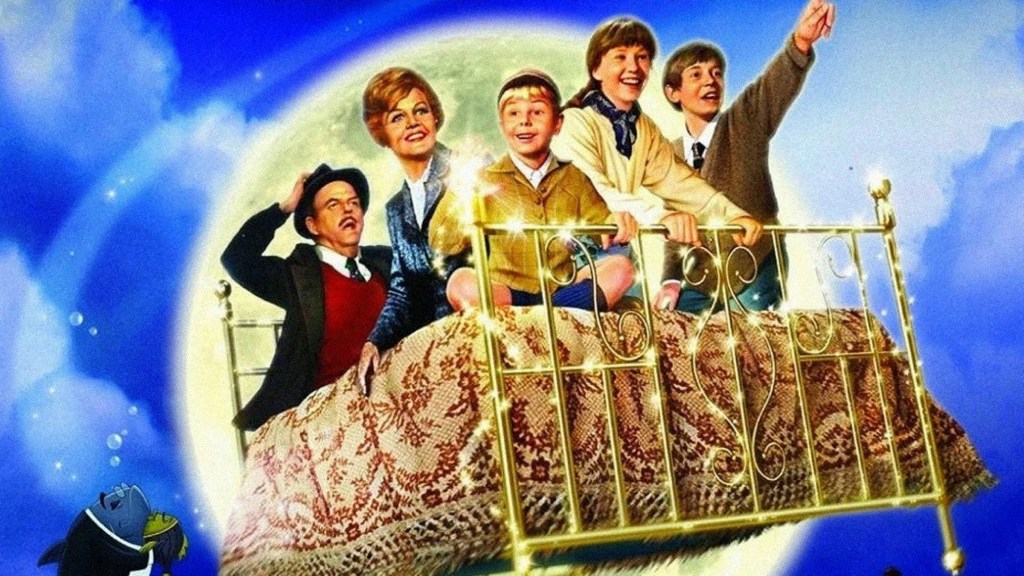
Yes, rather than a magical nanny or governess, Mrs. Price is a 40something year old Nazi-Fighting-Witch-In-Training in pastel knit, who just so happened to have had three precocious young children dumped on her just as she was about to finish the spell that would give her an overwhelming upper hand in battle. While the group’s subsequent adventures would indeed feature the Mary Poppins-esque plot beats of a jack-of-all-trades love interest, dancing street rabble, and cartoon animals doing sports, Mrs. Price makes it very clear through it all that she is only engaged in these fantastical romps because they are part of her search to find the last words to her spell and unleash the fury of ancient magic upon The Third Reich.
While this does create the rather unusual setup of a whimsical-witch-focused kids’ adventure movie where the whimsical witch in question spends the film’s wildest sequences seeming somewhere between bored and impatient (if not actively rushing through the background searching for her missing spell), the film’s cheerful tone is carried quite well by the other main characters. Professor Emilius Brown, Mrs. Price’s shady magic spell supplier turned reluctant ally turned love interest, provides comic relief with his absolute insistence on taking on whatever persona best fits the situation he’s in (and, inevitably, ending up hopelessly entangled in said situation). When he isn’t bumbling about getting into trouble, Mr. Brown also provides a lighter and more playful approach to Mrs. Price’s magic, balancing the goal-oriented witch’s stubborn practicality with genuinely awestruck reminders of how wondrous she and her powers truly are.
As for the aforementioned precocious London refugees Charles, Carrie and Paul, they are solid enough child roles, although the loud personalities of Mrs. Price and Mr. Brown do tend to overshadow them in many scenes. Elder brother Charles’ initial dismissal of witchcraft serves as a clear metaphor for the loss of innocence experienced by children during wartime, and its contrast against Mrs. Price’s faith in the idea of fighting Nazis with witchcraft illustrates one of the film’s core messages — that the practicality and efficiency required in a crisis does not need to come at the cost of joy, magic, and wonder, and that victory be found in the practical and clever application of things that would otherwise fall firmly into the realm of the fantastical.
The power of whimsy in dark times

Bedknobs and Broomsticks is, at its core, a film about hope and magic in times of fear. The looming presence of Nazi aggression and wartime shortages over a perpetually rain-soaked England is pointedly contrasted by the warmly-lit coziness of Mrs. Price’s home and the vibrant hues of the cartoon animal world into which the characters briefly enter. On a character level Charles’ cynical and selfish mindset is contrasted by that of younger brother Paul, whose willingness to believe in the magical and illogical also lets him notice vital information that even the adult characters miss, while Mrs. Price— a person who possesses true magic yet is solely focused on helping the war effort— balances Mr. Brown, whose (seeming) lack of true magical power does not stop him from trying to turn every situation into something fantastical.
As for the Nazis, they do indeed make their appearance in the film’s final act, embarking from a U-Boat off the English coast to invade the very town where Mrs. Price lives, taking her, the children, and Mr. Brown hostage in the process. However, Mrs. Price had already managed to locate the missing spell, and— not to spoil too much, as this ending is truly best experienced blind— the Nazis get their own encounter with the power of magic, although for them it is less “whimsy and wonder” and more “undying horrors beyond their comprehension”. The less details given about Bedknobs and Broomsticks’ ending the better, but suffice to say you may find yourself watching the ending credits scroll by with your jaw still on the floor. This film is, it cannot be stressed enough, a true delight. Heartfelt, hopeful, and truly unpredictable, it is the little spark of magic we all could use in these times.