Korean Director Na Hong-jin on the Meaning Behind ‘Hope’ and His Sequel Plans: “Don’t Be Surprised If He Crosses Over to the North” You Should Know
It’s an irresistible film-nerd conceit: What would such-and-such franchise movie look like if it were directed by an arthouse auteur renowned for their singular, uncompromising vision?
Say, for example, that Lars von Trier took the helm of the next Avengers movie, David Cronenberg directed Jurassic World 5, or Wes Anderson was inexplicably brought on board for reshoots of Fast & Furious 11.
Catnip for film-geek conversation, but rarely does a movie arrive that approximates an answer. Hope, it doesn’t feel unfair to suggest, actually sort of does. This, at last, is Avatar if it were directed by South Korean maestro Na Hong-jin — the current standard-bearer for his country’s rich tradition of wildly entertaining genre cinema suffused with a sicko, trauma-tinged streak.
The 52-year-old writer-director is beloved by both arthouse fans and action aficionados thanks to a trio of unforgettable genre vehicles: the relentlessly brutal crime thrillers The Chaser (2008) and The Yellow Sea (2010), and the supernatural horror sensation The Wailing (2016).
Hope, which landed in North American cinemas on Sept. 9 courtesy of Neon, shares many elements with those earlier works: characters who are lovably earthy one moment and gleefully grotesque the next, relentlessly kinetic action sequences, Na’s signature vice-grip over pacing and tone, and an above-average deployment of profanity (“ssibal,” the Korean word for “fuck,” is shouted 137 times in the film, according to a fan count widely circulated online). But it also boasts a soaring, multi-film story involving humanity’s first, hubristic brush with an enlightened race of blue-green aliens, creatures created via motion capture and lavish CGI. It’s by far Na’s most multiplex-friendly movie, but it also refuses to conform to standard tentpole storytelling conventions.
Unsurprisingly, this cocktail has proved divisive. Hope premiered at the Cannes Film Festival in May, drawing a six-minute standing ovation but a sharply divided critical reaction. Some, such as The Hollywood Reporter‘s lead critic, hailed Hope as a “rip-roaring sci-fi creature feature” that “has instant cult classic written all over it.” Others — and there were more than a few — bemoaned the story’s 160-minute runtime and CGI work that betrayed a budget stretched a bit beyond its max.
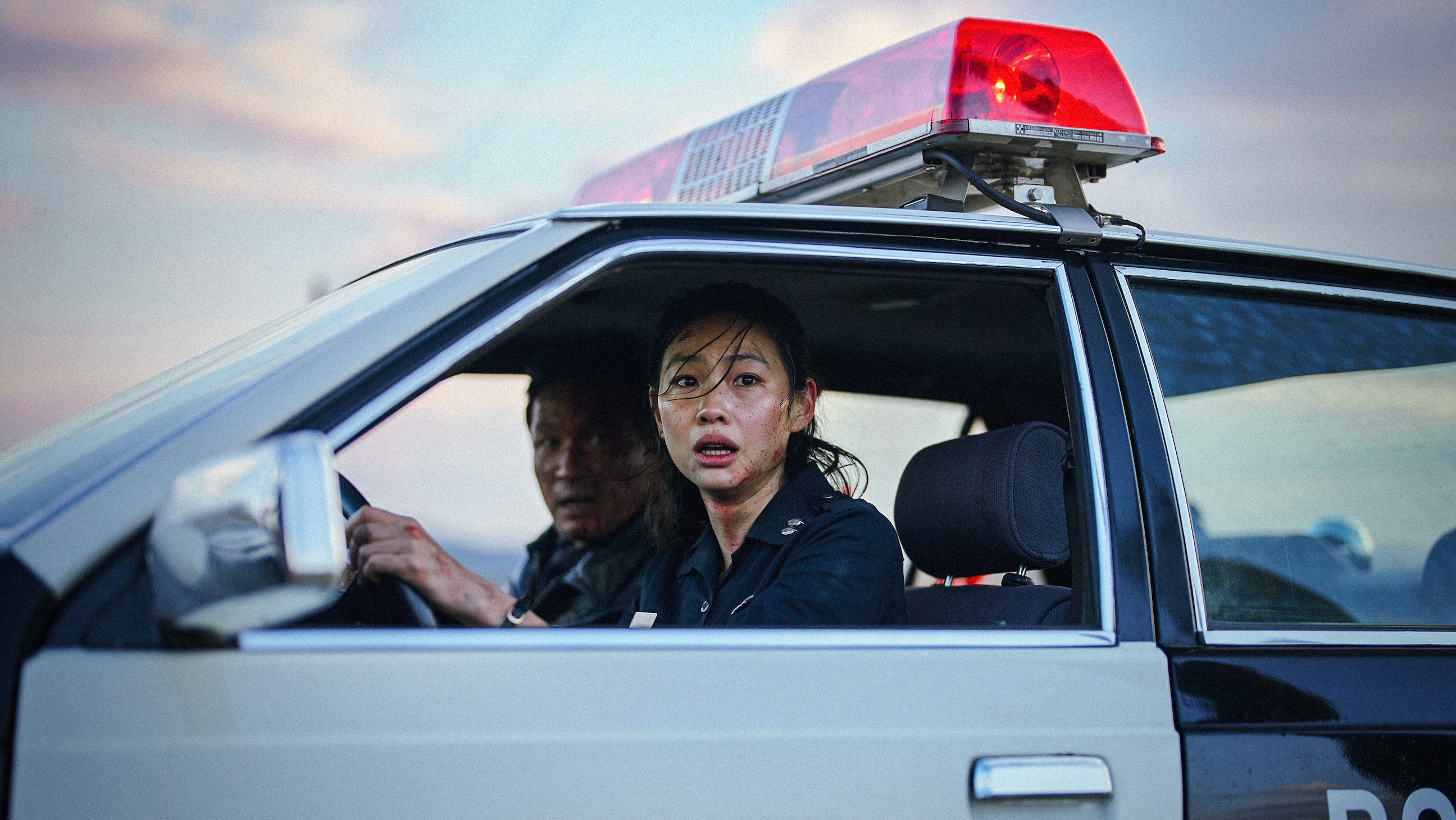
Set in the fictional border town of Hope Harbor near the Korean Demilitarized Zone, Hope follows put-upon police chief Bum-seok (the versatile Korean action star Hwang Jung-min) and his bad-ass female deputy Sung-ae (Squid Game’s Hoyeon) as they frantically hunt an enormous mystery creature that has begun rampaging through their village. A band of local hunters, led by the charismatic Sung-ki (Zo In-sung), soon join the chase and track the beast into a nearby forest. There, the discovery of a spacecraft and additional extraterrestrials transforms their chase into a simple struggle for survival, as what began as a series of understandable misjudgments spirals into a tragedy of cosmic scale.
Na conceived Hope as the first chapter of a potential franchise. The film earned a healthy $36 million at home in South Korea over the summer, and brought in just over $5 million during its first extended weekend in North America. Rollouts in other markets around the world are now underway.
THR recently sat down with Na at his office in Seoul to discuss his unconventional creative process, the timely message he embedded at the heart of the action spectacle, and where he plans to take the Hope saga in part two.
Let’s start by talking about the creative origins of Hope. How did you get started on this story?
Well, I don’t hang out with other filmmakers or people in the industry much. What I like to do is go to places that are unfamiliar to me, to meet new people, and then try things with them that I’ve never done before. In other words, I try to seek out new worlds to enter. As I’m trying to adapt to that kind of unfamiliarity, that’s where the stories I want to tell naturally come about. My films have all come from the things I learn and feel when I’m getting to know new people in totally unfamiliar situations.
How did this film emerge from that process?
Well, where ideas come from is always complex. But you may remember the character of Yang-bae from Hope? (Yang-bae, played by Eum Moon-suk, is a dimwitted carpenter and taxidermy enthusiast whose clueless, greedy actions, we learn midway through the story, are responsible for setting the movie’s conflict in motion.) He’s named after a real guy I met. I have a house in Sokcho, which is a mid-sized fishing town on the east coast of Korea. I go there when I want to hide away and write. Usually, I keep to myself, but I met this guy, Yang-bae, around town. He was crazy about fishing and invited me to go fishing with him and his friends. We ended up spending a lot of time together and became quite close, going out eating and drinking. Yang-bae is the kind of person most people would call a lowlife. I would never end up spending time with a group like his in Seoul. But I learned a lot from him and his friends. He would do slimy things — like sometimes he would bring a bunch of brand-new fishing gear to sell to the group. It was unclear where or how he got it, but he was definitely selling it to his friends for a profit. Other times, he’d get everyone to pitch in on something, or split a bill, and I was certain he was taking a hefty margin. But at the same time, he was kind of the heart of the group. So I found myself observing him and thinking, is this a good or bad man? And there wasn’t really a simple answer.
So, it wasn’t exactly a straight line, but I got this idea that I wanted to make a very entertaining action movie related to the notion that our biggest human conflicts usually have very little to do with whether the individuals are good or bad people. Conflicts and tragedies are almost always the result of carelessness or accidents that spiral totally out of control. And once it becomes “us versus them,” your perspective is trapped on one side or the other. I wanted to make an action movie that gives you a three-dimensional point of view on this very human problem.
Did your fisherman buddies know who you are and what you do?
No, they have no idea who I am. Honestly, it didn’t even really come up. They probably just thought I was another jobless bum. I definitely would never tell those guys where my house is — that would be asking for trouble. (Laughs) I consider them friends, though.

Hwang Jung-min in Hope.
Neon
Okay, so you had this loose theme for an entertaining action film. How did you get from there to aliens?
I wanted to tell a story that was as simple as possible, and in order to do that, I needed a very stark contrast. I wanted it to be about people who live in a very small village, who have a strong sense of unity and solidarity. And I wanted a very stark contrast between them and the “others” who invade their world — and eventually, the natural thought was actual aliens. The us-versus-them problem is a deeply human flaw — it’s a failing of human nature that we should be constantly aware of — so it was advantageous to have a completely other species to bring it into focus. I thought it would be fun to explore the notion that these creatures whom the humans are haplessly attacking are actually extremely noble beings from an unfathomable world. I wanted to create an almost fairy-tale structure, even though we start by filming from a human-eye view.
A lot of international viewers will probably wonder whether the film is a loose allegory about the divided Korean Peninsula. I suspected that your intentions might be broader than that, though.
Yeah, sure, you can view it with that interpretation. But the film’s structure, or message, could be applied to pretty much any societal conflict. The main reason I initially set the film near the demilitarized zone was more practical. [South Korea] is a very small country. If you want to tell a story in a truly remote, isolated place, that’s very hard to find here. But I needed a setting like that for the plot and action to work, and you have to go near the DMZ to find that much open space. As I was developing the story, it got longer, and I realized I would need at least a sequel, or maybe three films, to tell the whole thing. The first film takes place entirely in the daylight, but the sun is setting as we get to the end, right? Well, this is a bit of a preview, but when night comes in part two, military backup is going to arrive. Our main character, Bum-seok, he’s limping quite badly, but he’s still alive and in the fight, right? Don’t be surprised if he crosses over to the North…
Oh wow, we need to see this! So, one of the things I found most impressive about Hope was how you introduce the film’s narrative complexity right in the middle of the action sequences. In any traditional chase scene, a clear understanding of hero and villain propels the action forward. But in this film, you’re constantly blurring those lines right in the midst of the melee. I can’t recall watching such visceral chase sequences where I’m simultaneously starting to question who I’m even rooting for. How did you pull this off?
That was exactly the goal. Everything was really designed with that goal in mind. Without it, the chases wouldn’t need to be so long. I could have explored this through the dialog or other means, but to show that tragic dynamic via the violence and the way the two sides actually fight — it just felt more suitable, somehow.
In the last chase, for example, you see this alien coming after the humans, and he’s relentless, but he’s also exhausted. In that dynamic scene, I wanted the audience to say to themselves, that’s a scary being and it’s obviously the antagonist, but why do I feel kind of sorry for him? Why does part of me want him to catch them?
In a related way, once I came to understand the alien characters more by the end, it started to feel like we’ve actually been viewing the humans somewhat from their point of view all along. There’s obvious affection for the villagers’ earthy simplicity, but also a palpable sense of disgust — in the way they eat and conduct their various business.
That’s exactly right. You know, when you think about it, human beings — we eat, we conduct a series of either meaningful or meaningless actions, and then we defecate. We like to think that we are part of high-minded, solidarity-driven organizations — whether nations or smaller structures — but I wanted to explore the fact that we are rarely noble. We are not superior to any other kind of being. We’re just not. These moments get interpreted as humor, but for me, it’s more like I’m poking fun, or even ridiculing, humanity.
Hope has proved surprisingly divisive. At the Cannes Film Festival — a crowd of critics and hardcore cinephiles — the response was sharply divided, which is very rare these days. Some saw it as an instant cult classic; others felt it was overlong and that the VFX were undercooked. I understand it was similarly divisive in Korea. How do you account for this?
Well, I think it’s pretty simple: We just didn’t have enough time and money. We knew the odds were against us. This is the first time a Korean production has attempted a spectacle of this scale. Audiences everywhere are accustomed to Hollywood blockbusters, and there’s a huge gap between the resources those filmmakers have at their disposal and what we can pull together in Korea. I can say that this was a hugely challenging feat, and we did our absolute best. For me, the quality we pulled off is high enough for audiences to fully feel and understand the film as I intended. But I understand that might not be the case for everyone. We really came up against the technical and financial limits of what’s possible in Korea.
Hope
Neon
Tell me about working with your cinematographer, Hong Kyung-pyo (the celebrated DP behind Save the Green Planet!, The Wailing, Parasite, Burning, and more). I know he’s regarded as something of a legend in the Korean industry, and there is so much stunning camerawork in this film — the beautiful natural light; that incredibly cool effect when a car whips around a corner and the camera slingshots away from it.
Before I met Hong Kyung-pyo, I always thought that one day I would also do my own cinematography. When I met him, I dropped that idea right away. I think he’s a complete genius. He’s very animalistic and instinctive, and when it comes to positioning the camera, everything just comes naturally to him. And as you said, in terms of capturing natural light, I think he has no competition. He is an absolute beast. When he proposed a wide lens with near 360-degree panning, we all said yes and wanted to cooperate immediately. That would mean finding a place to conceal our crew of 300 people — not an easy feat in these locations! — but we all gladly accepted the challenge because of how much respect we have for him, and because we knew the results would be worth it.
Disaster films often tap into generational anxieties. Obviously, people are feeling pretty ill at ease, lately. No matter where you’re from, there’s a sense in the air that the world may be tipping towards truly dark times. Do you think Hope, with all the irony of that title, was born of this anxiety?
Of course. I started writing Hope in 2018, around the time of the Pyeongchang Winter Olympics. You might not remember, but some U.S. aircraft flew unusually close to Pyongyang and Trump was threatening a full-scale attack. There was a lot of concern and speculation about the possibility of imminent war on the Korean Peninsula — similar to what ended up unfolding in Iran. Tensions and anxiety here were really heightened. So, I do believe those events may have led to the creation of this story. And look what has happened around the world since. Every one of these ongoing conflicts is a tragedy— and every one of them is a total human folly. Did any of this violence need to go this far? Of course not.
My film is a piece of entertainment, but it’s also a story that asks the question: Where should we look to, or how can we live so that humanity’s pitiful cycles of violence will finally stop?
Naturally, that makes me very curious about where the story is headed in part two. I don’t expect you to tell me how you plan to end the franchise, but how confident are you that you’ll be able to finish it?
Well, two entities have told me that they think the sequel has to be made and that they’re willing to finance it. Having said that, nothing is concrete just yet. But the talks so far are very encouraging. The question I’m asking myself is whether the sequel should be my next project, or if I should do something else in between. Because when I was shooting Hope, I was already birthing the idea for a new film that’s very dark — a story filled with the stench of blood. Making Hope took a long time, and I started thinking that I’ve been standing in the sunlight a little too long. The whole Hope story is about goodness, and I can feel the darkness calling to me. We’ll see what happens.