LEGO Batman: The Movie – DC Super Heroes Unite: Revisiting the Brick-Built Blockbuster That Started a Franchise
When LEGO Batman: The Movie – DC Super Heroes Unite arrived on Blu-ray and digital platforms on May 21, 2013, few could have predicted it would become the cornerstone of a multi-film sub-franchise that eventually spawned theatrical blockbusters and a distinct animation style beloved by fans of all ages. Directed and co-written by Jon Burton—with additional scripting by David A. Goodman—the 71-minute feature brought together Batman, Superman, and a roster of Justice League heavyweights in a story that pitted the Dark Knight and the Man of Steel against a Joker–Lex Luthor alliance determined to dismantle the world “brick by brick.”
A Voice Cast That Punched Above Its Weight
One of the film’s most enduring strengths is its ensemble. Troy Baker, already a rising star in video-game voice work, pulls double duty as Bruce Wayne/Batman and the villainous Two-Face, while also voicing Brainiac. Charlie Schlatter delivers a kinetic Robin/Tim Drake and a zippy Flash/Barry Allen. Travis Willingham brings a warm, authoritative presence to Superman, and Clancy Brown—no stranger to the role—reprises Lex Luthor with his signature gravitas. Christopher Corey Smith’s Joker strikes a balance between manic humor and genuine menace, and Laura Bailey showcases remarkable range voicing Wonder Woman, Harley Quinn, and Poison Ivy in a single production. Supporting turns from Kari Wahlgren (Batgirl), Townsend Coleman (Commissioner Gordon), Steve Blum (Bane/Penguin), and Cam Clarke (Green Lantern/Martian Manhunter) round out a cast that feels more like a prestige series than a direct-to-video release.
Production Pedigree: LEGO, TT Animation, and Warner Bros. Collaboration
Behind the scenes, the project represents a unique convergence of partners: The LEGO Group (Denmark), TT Animation (UK), Warner Premiere Digital, DC Entertainment, and Warner Bros. Animation (US). Jon Burton, co-founder of Traveller’s Tales, served as writer, director, producer, and even production designer, giving the film a unified creative vision rare in franchise animation. Rob Westwood’s original score and the sound-design team—George Brooks, Luke Hatton, Michael Leaning, and Stefan Rutherford—crafted an audio landscape that blends orchestral superhero motifs with the distinctive “click-clack” of LEGO bricks, a sonic signature that would become a hallmark of later entries.
Narrative Simplicity, Franchise Ambition
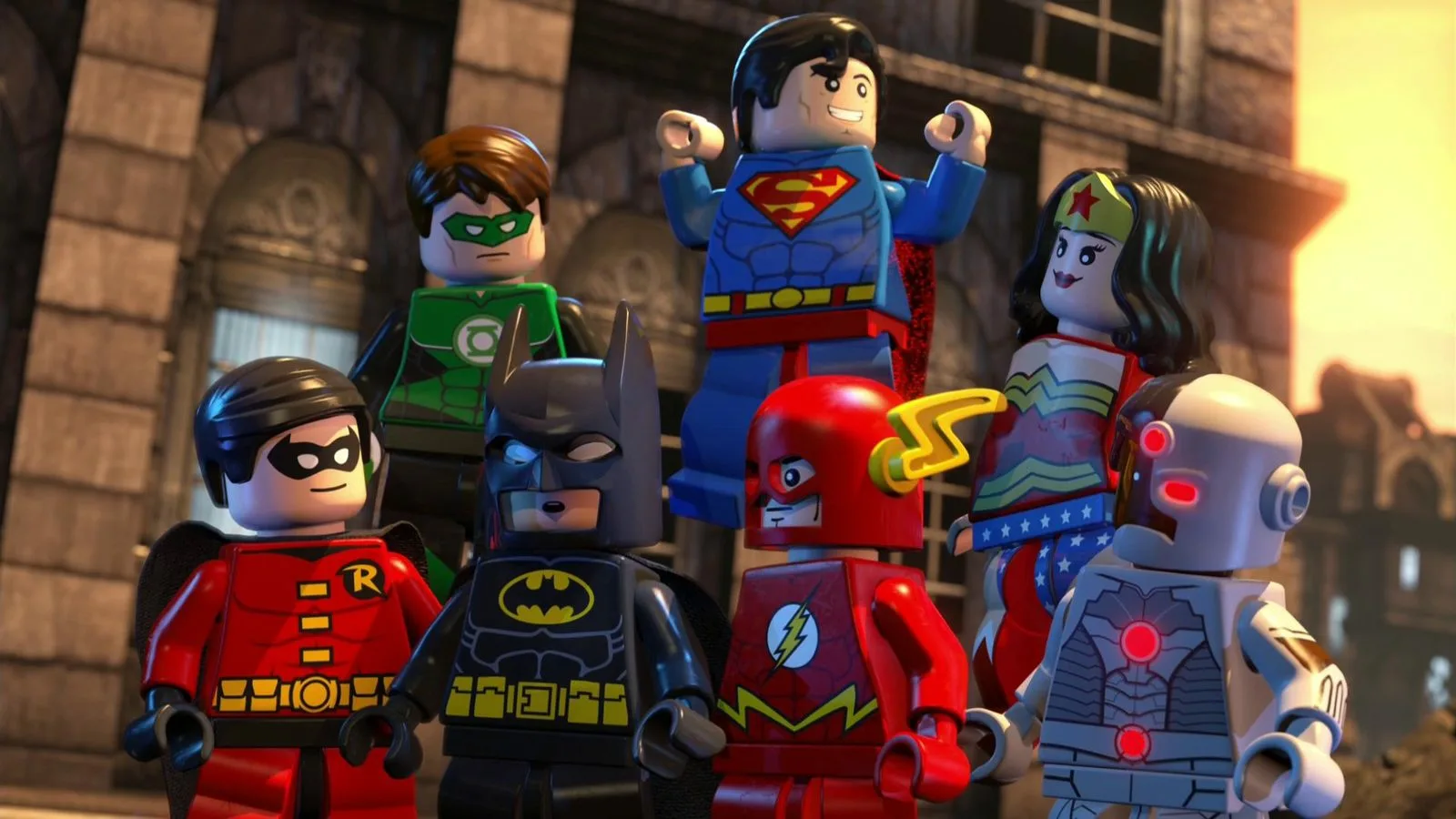
The plot is deliberately straightforward: Joker and Luthor join forces, deploy a “Deconstructor” ray that can dismantle LEGO constructions, and threaten to erase Gotham and Metropolis brick by brick. Batman reluctantly accepts help from Superman and the wider Justice League—Cyborg, Green Lantern, Martian Manhunter, Flash, and Wonder Woman—to thwart the scheme. While the runtime limits deep character arcs, the film efficiently establishes the comedic dynamic between Batman’s brooding self-reliance and Superman’s sunny optimism, a relationship that would be explored more extensively in The LEGO Batman Movie (2017) and The LEGO Movie 2 (2019).
Visual Style: Early Adoption of the “Brickfilm” Aesthetic
Cinematographer Jeremy Pardon and visual-effects leads Guy Avery, Tom Litton, and Mike Snowdon (VFX supervisor) leaned into the physicality of LEGO elements. Environments are built from recognizable bricks, vehicles disassemble and reassemble in real time, and character animations retain the slight stiffness of minifigure articulation—choices that charm rather than distract. The 720p trailer released in October 2012 showcased this aesthetic months before launch, signaling confidence in a look that differentiated the project from both traditional 2D DC animated films and the CGI polish of mainstream theatrical fare.
Global Rollout and Certification
The film enjoyed a coordinated international release throughout mid-2013: May 21 in the US (G-rated), Brazil, Spain, and the UK (PG); June 4 in Denmark (7+); June 5 in Sweden (DVD/Blu-ray); December 6 in Germany (6+); and later bows in France (U, March 2016), Hungary (12, May 2014), and Japan (PG12, November 2014). This staggered strategy maximized shelf life in physical media markets while building awareness for the LEGO DC brand ahead of subsequent specials and the 2014 theatrical feature The LEGO Movie.
Critical Reception and Legacy
On IMDb the title holds a 6.5/10 average from over 300 user ratings—a solid score for a direct-to-video family release. Critics at the time praised the voice performances and the faithful yet irreverent treatment of DC lore, though some noted the brisk runtime left little room for emotional stakes. Fast-forward to August 2026, and a new retrospective review by Anupama Chopra for The Hollywood Reporter India has reignited conversation around the film, prompting streaming platforms to feature it prominently in “LEGO DC Origins” collections. While the specifics of Chopra’s critique remain under embargo at press time, industry observers note that revisiting early franchise entries has become a staple of anniversary-year programming, and this title—often overshadowed by its theatrical successors—benefits from renewed curatorial attention.
Why It Still Matters in 2026
Thirteen years on, LEGO Batman: The Movie – DC Super Heroes Unite functions as a time capsule of pre-LEGO Movie animation: ambitious within its constraints, unafraid to mix deep-cut characters (Brainiac, Martian Manhunter) with household names, and confident enough to let humor drive the narrative engine. For collectors, the film’s inclusion in the “LEGO DC Comics Super Heroes Collection” bundle—alongside later specials like LEGO Justice League: Attack of the Legion of Doom and LEGO Batman: Be-Leaguered—makes it a mandatory shelf item. For newcomers, it offers a low-stakes entry point into the DC multiverse that requires zero prior continuity knowledge.
Where to Watch
As of publication, the film is available for purchase or rental on major digital storefronts (Apple TV, Amazon Prime Video, Vudu, Google Play) and streams on Max in the US as part of the “LEGO DC” hub. Physical Blu-ray editions—often bundled with a minifigure—remain in print via Warner Archive and can be sourced from specialty retailers.
Final Verdict
LEGO Batman: The Movie – DC Super Heroes Unite may lack the meta-narrative sophistication of its theatrical cousins, but its earnest charm, top-tier voice work, and foundational role in a billion-dollar franchise make it essential viewing for animation historians and DC fans alike. As the latest critical wave demonstrates, sometimes the smallest bricks build the most enduring legacies.