Marvel’s Most Iconic Villain Team Made Their First and Only Appearance For Decades in This Iconic Issue
I’ve written before about just how remarkable the original Lee-Ditko Amazing Spider-Man run is. Reading those early issues, it’s spectacular just how many of Spider-Man’s most famed foes debuted in just the first year of the title – enough so that for 1964’s Amazing Spider-Man Annual #1, Lee and Ditko teamed a half-dozen of them together against the wallcrawler. The so-called “Sinister Six” (there is little Stan Lee loves more than some alliteration), consisting of leader Doctor Octopus along with Vulture, Sandman, Electro, Mysterio, and Kraven the Hunter. For several of them, the annual was only the second-ever issue they appeared in – Kraven had debuted just two months prior in the pages of Amazing Spider-Man #15. Although memorable enough to be reprinted just five years later as Amazing Spider-Man Annual #6 and iconic enough to appear in live-action film, television, and video games, Amazing Spider-Man Annual #1 was the only story this team appeared in for almost three decades of Spider-Man comics.
Early nineties comics storylines “Return of the Sinister Six” and “Revenge of the Sinister Six” would help repopularize the team, though it was their appearances in Spider-Man: The Animated Series that truly turned the villain group from a silver age curiosity into an iconic part of the world of Spider-Man. When Spider-Man: No Way Home came closer than any film before to finally bringing the team to live-action and the big screen, the issue’s popularity with comic books fans and speculators alike exploded. At the height of the early-2020s speculative boom, high-grade copies were worth $5-10k to well-heeled collectors, especially hot off of Spider-Man: No Way Home’s release. Though the market has cooled off in the intervening years, a high-grade copy is still worth thousands, evidenced by the already $1.9k bidding price attained by a CGC (Certified Guarantee Company)-graded 7.0 copy on auction next week through Heritage.
How the Sinister Six Formed (& Why It Took So Long For Them to Re-Form)

Even in 1964, Doctor Octopus had already cemented himself as Spider-Man’s arch-foe. Debuting in Amazing Spider-Man #3, the villain had already returned to menace the web-slinger twice, in issues #11-12. Just six real-world months after the culmination of that two-part altercation – which saw Spider-Man unmasked for the first time – Doc Ock was already plotting his revenge. He hits upon the plan of teaming several of Spider-Man’s greatest foes to accomplish together what none were powerful enough to do alone: destroy Spider-Man. And then, in his most masterful stroke of genius, after assembling his “Sinister Six,” Ock sends them each to … battle Spider-Man individually? Yes, despite the cover, Spider-Man does not at any point in Amazing Spider-Man Annual #1 fight all six villains at once. Instead, he is made to run a gauntlet, battling each of them individually. Using Betty Brant and Aunt May as bait to lure Spider-Man into combat, Doc Ock reasons that “each one of us will weaken him a little bit more, so his chances will grow slimmer after each battle!”
The choice of hostages is largely coincidental. Because of a previous encounter, Doc Ock knows there is some relationship between Betty and Spider-Man (who Peter Parker was dating at the time in his civilian identity), but Aunt May just happens to be in the wrong place at the wrong time: she’s with Betty when she’s abducted, and is taken as a second hostage out of necessity. Spider-Man soundly defeats each of Doc Ock’s five recruits with an epic splash page from Ditko showing Spider-Man locked in battle with each, then confronts Doctor Octopus. On defeating the master planner, even Spidey feels compelled to remark on how silly of a plan this was: “if you each hadn’t been so anxious to get the credit for beating me alone, and teamed up against me, you might have had a chance!” This must have stuck in writer Dave Michelinie’s head, as twenty-six years later, that was just what the Sinister Six did.
Replacing the recently-deceased Kraven with Hobgoblin, the Sinister Six reformed in Amazing Spider-Man #334 to battle Spider-Man once again, and readers were finally treated to six-on-one combat between Spider-Man and his foes. The six-part story delivered some of the coolest Spider-Man battles of the nineties, though none topped the final confrontation between Spider-Man and the Sinister Six – minus one member. At this point in Marvel continuity, Sandman was a hero, serving as a full member of Silver Sable’s “Outlaws” (a team built out of reformed Spider-Man rogues) and even a reserve Avenger. Infiltrating the Sinister Six, Sandman betrayed them in their final confrontation with Spider-Man. The Sinister Six’s reformation, however, was just a ruse on the part of Doctor Octopus, who used them to distract Spider-Man from his true, Bond villain-esque plan to make cocaine toxic and then sell a cure.
The Sinister Six reformed a third time under the leadership of Hobgoblin to take revenge – but not against Spider-Man. They seek revenge against Doc Ock for duping them, though Ock defeats his former teammates and forces them to serve him. As Doc Ock was no longer an official member, the monster alien Gog (introduced in Amazing Spider-Man #103) becomes the team’s sixth. In this incarnation, Spider-Man assembled a very-nienties team of his own – consisting of Ghost Rider, Deathlok, Nova, Solo, and the Hulk – to defeat the villains. These two storylines, which ran across twelve issues, cemented the Sinister Six’s place in Spider-Man comics, with their inevitable return serving as a recurring source of multi-issue event storylines. Though their appearances became more regular in the 2000s and 2010s, writers have showed impressive restraint in not overusing the team, and it still feels like an event when they appear.
Why the Most Iconic Version of the Team Isn’t Even Technically the Sinister Six
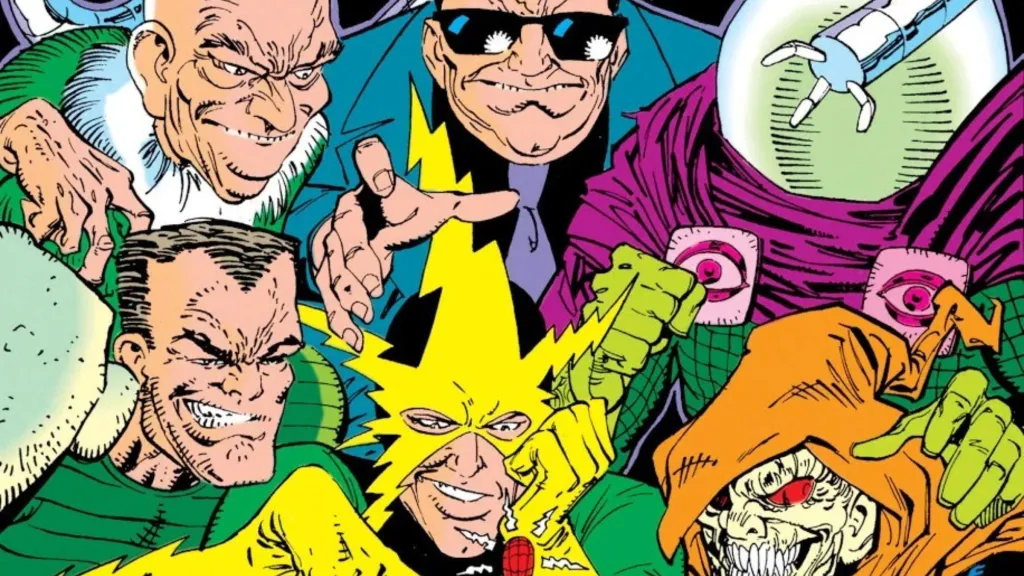
For whatever reason, the censors at the Fox Kids Network felt the word “Sinister” was inappropriate for children, necessitating that the version of the team appearing in Spider-Man: The Animated Series was instead referred to as the “Insidious Six.” The “Insidious Six” made numerous appearances on the series, which, like X-Men: The Animated Series and Batman: The Animated Series, did a lot to shape pop cultural perceptions of their title characters. Combined with the inherent appeal of the concept of a grand super-villain team-up, the Sinister Six became a true fan favorite because of their newfound exposure. In 1992, “Return of the Sinister Six” was even the basis for a Spider-Man arcade game. Prior to the release of 2018’s Spider-Man from Insomniac, one of the aspects of the game that really served to generate interest from fans was when the Sinister Six were confirmed to make an appearance. Sony even had plans for a Sinister Six film in their ill-fated Spider-Man Cinematic Universe, teased in a post-credits scene for The Amazing Spider-Man 2.
The biggest tease would come from Spider-Man: No Way Home, which came close to delivering a live-action Sinister Six with its five multiversal villains. Seeing these five together only whetted fans’ appetite for a proper Sinister Six, especially as Spider-Man’s live-action rogues’ gallery grows. The popularity of the films has served to super-charge the collectibility of the comics, already the most coveted of Marvel’s silver age titles. Even ungraded, fans can expect to pay hundreds for a copy of Amazing Spider-Man Annual #1, and high-grade samples seldom go for less than $1.5k. Finding a copy in high grade is more difficult than many other issues because of the mostly-white cover, which shows off virtually any defect or flaw the comic has picked up in its sixty-two years life. High-grade copies are prized, and the $1.9k price for this one (at time of writing) indicates it could sell for well-above $2k – a higher than average result.