$112,000 Just Bought a Collector a Key Piece That Helped Create Jurassic Park’s Greatest Scene
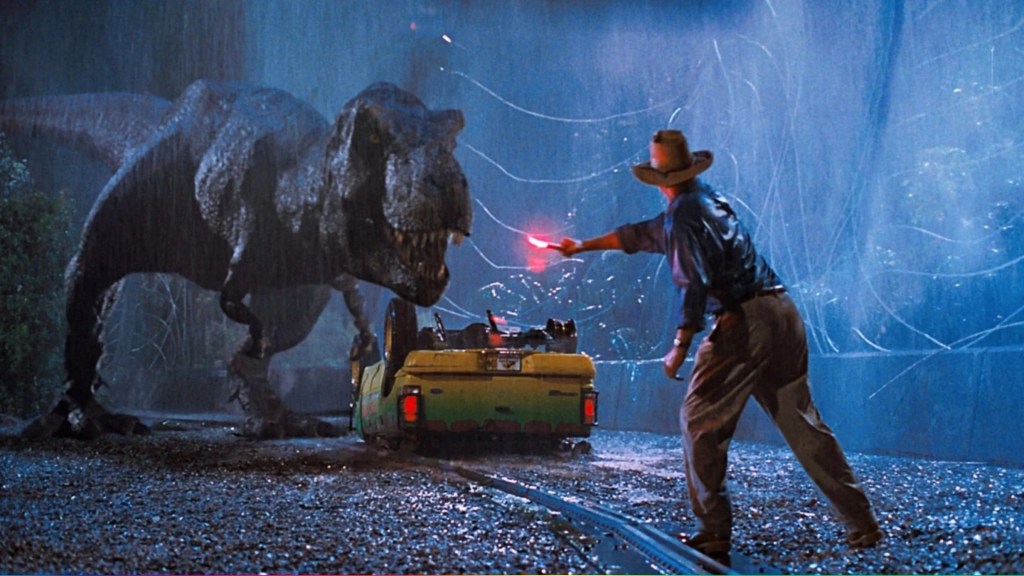
Long before Jurassic Park‘s “Rexy” appeared on-screen as one of the most convincing dinosaurs ever, it was a stop-motion creation of movie master Phil Tippett. Now the articulated T. rex armature that was responsible for visualising the iconic Tyrannosaur attack scene in Steven Spielberg’s classic adventure thriller has found a new home after being sold at Heritage Auctions.
Used during the filming of a stop-motion version of the incredible sequence, the metal skeleton seems like an unfinished child’s science project, but is possibly one of the most important pieces of the Jurassic Park franchise when it comes to the impact it had on the movie. That is probably why the piece sold for $112,000, because who wouldn’t want to own a piece of cinema history that comes from the exact period when traditional special effects began to give way to flawless CGI-enhanced visuals.
Why This is One of Cinemas Most Important Items
When Steven Spielberg began developing Jurassic Park, legendary effects artist Tippett, the man behind the AT-AT walkers in The Empire Strikes Back and an Oscar winner for his work on Return of the Jedi, was enlisted to help bring dinosaurs to life like never before. Tippett was hired specifically because of his mastery of go-motion, an advanced form of stop-motion animation he helped pioneer, which avoided the usual jarring movement of stop-motion by adding realistic motion blur to footage. Armatures like the one recently sold were solid metal skeletons that could be posed frame by frame and were an essential tool in the making of Jurassic Park.
While Tippett’s team worked on go-motion, ILM animator Steve Williams had been developing a computer-generated T. rex. When producer Kathleen Kennedy, and soon after Spielberg, saw a short test reel of Williams’s CG dinosaur walking, just a few seconds of footage, the realism of the graphics, combined with some incredible puppetry, was enough to convince them it was the way for the movie to go. For Tippett, seeing the new footage was enough for him to reportedly say to Spielberg, “I’m extinct,” a line that was then incorporated into the movie, spoken by Sam Neill’s Alan Grant.
Despite his sequences being cut from the final movie, Tippett himself was kept on the production as “dinosaur supervisor.” Bringing prehistoric beasts to life needed someone who understood how the creatures of the past moved. Tippett and his collaborators, including designer Craig Hayes, built what became known as the Dinosaur Input Device, essentially a sensor-rigged armature that let an animator physically pose a model the traditional way, with the movements then being captured by the computer to be animated. This is the model that was recently sold, and with such a story behind it, there is perhaps little surprise it drew a lot of interest and an impressive final sale price.
While stop-motion had continued to appear in some notable movies and TV shows over the last three decades, the stunning dinosaurs of Jurassic Park were partly responsible for ending the old technique’s run as Hollywood’s go-to method for creature creation.
The result of that collaboration between old craft and new technology is now the stuff of film legend. Jurassic Park’s CG dinosaurs stunned audiences on release in 1993 and effectively ended the era of stop-motion as Hollywood’s default tool for bringing creatures to life. Tippett went on to win an Oscar for his work on the movie, and his creative input alongside the work of Stan Winston and his team ensured that Jurassic Park remains one of the most impressive movies of all time.
For collectors, an object like this armature offers something rarer than a costume or a hero prop. It is a piece that shows the changing methods and processes of the moviemaking industry as it headed into a digital age that has now completely changed the way films are made. The T. rex armature ended up selling for more than $60,000 over its low estimate, which is a sign of just how valuable physical reminders of the old filmmaking processes can be.