

What removal of mandatory ‘spiral progression’ means for K to 12 program
MANILA, Philippines – After over a decade of implementation, Republic Act No. 10533 or the Enhanced Basic Education Act of 2013, which institutionalized the K to 12 program, was amended in a bid to improve the quality of learning in the country.
Republic Act (RA) No. 12322 removed the mandatory use of a “spiral progression” approach in implementing the curriculum. It lapsed into law on August 2, and was publicized on the Official Gazette website on August 5.
Section 5 of the K to 12 law now provides: “The curriculum shall employ the approach deemed most effective by the DepEd (Department of Education) to ensure mastery of knowledge and skills after each level.”
It also said that the curriculum and approach will be subjected to review at least once every five years.
The amendment came nearly two years since the discontinuation of the use of mother tongue as the language of instruction from kindergarten to Grade 3, a specific provision of the K to 12 law. The discontinuation was through RA 12027, which lapsed into law in October 2024.
What is spiral progression?
Spiral progression is a curriculum approach where the concepts taught are revisited with increasing depth and complexity as students progress through their schooling.
Let’s take for example how science is taught in basic education.
Before the K to 12 program, each level in high school focused only on a single discipline (general science for freshmen, biology for sophomores, chemistry for juniors, and physics for seniors). This is called a discipline-based approach.
But under the K to 12 program’s spiral progression, Grade 7 to 10 learners or junior high school students study all of these disciplines in one academic year, with the lessons becoming more complex at each grade level.
During a Senate basic education committee hearing in January, Education Undersecretary Carmela Oracion said spiral progression is a “sound, research-based curriculum principle.”
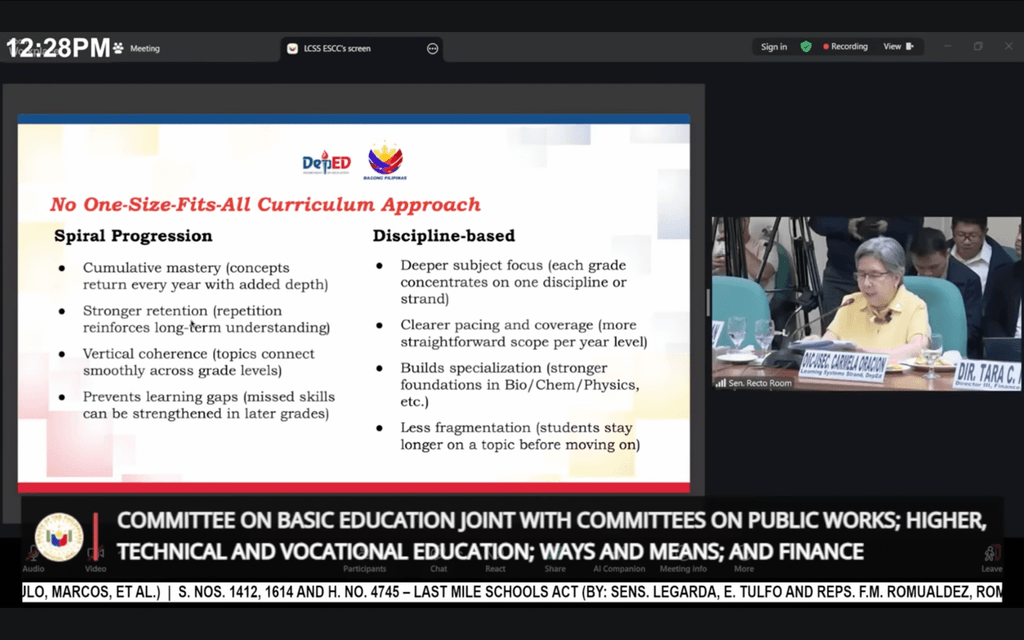
She said one of the advantages of the approach is cumulative mastery, as concepts return every school year with added depth.
Other advantages include stronger retention of lessons, smooth connection of topics across grade levels, and the prevention of learning gaps as missed skills can be learned in later levels.
But Oracion, who was also a math teacher, acknowledged that spiral progression may not be suitable for some subjects. During the Senate committee hearing, she specifically said a discipline-based curriculum may be more suitable for mathematics and science in high school.
The DepEd official explained that a discipline-based approach may provide a deeper subject focus as well as clearer pacing and coverage with its straightforward scope per grade level. It could also build specialization for learners as they stay longer on a topic before moving on to the next.
The Philippine experience
In 2023, the Second Congressional Commission on Education (EDCOM 2) flagged that teachers were challenged by spiral progression and were concerned about repetitive lessons throughout the curriculum.
In its research, EDCOM 2 found studies as early as 2014 saying that teachers criticized the lack of depth and concentration for each science discipline under the K to 12 program’s spiral progression approach.
According to the commission, the approach “conflicts with the preservice training of teachers, in which they specialize in one discipline only.”
There is also another finding that six out of 10 high school teachers handle subjects they “did not major in college”.
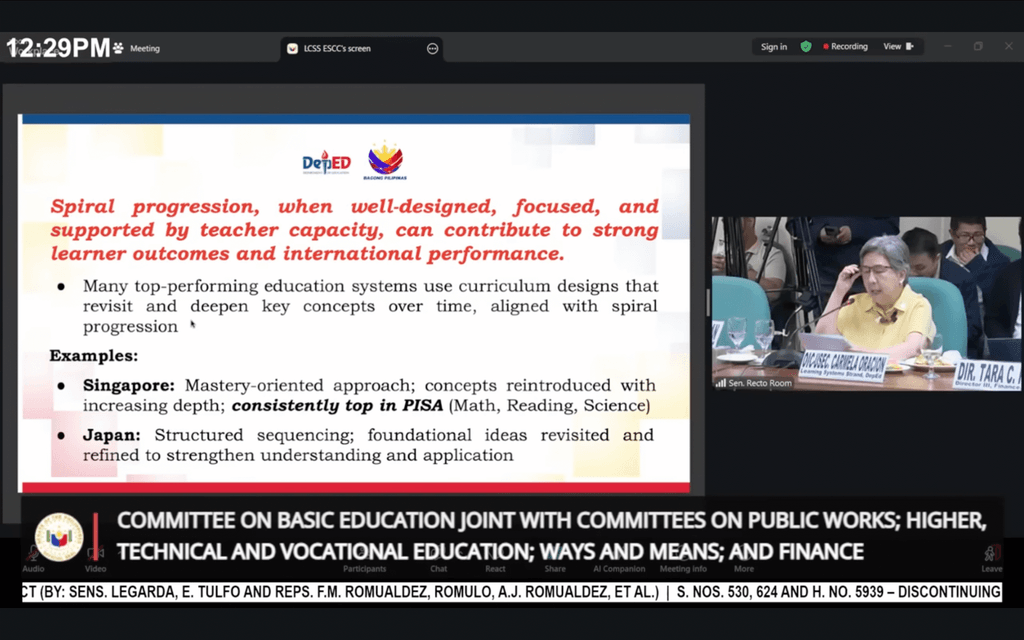
“We see that when the spiral progression is well-designed, focused, and supported by teacher capacity — which we may not have yet at a very good state in the country — this can contribute to strong learner outcomes and international performance,” Oracion told the Senate basic education committee in January.
“And maybe that’s the reason why the spiral progression approach even in secondary school mathematics and science is working very well in Singapore and Japan,” she said.
Singapore consistently tops the Programme for International Student Assessment or PISA rankings, while the Philippines is still among the countries with poor proficiency in reading, mathematics, and science for young learners.
Welcoming flexibility
The amendment has granted the DepEd freedom from a “one-size-fits-all” approach, bringing back flexibility in determining the teaching methods suited for every class.
The DepEd said it allows science and mathematics teachers to “adopt mastery-based learning or alternative methods, ensuring learners thoroughly understand foundational concepts before advancing.”
The development does not mean teachers are barred from using spiral progression. It does not mean that schools will see immediate curriculum changes either, as implementing rules and regulations still have to be crafted.
The DepEd clarified that any adjustments to instructional delivery “remain subject to thorough review, pedagogical evidence, and practical considerations, including textbook supply and teacher training.”
“This update is about maintaining the flexibility our curriculum experts and field officers need to address learning gaps,” Education Secretary Sonny Angara said. “Our focus remains on stability in our schools and ensuring our teaching strategies directly improve learner outcomes.”
The DepEd said all other curriculum standards under the law “remain intact.”
In 2024, the agency began the phased rollout of the Matatag curriculum, or the revised K to 10 curriculum, lessening the number of learning areas for students to focus on foundational skills.
In 2025, the agency started the Strengthened Senior High School Program to reduce learning tracks and extend work immersion hours, in a bid to address job mismatch after graduation from SHS.
The curriculum approach is just one of the many issues in the country’s education sector, which continues to face budget constraints, school congestion, classroom shortages, insufficient textbooks and other resources, and heavy workload for teachers, among others. – Rappler.com


