Senate court lowers conviction voting threshold in Duterte impeachment trial
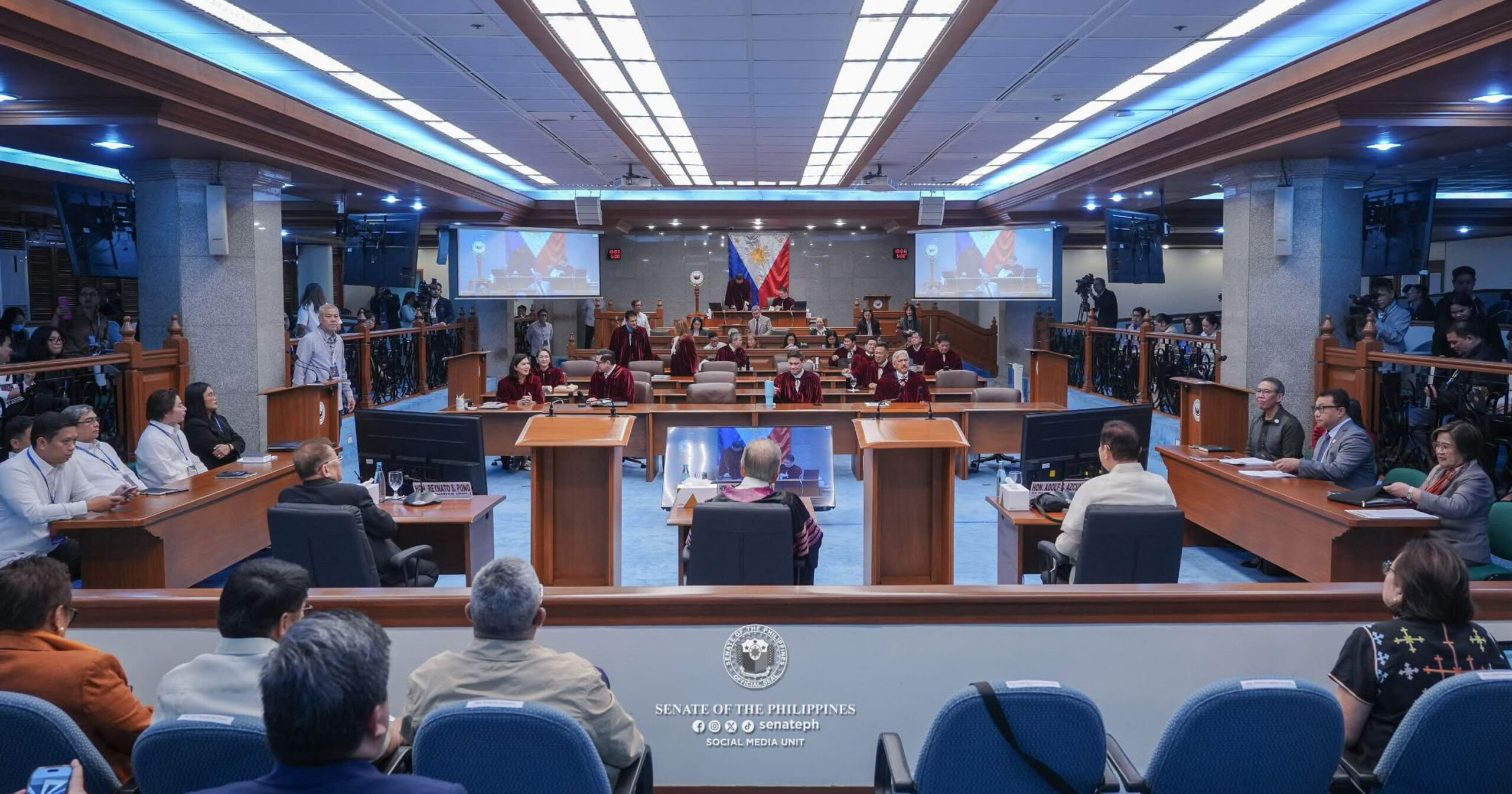
MANILA, Philippines – The Senate impeachment court on Wednesday, September 23, voted to lower the voting threshold for the conviction of Vice President Sara Duterte in her impeachment trial.
With 13 affirmative votes and one negative vote, senator-judges approved the September 8 appeal of Senator-judge Erwin Tulfo seeking to overturn the July 6 ruling of impeachment court Presiding Officer Francis “Chiz” Escudero.

Escudero cast the lone vote against Tulfo’s appeal.
“While the chair takes exception to this decision, the chair nonetheless accepts it as a judgment of this court and is bound to give it effect. The presiding officer, after all, is not the court. He is merely the custodian of the process, not the proprietor of it,” Escudero said.
“This is the tradition that gives the strength and legitimacy to the Senate, whether we sit as a legislative body or as an impeachment court. We allow the fullest ventilation of views, even if those views differ sharply from our own. But at the end of the day, we vote. We abide by the judgment of the majority, even if we disagree with it,” he added.
The approval of the appeal means the impeachment court will no longer use the Senate’s full 24-member membership as the baseline for determining the two-thirds vote needed to convict Duterte.
Instead, the Senate impeachment court will only count senator-judges who are “legally and factually capable” of participating in the proceedings at the time of the vote. This excludes those who are detained, suspended or otherwise restrained from legally exercising their functions; those being sought by authorities whose whereabouts are unknown; those suffering from physical or medical incapacity; those beyond the coercive processes of the Senate; and others similarly situated.
The new computation ruling shall likewise apply pro hac vice, or “for this occasion only” and shall not constitute a binding precedent in any future impeachment proceedings.
“This is a ruling, not an amendment of the rules. As such, it has no binding but merely persuasive effect on future impeachment proceedings, the hands of whom we cannot shackle as there is no stare decisis as between impeachment courts,” said Escudero.
Six members of the Senate minority bloc — Senator-judges Alan Peter Cayetano, Pia Cayetano, Robin Padilla, Cynthia Villar, Imee Marcos, and Bong Go — were absent and did not participate in the afternoon proceedings. Prior to the resumption of the trial, Padilla was seen approaching and shaking hands with other majority senators before exiting the Senate plenary hall.
Marcos, in an ambush interview, said they decided not to participate in the voting, reiterating their position that the impeachment court’s interpretation of the voting threshold is unconstitutional.
“We should not interpret the Constitution. Like I said before, I never imagined I will fight for the Constitution, which was said to have been crafted against my father. But this is the law of the land and we need to adhere to it,” Marcos said in a mix of English and Filipino.
Before the court went on a lunch break on Wednesday, senator-judges also rejected a point of order raised by Senator-judge Alan Peter Cayetano, who argued that the Senate impeachment court has no authority to interpret the voting threshold.
The point of order was rejected with 13 votes in favor of proceeding with the issue, six against, and one abstention.
Senator-judge Mark Villar, who (along with his sister Camille, brother Paolo, mother Cynthia, father Manny) has been slapped by the Ombudsman with graft complaints in relation to alleged irregularities involving PrimeWater, abstained from the vote on Cayetano’s point of order. He later voted in favor of lowering the threshold.
“We are raising a point of order of the power of the impeachment court to raise this issue at this time,” Cayetano said.
New guidelines
Following the voting, the Senate impeachment court issued guidelines for the full effect of the new controlling number.
Escudero said the court shall determine on the basis of “competent and sufficient evidence” whether a senator-judge falls within any of the five circumstances mentioned in the exclusions. The remaining members shall then constitute the denominator from which the required two-thirds concurrence shall be computed.
If the computation results in a fraction, Escudero said the number of votes required for conviction shall be rounded to the next highest number even if the fractional number is less than 0.5.
“This shall ensure that no person shall be convicted without the concurrence of two-thirds of all the members of the Senate, as determined by the court in this new controlling ruling and as required under Article 11, Section 3,” he added.
Tulfo appeal
To recall, Tulfo had sought to reverse Escudero’s July 6 decision and revisit the voting threshold for Duterte’s conviction amid the prolonged absence of four senator-judges — Loren Legarda, Ronald “Bato” dela Rosa, Rodante Marcoleta, and Jinggoy Estrada.
Legarda remains on extended medical leave abroad, while Dela Rosa is in hiding due to an arrest warrant issued by the International Criminal Court (ICC) over alleged crimes against humanity stemming from the Duterte administration’s drug war.
Marcoleta and Estrada are detained over separate plunder charges.
To guide the court in its decision, Escudero had invited four retired Supreme Court justices last week to serve as amici curiae, or “friends of the court,” and provide their legal views on the issue.
Retired Chief Justices Reynato Puno, Hilario Davide Jr., and Artemio Panganiban took the position that the number of votes needed to remove an impeached official is not fixed at 16, while retired associate justice Adolfo Azcuna maintained that the voting basis should be anchored on the entire membership (24) of the Senate.
“The framers of the Constitution of 1935, 1973, and 1986 would never have intended to include in ‘all members’… those who cannot participate in the hearings and deliberations on the impeachment, such as those outside the jurisdiction of the Philippines, or whose whereabouts are unknown or are in hiding to avoid arrest,” Davide stated in a written position read by the Senate secretary on September 16.
Puno and Panganiban shared Davide’s view, while Azcuna maintained that the voting threshold should remain at 16.
Under Article XI, Section 3(6) of the 1987 Constitution, the Senate has the sole power to try and decide impeachment cases. Conviction requires the concurrence of two-thirds of all the members of the Senate. – Rappler.com