After 60 Years, Star Trek: Strange New Worlds Officially Rewrites the Rules of Time Travel
We thought we knew what Star Trek: Strange New Worlds Season 4’s opening episode was about. Titled “Valles Marineris,” the premiere had been accompanied by shots showing Captain Pike horse-riding across red dust. All this meant we expected a deep, character-centric episode in which Pike wrestled with the emotional impact of everything he went through in the previous season. What we got, though, was something completely different.
The tone was set early on, when we got yet another amusing Doctor Who Easter egg; Pelia simply can’t resist remembering her time traveling in a police box. From there, we dove into a joyful time travel story that changed all the rules for the Star Trek franchise. We learned the true history of Mars, the reason the dinosaurs went extinct, and even got a terrifying new alien threat that could have destroyed the Federation before it even began.
Star Trek: Strange New Worlds Season 4 Reveals the Solar System’s Secret History
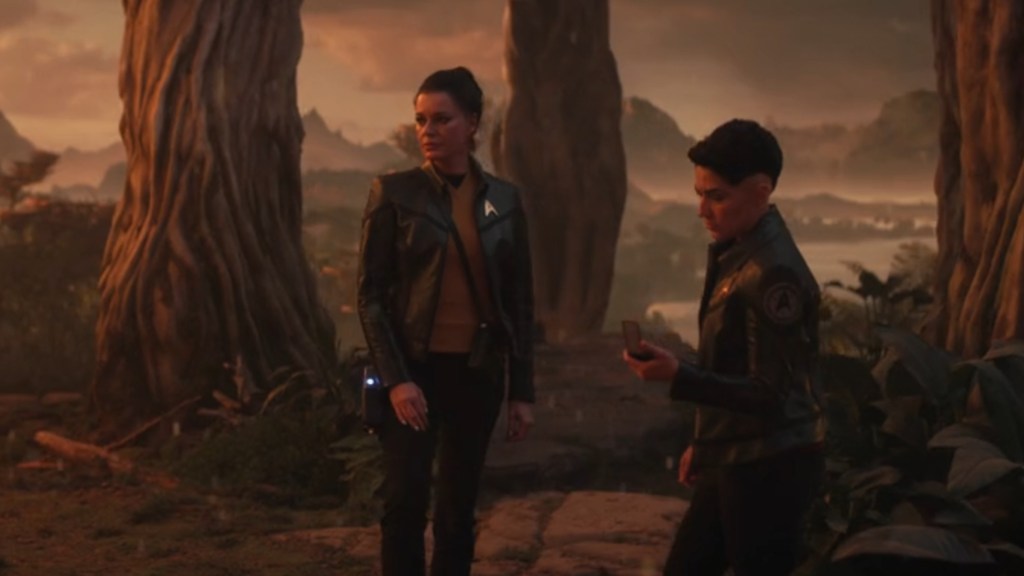
Let’s start with the basics: the USS Enterprise investigates a category ten interstellar squall, described as “space-time gone wild.” Responding to an unexpected buoy, the starship is transported back to the solar system 65 million years ago, in the age of the dinosaurs. Time travel has always been big in Star Trek, and we’ve known the rules since the Guardian of Forever; if you change the past, you rewrite the present. 65 million years ago, the Enterprise crew have no way of knowing what the consequences of their actions could be. They’re even nervous about killing the wrong dinosaur.
But here’s where things get really fun; the Sol system of 65 million years ago is unlike anything the Enterprise crew expected. There are three M-class planets, not just the one; Mars and a fifth planet (which would become the asteroid belt) are both inhabitable. In fact, the Martians and the aliens from the fifth planet – the Dol’drm – are locked in a war of mutual extermination. Pike’s discussions with Martian Battle Commander Cassell are chilling; as much as Pike tries to hold back Federation technology, he introduces ideas and philosophies that could theoretically rewrite history far more dramatically.
It’s quite fascinating; “Valles Marineris” tackles the inconsistency of the Prime Directive in the best possible way, because the Enterprise crew don’t even question Pike’s discussion of Federation philosophy. As much as they want to protect their own time, they also can’t help themselves wanting to do good, and they toy with trying to rewrite the end of the Martian-Dol’drm war. There’s something quite beautiful about the Enterprise crew’s initial reluctance to leave history alone, and it shines a light on the Federation at its best: do good, no matter the risks.
Star Trek Reveals a Paradox at the Heart of Human History

In the end, though, “Valles Marineris” reveals human history – and, indeed, the history of the entire solar system – is basically a time paradox. Cassell does exactly what she was destined to do; she steals antimatter from the Enterprise, using it to destroy the fifth planet. This creates the asteroid belt as we know it, and shifts Mars’ orbit to make that world uninhabitable too; the Martians fled. Meanwhile, a fragment from the Dol’drm planet is actually the Chicxulub asteroid that wiped out the dinosaurs. Had the Enterprise not been there, humanity would never have evolved.
This is a very different model of time travel to the one we see with the Guardian of Forever. This time, there is an outright paradox; humanity’s own evolution made its very existence possible. In fact, the Enterprise entered the interstellar squall because it was responding to a buoy it had actually dropped while back in the past, 65 million years ago. The whole thing is wonderfully paradoxical, and it makes for a weighty discussion of destiny and fate. It’s a conversation Captain Pike is uniquely suited to, given his own preoccupation with these ideas.
And yet, as powerful as these concepts may be, Strange New Worlds‘ Season 4 premiere will really be remembered for one thing: its sense of wonder. This episode plays with some of the most complex, sophisticated ideas in time travel fiction, but it consistently stops to celebrate the splendor of simply giving people a chance to see dinosaurs. In doing so, it reminds us of the deeper rule of Star Trek, one more important than any temporal mechanics – that this should be a series about exploration, steeped in joy and wonder. As such, regardless of the rules, this is one of the best time travel stories I’ve seen in Star Trek.
What do you think? Leave a comment below and join the conversation now in the ComicBook Forum!