amnesty international condemns
|

Amnesty international condemns violence against youth in India


Global human rights organization Amnesty International has strongly condemned the use of force against young people in India, expressing serious concern over reports of violence during recent demonstrations. The organization has urged Indian authorities, particularly the police, to immediately stop using excessive force against peaceful protesters and to uphold the fundamental rights guaranteed under international human rights law.

In a statement, Amnesty International said it was deeply concerned about the suppression of peaceful dissent in India. According to the organization, young demonstrators exercising their right to express their opinions were met with unnecessary and excessive force by law enforcement agencies. Amnesty stressed that the right to peaceful assembly and freedom of expression are essential democratic freedoms that must be protected, not restricted.

The human rights group further stated that authorities imposed several measures to prevent protesters from reaching the Parliament House, where many intended to demonstrate peacefully. Barricades were reportedly erected across key routes leading to the area, limiting public movement and restricting access to the protest site. Such actions, Amnesty argued, hindered citizens’ ability to exercise their democratic rights and raised concerns about the government’s handling of peaceful public gatherings.

Amnesty International also criticized the suspension of public services during the protests. According to the organization, metro services were disrupted and mobile internet access was temporarily shut down in several areas. The group noted that internet shutdowns and transport restrictions not only affect demonstrators but also disrupt the daily lives of ordinary citizens, limiting communication, access to information, and emergency services. Amnesty has repeatedly argued that blanket internet restrictions are inconsistent with international human rights standards and should only be used under exceptional and legally justified circumstances.

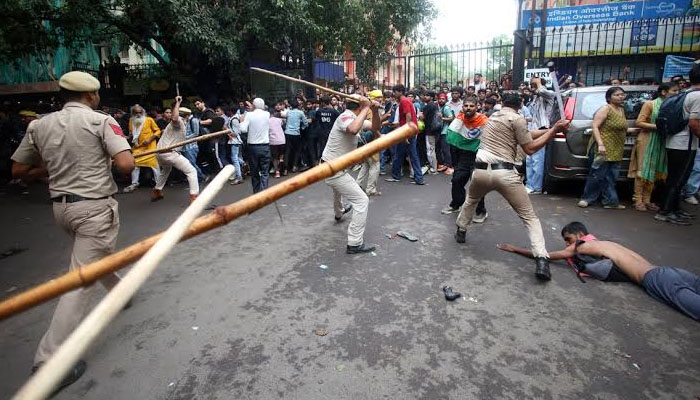
The organization emphasized that the use of batons (lathi charge), tear gas shelling, and other crowd-control measures should always comply with the principles of necessity, legality, and proportionality. It maintained that law enforcement officials should prioritize dialogue and de-escalation over the use of force, especially when dealing with peaceful assemblies.


Amnesty International has called on the Indian government to conduct an immediate, independent, and impartial investigation into allegations of excessive police force, including reports of baton charges and shelling against protesters. The organization said that any officials found responsible for violating human rights should be held accountable through transparent legal processes.

The human rights body reiterated that governments have a responsibility to protect the rights of all citizens, including young people who participate in peaceful demonstrations. It urged Indian authorities to respect freedom of expression, freedom of assembly, and access to information while ensuring that policing practices remain consistent with international human rights obligations.

Amnesty International concluded by emphasizing that safeguarding democratic freedoms is essential for maintaining public trust and strengthening the rule of law. The organization called on Indian authorities to take immediate steps to protect the rights of peaceful protesters, ensure accountability for any abuses, and prevent similar incidents from occurring in the future.


Similar Posts

  • |

    Trump’s generic drug tariff plan puts US-India pharma ties to test

    A newly announced tariff schedule introduced by President Donald Trump targeting generic pharmaceutical imports is expected to significantly affect the deep trade relationship between the United States and India, which serves as the principal supplier of generic medicines to the American market. Indian drug manufacturers currently supply roughly half of all generic pharmaceuticals consumed in the United States, with the American market generating close to a third of India’s overall pharmaceutical export earnings. The scale of this commercial exposure means the newly outlined tariff timeline, despite featuring a two-year grace period, has immediately drawn close scrutiny from Indian pharmaceutical firms and market analysts due to the critical role US sales play in corporate revenues. The policy introduces additional uncertainty to a bilateral trade dynamic already strained by recent tariff disputes, raising the stakes for Indian manufacturers as they decide whether to commit capital toward expanding domestic manufacturing inside the United States or absorb steep import duties in the future. Trump outlined a phased tariff framework for generic medications entering the United States. Under this timeline, generic drug imports will continue to enter duty-free under a zero per cent tariff until August 1, 2028, marking a two-year transition window from the policy’s effective date. Following this grace period, a 100 per cent tariff will apply for one year, after which the import levy will rise to 200 per cent. Trump framed the escalated duties as a penal mechanism designed to compel foreign pharmaceutical companies to construct manufacturing facilities on American soil within the allotted timeframe, rather than remaining reliant on overseas production plants. He explicitly distinguished this new generic drug framework from the administration’s policy on branded and patented pharmaceuticals, stating that existing regulations for branded drugs would remain unchanged due to their ongoing success. Reports citing White House details indicate that the new generic tariffs will be executed under Section 232 trade authority, matching the legal foundation used for the administration’s earlier tariffs placed on branded pharmaceuticals in April. Trump also highlighted what he described as an unprecedented surge in new domestic pharmaceutical plant construction currently underway across the United States, presenting the new tariff schedule as a measure to reinforce an existing shift toward onshore manufacturing. The policy holds major implications for the broader American healthcare system and global exporters because generic medications account for nearly 90 per cent of all prescriptions filled in the United States. This action follows previous interventions in the pharmaceutical sector, including the 100 per cent tariff placed on branded drugs starting in October 2025, alongside a most-favoured-nation pricing push. That pricing policy led more than a dozen major pharmaceutical corporations, including Pfizer, Eli Lilly, and Novo Nordisk, to conclude agreements to reduce US drug prices in exchange for multi-year exemptions from import duties. For Indian drugmakers, the two-year transition window provides initial breathing room but lacks long-term security. Indian generic manufacturers now face the choice of allocating capital to construct or expand production facilities within the United States before the 2028 deadline, or facing severe cost disadvantages once the punitive tariffs take effect. Industry analysts expect to monitor whether major Indian drug companies will announce accelerated manufacturing investments in the United States over the coming months as the sector formulates its response.

  • | |

    Katy Perry slams Trump administration over ‘Fire…

    WASHINGTON: Pop star Katy Perry has sharply criticized the Trump administration after the White House used her hit song “Firework” in a social media video showing US military strikes on Iran, saying the use of her music was completely contrary to the message behind the song. The White House’s official TikTok account shared a video on Thursday featuring footage related to US attacks on Iran. The clip used the familiar “boom, boom, boom” lyrics from Perry’s 2010 hit alongside images of military strikes. The post carried a blunt warning directed at Iran, adding a strikingly confrontational tone to a song that Perry has long described as being about hope, confidence and personal strength. Perry responded on social media on Saturday, making clear that she had not authorized the use of the song and did not support the way it had been presented. “I’m deeply shocked and angry,” Perry said in her statement, objecting to the song’s appearance alongside images of destruction and military action. She emphasized that no permission had been sought from her for the video and that she did not endorse its message. For Perry, the controversy goes beyond the question of whether her music was used without authorization. She argued that the video fundamentally changed the meaning of a song intended to encourage people facing difficult moments. “Firework,” released in 2010, became one of Perry’s biggest international hits. Its message centers on self-belief, resilience and finding inner strength during challenging periods. The song has also become closely associated with celebrations and inspirational moments. That made its use in a military video particularly jarring for the singer. Perry said her music was created to bring people together rather than celebrate war, arguing that pairing an uplifting song with images of destruction undermined its original purpose. The dispute comes as tensions between Washington and Tehran remain extremely high, with military action and threats dominating international headlines. The White House has not been reported as having received Perry’s approval for the video, while her comments have reignited a wider debate over the use of popular music in political and military messaging. The incident also highlights the complicated relationship between artists and governments when copyrighted music is used in political communications. Musicians have repeatedly objected when their songs appear in campaigns or political videos without their consent. For Perry, however, the central issue appears to be the message. A song written to tell people to find their light in dark times was suddenly placed against scenes of war — a contrast she clearly believes turns its meaning upside down.

  • | | |

    Europe to witness rare total solar eclipse today

    A total solar eclipse is set to occur today, offering skywatchers across parts of Europe an opportunity to witness a rare astronomical phenomenon, according to Arab media reports. The eclipse is being described as the first total solar eclipse visible from Europe since 1999. The event will be particularly prominent in western Spain and Iceland, where observers will have the chance to see the Moon completely cover the Sun for a brief period. The total phase is expected to begin at around 6:27pm local time in the areas where the eclipse will be visible. Near Iceland, the period of totality is expected to last approximately two minutes and 18 seconds, making it one of the key locations for viewing the phenomenon. However, the eclipse will not be limited to areas experiencing totality. Several major European cities are expected to witness a significant partial eclipse. In Madrid and Barcelona, around 99% of the Sun’s disc will be obscured, while Paris is expected to experience approximately 92% coverage. London will see about 91% of the Sun covered, while Berlin is expected to experience an eclipse of around 85%. The exact appearance and timing of the eclipse will vary depending on the location of observers. Parts of Africa, Canada and the United States are also expected to witness the eclipse in its partial form, although the degree of visibility will differ from one region to another. Eclipse not visible in Pakistan Pakistanis will not be able to observe the solar eclipse, as the astronomical event will take place outside the country’s visible path. The Pakistan Meteorological Department (PMD) has said that the eclipse will begin at approximately 8:34pm Pakistan Standard Time. It is expected to reach its maximum phase at around 10:46pm before ending at approximately 12:58am. Since the entire event will occur during nighttime in Pakistan, the eclipse will remain below the horizon and therefore cannot be seen from the country. The Meteorological Department has also indicated that another major astronomical event is expected later this month. A partial lunar eclipse is scheduled for August 28, but this event, too, will not be visible from Pakistan. Solar eclipses occur when the Moon passes between the Earth and the Sun and temporarily blocks some or all of the Sun’s light from reaching certain parts of the Earth. A total solar eclipse occurs when the Moon completely covers the visible disc of the Sun for observers located within the narrow path of totality.

  • | |

    Iran vows to withstand sweeping new US sanctions

    TEHRAN: Iran has said it is fully prepared to deal with the latest expansion of US economic sanctions, as Washington launches what it describes as a major campaign to cut Tehran off from international financial and trade networks. Iranian Economy Minister Ali Madanizadeh said the government had anticipated the new measures and prepared a long-term strategy to limit their impact. He said Tehran had its own economic tools and expected to continue commercial relations with countries willing to trade with Iran. The remarks came after US Treasury Secretary Scott Bessent announced a broad package of sanctions targeting Iran’s financial connections and revenue sources. Washington said the measures were designed to put further pressure on Tehran and force it to choose between greater international isolation and a return to normal economic relations. Bessent described the campaign as an unprecedented financial offensive against Iran. He said the United States would target networks and channels allegedly used by Tehran to generate revenue and bypass existing sanctions. The new measures cover several sectors, including digital assets, technology, gold, aviation and shipping. The US Treasury also announced sanctions against dozens of entities, individuals and vessels allegedly connected to Iran’s economic activities. Washington warned governments, banks and businesses that continue dealing with Iran that they could also face consequences. Bessent said the administration would move quickly against entities that continued to support Tehran’s financial networks. Iran, however, rejected the pressure campaign and said it expected to maintain economic relations with key trading partners. China has also criticised the latest US measures, describing unilateral sanctions as illegitimate. Beijing said economic pressure would not resolve disputes and stressed that it would protect its own economic interests. China is particularly important to Iran because it remains a major buyer of Iranian oil. Analysts say the effectiveness of the latest sanctions will depend heavily on whether countries such as China enforce Washington’s restrictions. Experts have also questioned how much additional pressure the new measures can place on Iran’s energy sector. Some analysts argue that existing restrictions and disruptions to oil exports have already significantly affected Tehran’s energy revenues. The confrontation is also affecting global energy markets. Oil prices have risen sharply since the conflict began, raising concerns about inflation and fuel costs in several countries. Iran has warned that it could take further action against regional oil exports if the conflict continues. Tehran has also issued warnings to vessels seeking to pass through the Strait of Hormuz, a strategically important waterway through which a significant share of global oil and gas shipments normally travels. The latest sanctions come after months of escalating pressure between Washington and Tehran. The United States has repeatedly sought to use economic measures to force Iran to change its policies, while Tehran has continued to reject what it calls unilateral American pressure. The economic consequences are also being felt in the United States. Higher oil prices have pushed gasoline costs above $4 per gallon in parts of the country, adding to concerns over household expenses ahead of the November midterm elections. For Iran, the latest US campaign presents another major economic challenge. However, Tehran’s response indicates that it intends to rely on existing trade relationships, particularly with countries that oppose unilateral US sanctions, to keep its economy functioning.

  • |

    Gaza students overcome adversity for top results

    Thousands of students across the Gaza Strip achieved success in this year’s Tawjihi high school examinations despite months of conflict, displacement and severe disruptions to daily life, demonstrating remarkable determination to continue their education under extraordinary circumstances. The annual Tawjihi examinations, which play a decisive role in determining admission to universities and future careers, were completed by thousands of Palestinian students who prepared for the tests while living through prolonged instability, damaged infrastructure and limited access to educational resources. Among the success stories were three siblings from Khan Younis who earned outstanding grades after months of dedicated study. Despite facing repeated challenges during the academic year, the family celebrated their achievements, describing education as a source of hope and resilience. The students said the difficult conditions often made it emotionally exhausting to continue studying. However, they remained focused on their academic goals and credited their family for providing encouragement throughout the year. They said their success represented not only personal achievement but also a reward for months of perseverance. The family’s journey was particularly challenging because two of the siblings have physical disabilities, making regular attendance at private tuition difficult. Their parents arranged for teachers to conduct lessons at home, ensuring they could continue their studies despite mobility challenges and the difficult security situation. Their mother said years of continuous support, confidence and determination helped her children overcome obstacles. She expressed pride in their achievements, saying their success proved that dedication and family support can help students overcome even the most difficult circumstances. Education officials said nearly 89,000 students from the occupied Palestinian territories took the Tawjihi examinations this year, while thousands of Palestinian students living abroad also participated. Authorities added that more than 36,000 students from Gaza alone sat for the examinations despite the ongoing humanitarian crisis. Officials also noted the heavy impact of the conflict on the education sector. Hundreds of schools have reportedly been damaged, while many educational institutions remain unusable because of destruction. In many areas, students attended lessons inside temporary shelters, tents or partially damaged buildings where classrooms lacked desks, chairs and basic learning facilities. Teachers continued providing instruction despite the challenging conditions. Many educators said they had to support students emotionally as well as academically because many had lost family members or been forced to leave their homes during the conflict. One mathematics teacher said students often arrived carrying emotional trauma, making psychological support just as important as classroom instruction. She explained that teachers tried to encourage students, helping them remain focused on their studies despite the hardships surrounding them. Several students also shared deeply personal stories of loss. One student who lost multiple close family members during the conflict said completing her examinations became both an emotional struggle and a tribute to her loved ones. Although she celebrated passing the exams, she said the moment was bittersweet because many family members were no longer alive to witness her achievement.

Leave a Reply

Your email address will not be published. Required fields are marked *