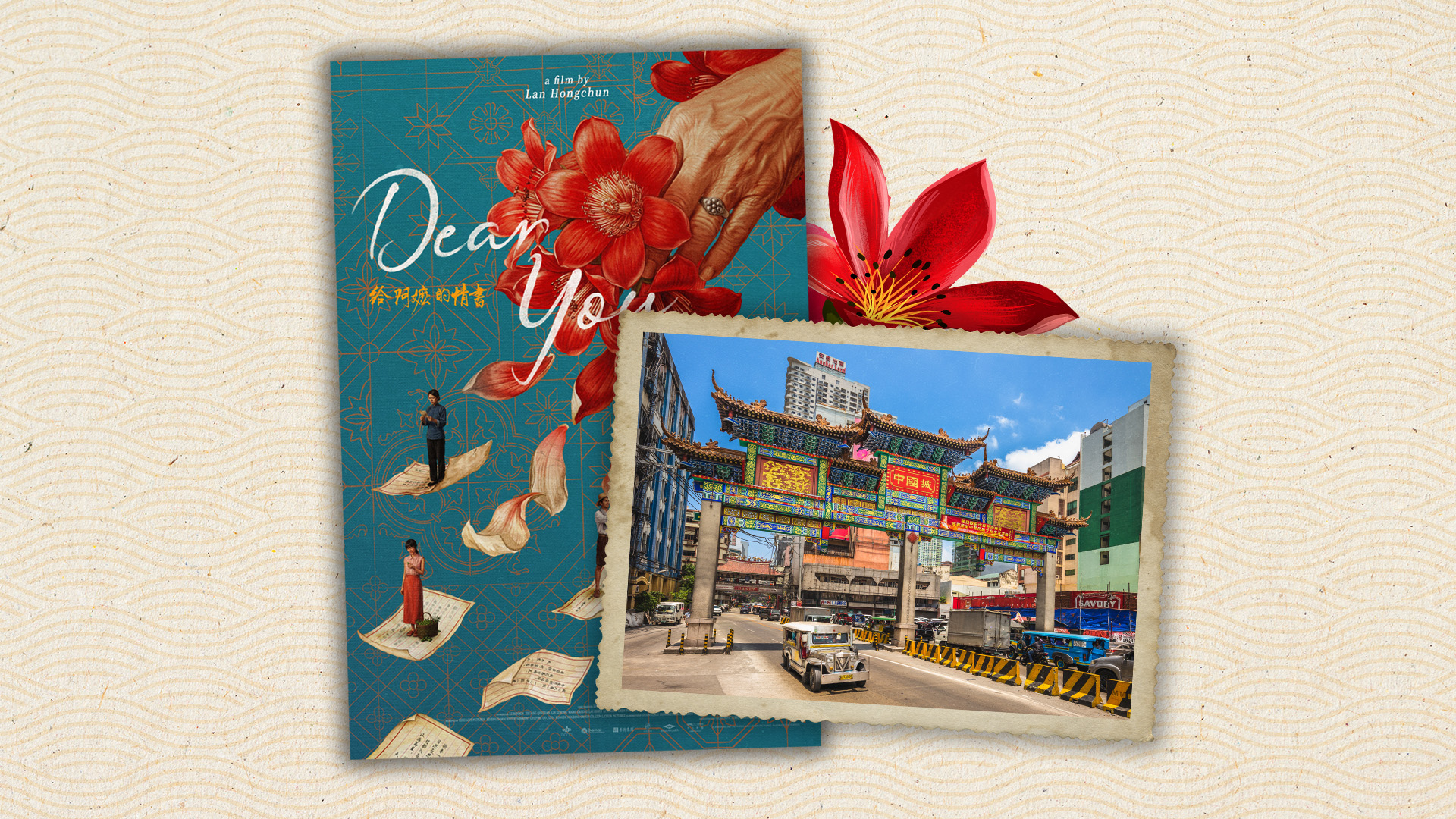
Dear You, and the stories of love and migration the Filipino-Chinese pass down
I went into Dear You expecting a tear-jerker. I came out thinking about my Gua-kong, the small boat that carried him out of China, and the life he built on this side of the sea. How wonderful, then, that a Teochew story could closely echo across so many Filipino-Chinese families.
But before I get ahead of myself, a bit about the movie first. Made on a modest budget, Dear You has become a surprise hit in China, remarkable because the whole film is spoken not in Mandarin but in Teochew, the regional language of the Chaoshan area in Guangdong and of a sprawling diaspora across Southeast Asia.
It was, in fact, a real tear-jerker, full of secret letters, long-lost relatives, families split across oceans, and love expressed in just about every possible way except through the word itself. The story centers around Chinese migrants in Thailand and the qiaopi, letters sent home together with remittances, making it particularly resonant across Southeast Asia, where generations of Teochew families settled.
But Dear You has been warmly received in the Philippines too, especially among Filipino-Chinese viewers, most of whom trace their roots not to Teochew-speaking communities, but to Hokkien-speaking southern Fujian.
I think part of the reason is simple. I had never heard anything on the big screen that sounded this close to what we spoke at home.
Technically, I still haven’t. The movie is in Teochew, not Hokkien, or Lannang-ue, literally “our people’s language.” They’re different languages and not interchangeable, but every so often Dear You produces a line that makes a Hokkien speaker’s ears perk up.
At one point, a character being teased for never having ridden a plane before is reassured: “Bue-gi bhoi ziah nang.” (Airplanes don’t eat people.)
In Hokkien, we would say something closer to: “Hui-ki bhoi chia lang.”
It’s not quite the same, but close enough.
In the cinema, I could hear Filipino-Chinese families excitedly echoing Hokkien-sounding tidbits. It was the little thrill of catching a word even before the subtitles told you what it meant.
There’s just something so intimate about hearing a language that sounds like the one your grandparents used at the dinner table.
Mandarin was the Chinese of school. Hokkien was the Chinese of home, shops, restaurants, family spats, and phone calls with uncles and aunties. For many younger Filipino-Chinese, it’s also a language we speak badly – or so our a-ma and ang-kong would like us to believe. E hiao tia, bue hiao kong, they would tease. (You can understand Hokkien, but you can’t speak it.)
Love is in the subtext
But I think the representation goes deeper than language. There definitely is something familiar about the film’s characters themselves, the brusque way they speak and move through the world.
After all, we Filipino-Chinese are a practical bunch. Commerce runs through so much of the community’s history, from the massive conglomerates that dominate Philippine business to the mom-and-pop restaurants in Binondo that’ve been running for three generations. Business is such a natural part of everyday life that a conversation with even your closest relatives might go something like this:
“Seng-di ho bo?” (How’s business?)
“Ho ah. Seng-di chin ho.” (Good. Business is very good.)
There. Everybody’s caught up. Now we can sit beside each other in silence for the next two hours.
That practicality carries over into almost everything else, even love. Filipino-Chinese families are not particularly effusive people. We don’t fawn over one another or fill conversations with words dripping in honey. Love lives beneath the sentence. It’s in the subtext, the gesture, the thing somebody does for you with an easily missed yet unmistakable tenderness.
Concern is “Chia lo bue?” (Have you eaten yet?) Care is a bowl of oranges, peeled and placed by your bedside, or a wad of crumpled cash pressed into your hand when you protest that you don’t need it.
That’s also part of what makes Dear You feel so close to our hearts. Its characters can carry an entire lake of love while remaining almost maddeningly indirect about them. Feelings are tucked into letters, sacrifices, obligations, a bicycle sent home, a hurried wave of the hand to a boat setting sail.
Different journeys, familiar lives
Still, Dear You isn’t exactly the Filipino-Chinese story.
At its heart, the film is about a different kind of migration where a husband leaves China for opportunites elsewhere while wives, children, or other relatives stay behind. They send money home. They send letters home. Crucially, China is still home.
That’s not the case for most Filipino-Chinese families. For us third, fourth, even fifth-generation Chinoys, we see China as something ancestral. Sure, there are family associations, Chinese schools with trips to Xiamen, distant relatives whose exact relationship requires a family tree. If you’re a billionaire shoe tycoon, you might even build a mall, school, and road in your hometown.
But we don’t land in China as balikbayan. Our home is here.
That’s why Dear You works so well. A good film is particular yet universal at the same time. Watching it made me think less about coming back to China than about how my own family arrived in the Philippines in the first place.
It made me think about my Gua-kong.
Gua-kong, and the boat that brought us here
My grandfather had his own boat story.
As he told it, he was a young man in Shanghai during the Chinese Civil War, when his family feared he would be pulled into Chiang Kai-shek’s Kuomintang army. He was their only son. They refused to let him fight and possibly die in a war they wanted no part of.
So they scrunched up what money they had and sent him away.
I grew up hearing the dramatic retelling: how he was smuggled out of China aboard a small motorboat, crammed together with other passengers, leaving with little more than the suitcase he could carry – not unlike Iron Fish, I imagine.
But in my grandfather’s case, there would be no great return, not even the ambition of it.
A relative helped him find work at Philippine Bank of Communications (PBCOM) then an important fixture in the Filipino-Chinese business world of Binondo. It wasn’t easy. Gua-kong spoke Mandarin, a bit of English, and not a word of Filipino. Perhaps most damningly for someone entering Manila’s Chinese community, he didn’t even speak Hokkien, having come from Shanghai and not Fujian. (I would eventually pick up the language from my father’s side of the family.)
But he proved capable enough that the bank shipped him off to St. John’s University in New York for his master’s degree. He came back with an accent – and enough business savvy to work his way up.
By 1980s, my grandfather had risen to become an executive vice president of PBCOM and was a director of PBCOM Finance, the bank’s financing affiliate, sitting on the board alongside heavyweight bankers like Luy Kim Guan and Maurice Nubla. Luy would later serve as chairman of PBCOM itself and belonged to the family that became the bank’s single biggest shareholder bloc. Maurice Nubla, meanwhile, was an original incorporator of PBCOM Finance alongside Ralph Nubla, who led the group that took majority control of PBCOM in 1974. Gua-kong counted the Nublas among his closest friends, attending dinners and parties togehter.
Quite the rise for a young man far away from home.
Then there was Gua-ma.
Their romance is worth telling. Because as accomplished as my grandfather would eventually become, when he first started courting my grandmother, he wasn’t exactly the best of suitors.
Gua-ma was an only daughter from the Cham family behind Cham Samco & Sons, one of old Manila’s prominent hardware stores and construction material importers. Gua-kong, meanwhile, was still building his name, and apparently decided that what he needed to improve his chances was a car.
Problem: he didn’t own one. Worse, he didn’t know how to drive.
So he borrowed a friend’s car. His cousin would drive him almost all the way to my grandmother’s house, stop around the corner, and let Gua-kong take the wheel for the final stretch.
He faced stiff competition for sure, but apparently the strategy worked. He got the girl.
Years later, he would tell another story involving perhaps the Philippines’ most famous businessman and certainly one of its richest.
According to Gua-kong, Henry Sy Sr. remembered him from his years at PBCOM, when the bank regularly helped finance SM as it grew and my grandfather was among the senior officers giving the final go-ahead on loans.
Years later, with the mall business already taking shape, the Sy family patriarch came back with a new idea from his son: bring Ace Hardware to the Philippines. Would he perhaps want to join the venture? He was a seasoned banker, after all, and one who had married into a hardware family.
This was in the 1990s, back when hardware stores were still mostly small, family-run places where you knew the owner and tawad was simply part of the transaction. An air-conditioned hardware store in a mall? Who would go out of their way to pay higher prices and not even be able to bargain? My grandfather passed.
Every time I walk into an Ace Hardware inside an SM mall, I have to remind myself that even successful businessmen are allowed at least one spectacularly bad call.
But Gua-kong kept building things. After retiring from PBCOM, he hardly slowed down. He set up a garments export factory, owned a branch of Panciteria Lido – a Chinese restaurant that may ring a bell with older members of the Filipino-Chinese community – and put up both a high-rise condominium and a smaller apartment building.
Here is where Gua-kong‘s story diverges from the many true stories that inspired Dear You. They spent their lives with China in their heart, through letters, remittances, visits.
My grandfather crossed the same sea, but set his feet firmly on Philippine shores. He built his life – his family – here. By the time it got to us grandchildren, China no longer felt like somewhere to return to. We were left with the language, the food, the traditions we choose to still keep alive, and most of all, the stories.
Maybe that’s what our generation inherited instead of the qiaopi: the stories of how we got here. Looking back so many years after that young man first stepped on that boat, I hold them close until it’s my turn to pass them on to the next. – Rappler.com
In memory of Edward Ting, the author’s late grandfather.