Disney’s Star Wars-Inspired Flop Left Behind a Toyline Collectors Still Love
It would be putting it mildly to say that the Walt Disney Company was a little lost after its founder and namesake’s untimely 1966 death. Without Walt Disney’s corporate and creative direction, the company’s output suffered, paralyzed in the face of a changing market and changing audience tastes. Referred to now as the Disney “Dark Age,” the era saw Disney’s new leadership experimenting with new genres, mediums, and target audiences to try and recapture their earlier successes. Costly underperformers like The Island at the Top of the World and Bedknobs and Broomsticks emerged from this strategy, a testament to Disney’s floundering ability to connect with audiences. Even when a film was a short-term success, Disney feared that it wasn’t leaving a lasting impact on kids and families in the way that their Walt-era films had. This created a major threat to the market for theatrical rereleases, then a significant source of income for Disney. With the decade drawing to a close, Disney was ready to try anything, and sought to replicate a film that had become a global phenomenon with audiences of all ages: Star Wars.
The success of Star Wars, an earnest, pulpy throwback to science fiction serials of the thirties, had caught all of Hollywood off-guard. Studios scrambled to greenlight copycat science fiction film and television, and Disney was no different. They dusted off a script they purchased years earlier called Space Station One, envisioned as an outer-space disaster movie. Bringing on new writers, Space Station One was retooled into The Black Hole, an outer space mystery with a cast of marketable robots and spaceships — designed in hopes of recapturing another major facet of Star War‘s success: merchandising. With this can’t lose proposition, Disney partnered with toy giant Mego, still stinging from passing on the hugely lucrative Star Wars license, for an expansive line of Black Hole toys and action figures. On paper, the partnership was between two leaders in their respective fields, sure to bring out the best in each other. In practice, both Mego and Disney were desperate, struggling to adapt to a market that was in danger of leaving them behind.
How The Black Hole Became a $20 Million Dollar Flop
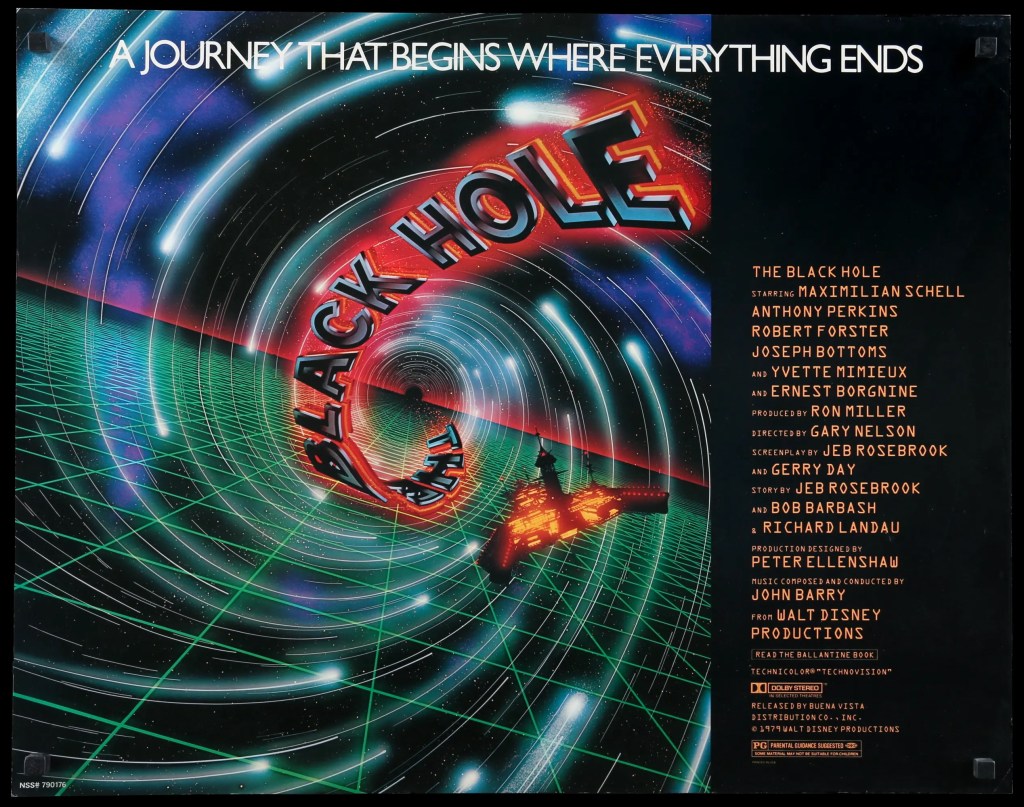
Disney lavished money on The Black Hole, which ultimately came in at a twenty million dollar production budget. Most of this was spent on the elaborate spaceship sets and its aforementioned cast of robots (today the film’s best remembered feature), both front and center in Mego’s in-development toyline. The Black Hole was to be a dark science fiction mystery, following a spaceship crew’s discovery of a long-lost deep space exploration vessel on the edge of a black hole. Between its initial pitch as Space Station One and the its 1979 release, at least seven writers worked on The Black Hole. This exacerbated the film’s existing identity crisis, created when producer Ron Miller and director Gary Nelson adopted a daring strategy to set the film apart from Disney’s past output: a PG rating.
The Black Hole would be the darkest, most adult film Disney had produced, which Miller and Nelson hoped would broaden its appeal to a larger audience segment than Disney’s family friendly films. The problem was the Disney name, which was synonymous with family-friendly. Families expecting a “Disney movie” were put off by The Black Hole‘s dark and violent tone, while older kids and grown-ups didn’t want to see a film made by Disney. While The Black Hole made money, its stunning visual effects meant a high price tag meant it didn’t turn a profit. And worse yet, it meant that while audiences saw the film, no one wanted more of it. Which left Mego in a worrisome position, having invested millions of dollars into an expansive, scale-spanning Black Hole toyline.
Why These 12″ Black Hole Action Figures Were Mego’s Biggest Mistake
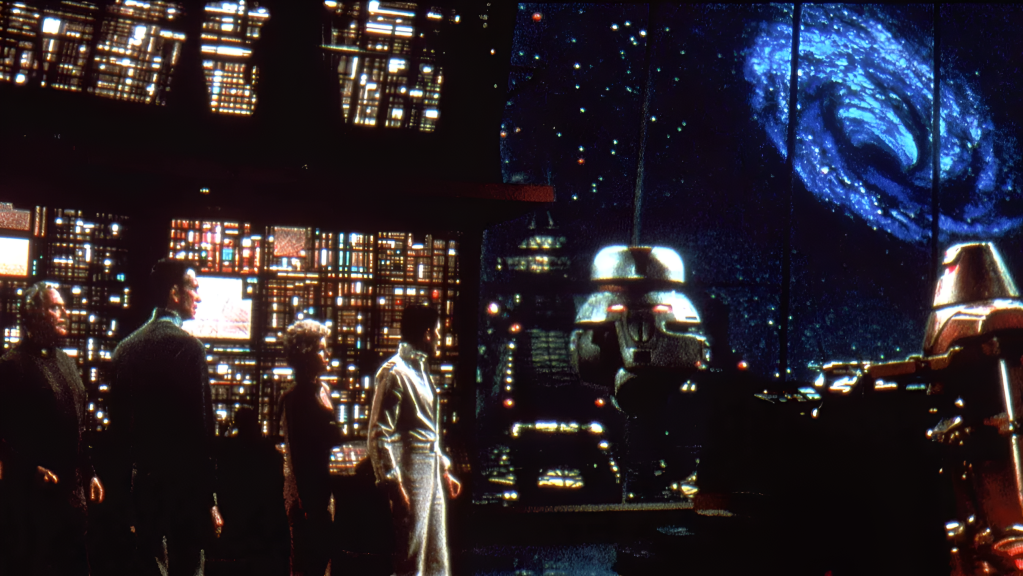
Across both scales, Mego made a critical miscalculation when it came to character selection for their Black Hole line: they made the humans first. Operating under the assumption that kids would want to play with the “main characters” of The Black Hole, Mego produced faithful reproductions of the heroic crew of the spaceship Palomino — a bunch of people in turtlenecks and jump-suits — rather than the colorful, eye-catching robots that were front and center in Disney’s marketing for the film. In the 3.75″ line, Mego at least mixed several of the robots in with the line’s first wave, giving kids the chance to buy both. For the 12″ line, Mego led with a half-dozen of the human cast, including Ernest Borgnine, famously inspiring a scene in True Romance.
The human figures were undeniably well-produced, featuring highly detailed cloth outfits and remarkable actor likenesses. These went unappreciated by kids in 1979, who stayed away from the line in droves. This initial wave sold so poorly that Mego cancelled the North American release of the 12″ magnetic robot figures. One of these, V.I.N.C.E.N.T, saw limited release in Italy, and is today one of the most sought-after pieces in the Black Hole line. As the film’s breakout character, V.I.N.C.E.N.T. (voiced by the ever-charming Roddy McDowall) is usually the most in-demand figure in any Black Hole line. Even rarer than the magnetic V.I.N.C.E.N.T. is the never-produced “Walking V.I.N.C.E.N.T.” remote control toy, cancelled by Mego because of its high production costs. Prior to cancellation, a commercial for the toy was produced to sell it to retailers, providing a glimpse at what would likely have been a poor seller then and a high-priced collectors’ item today.
How Mego’s 3.75″ Black Hole Line Became a Collectible Cult Classic
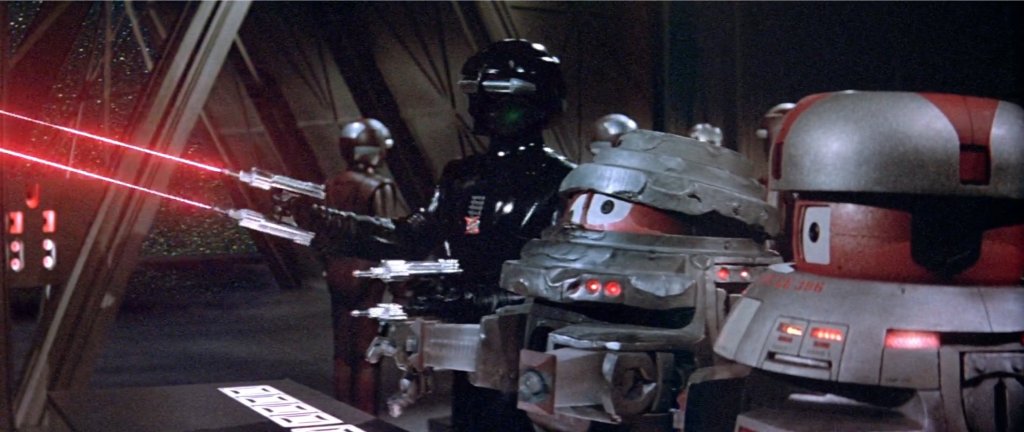
The most-elaborate and collectible Mego Black Hole offerings were their 3.75″ figures. Nine characters made it to shelves in 1979, including the same six human characters as the 12″ line, plus V.I.N.C.E.N.T. and bad-guy robots Maximillian and the army-builder Sentry. For the figures, Mego took design cues from their popular Micronauts import figures, implementing better-than-industry-standard articulation. Rather than the standard five-point design scheme employed by Kenner’s Star Wars or Mego’s Star Trek: The Motion Picture line, these figures featured fourteen points of articulation (jointed elbows, knees, shoulders, hips, and a swivel in the upper arm). They also boasted impressive, detailed sculpts like their 12″ counterparts.
The figures’ quality was not enough to counteract consumer apathy toward The Black Hole, and while the robot figures sold fairly well (and are difficult to find on the secondary market today), the human characters joined Mego’s Star Trek: The Motion Picture in the clearance aisle. As a result, American retailers cancelled their orders for the second wave that Mego had already put into production. The second wave consisted of a trio of the film’s robots: V.I.N.C.E.N.T.’s predecessor Old B.O.B, the Sentry robot leader S.T.A.R, and the gruesome “Humanoid,” the cyborg product of the villainous Dr. Reinhardt (Maximilian Schell)’s experiments. Mego cancelled further production of these three, and sent those that were produced to Italy and Canada (this is the result of a contract technicality with how toys were ordered in these countries, more detail can be found in this article). Today, all three are collectors grails, and even loose, the Humanoid commands a four-digit price-tag on the secondary market whenever one turns up for sale.
Mego had hoped to produce playsets and vehicles to accompany the 3.75″ line, these were also cancelled due to poor sales. Prototypes were shown for a Palomino vehicle and a Cygnus Bridge playset, its design similar to the Mego Star Trek: The Motion Picture bridge playset. Dedicated fans have used the prototype pictures to make custom recreations of both the Palomino and the Cygnus. Better than anything else, this exemplifies the enthusiasm with which Mego’s Black Hole toys are collected by both fans of Disney and fans of Mego. The toys are some of Mego’s best work, and help showcase some of Disney’s most inventive designs. Though they languished for a dollar each on shelves in 1979, today a complete set of the American 3.75″ figures sells for hundreds, as with this Heritage auction — still bearing their clearance stickers from Toys R Us.
It’s an unfortunate irony that The Black Hole helped kill Mego, who filed for bankruptcy in 1982. Together with their failed investment in electronic games and Star Trek: The Motion Picture, Mego took an unsustainable loss of both the research and development and the sales of their Black Hole product line. While even bigger bombs followed The Black Hole in the eighties, Disney endured through its “Dark Age,” reviving in the latter years of the decade with the “Disney Renaissance.” For Mego fans, these figures represent the end of an era, while for Disney collectors, they are a relic from a time of change and experimentation. Like the film that spawned them, the action figures are a cult classic.
Do you remember Disney’s The Black Hole? Leave a comment below and join the conversation now in the ComicBook Forum!