Revilla’s P1-M bail: What ‘weak evidence’ bought him
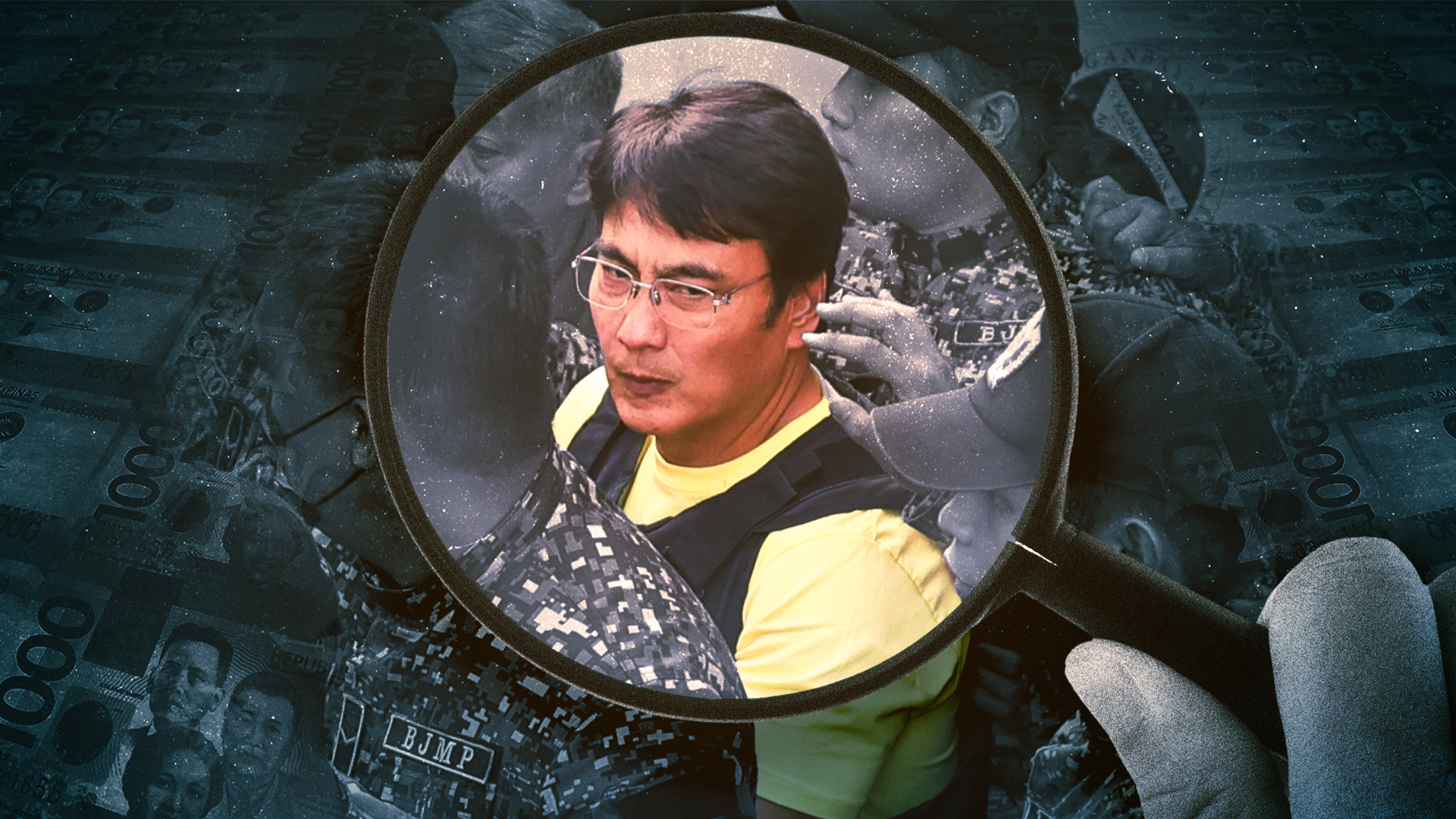
Former senator Bong Revilla is temporarily out of jail after the Sandiganbayan 3rd Division granted his bail petition on his malversation case.
Revilla is facing graft and malversation cases over a P92.8-million flood control ghost project in Bulacan. He was arrested in January and spent over six months in detention at the New Quezon City Jail in Payatas.
While graft is bailable, malversation is not, so the former senator had to file a petition for bail and attended weeks-long hearings at the Sandiganbayan. Ultimately, the 3rd division justices decided to grant Revilla temporary liberty in a resolution made public on July 31.
The court, however, did not grant the petition for bail of Revilla’s co-accused, which includes former Department of Public Works and Highways (DPWH) engineers Brice Hernandez, Jaypee Mendoza, and Arjay Domasig, among others.
The three justices — Chairperson Associate Justice Karl Miranda, Associate Justice Ronald Moreno, and Associate Justice Fritz Bryn Anthony delos Santos — were unanimous in denying the motions of almost all of Revilla’s co-accused. Moreno wanted to grant Christina Mae Pineda’s bail, but was outvoted.
However, Miranda was the lone dissenter in granting Revilla’s bail. Both Moreno and Delos Santos believed that the former senator must be given temporary liberty.

Revilla not yet acquitted
For grave offenses like malversation of public funds, bail is not automatic. An accused like Revilla has to file a petition for bail.
The court then holds summary hearings where the prosecution presents its evidence and witnesses, solely for the purpose of determining whether the evidence of guilt is strong. This threshold is important because if the court, after the bail hearings, finds that the evidence is weak, it grants the bail petition of the accused.
This is what happened to Revilla. The evidence against him, in so far as the bail hearings are concerned, was found to be weak, that is why his petition was granted.
For his fellow accused, however, the court found the evidence to be strong. Their request was denied.
Remember, these summary hearings and evidence were intended only for the bail petition, and excluded the actual malversation case.
Revilla is out of jail for now, but this does not mean he’s completely off the hook. His temporary liberty means he won’t have to remain under the custody of the Bureau of Jail Management and Penology in Payatas, but he will still have to attend his graft and malversation hearings.
His innocence will only be determined at the end of court’s trial. The prosecution may also present additional evidence during the trial proper.
“A finding of strong evidence of guilt after the conclusion of a bail hearing is not equivalent to a finding of guilt beyond reasonable doubt. It is primarily based on evidence being initially established by the prosecution prior to resting on the presentation of its evidence-in-chief,” the 176-page resolution penned by Delos Santos said.
“It is by no means an exhaustive inquiry of guilt — especially as to the elements of the crime and the degree of participation. It is limited only to the assessment of a subset or sample of the entirety of the prosecution’s evidence,” it added.
The prosecution automatically adopts its evidence presented during the bail hearings for its mother case. It may also present additional evidence during the trial proper.
“As a matter of practice, the evidence presented in support of a bail application are adopted as part of the evidence-in-chief. Although the prosecution may present additional evidence,” National Union of Peoples’ Lawyers president Ephraim Cortez told Rappler.

Evidence vs Revilla is weak
Moreno and Delos Santos found that the prosecution failed to show strong evidence of guilt on the part of Revilla.
Revilla was dubbed by the Office of the Ombudsman a proponent, or a politician whose job is to ensure that a specific DPWH project will be funded by the national budget. In exchange, a public official gets a commission or alleged kickback from the scheme.
This was how the supposed “kalakaran” or corruption scheme inside the DPWH worked.
To prove their allegations, the prosecution presented state witnesses former DPWH undersecretary Roberto Bernardo, former DPWH engineer Henry Alcantara, and DPWH Metro Manila regional director Gerard Opulencia, as well as some DPWH staff. They also presented documentary printouts that bear the initials “SBR,” supposedly standing for “Senator Bong Revilla.”
This evidence was supposed to prove that Revilla allegedly:
- Obtained a list of projects from DPWH officials and employees to fund them
- Facilitated and caused the inclusion of these projects in the national budget
- Received kickbacks from doing all of these
Meanwhile, Philippine courts have identified the elements of malversation. They are as follows:
- The offender is a public officer
- He or she had custody or control of funds or property by reason of the duties of his or her office
- Those funds or property were public funds or property for which he or she was accountable
- He or she appropriated, took, misappropriated or consented or, through abandonment or negligence, permitted another person to take them
However, the court said there was no evidence narrating how Revilla allegedly facilitated the project’s inclusion in the national budget. It explained that being the chairperson of the Senate committee on public works did not mean that he had the power to author a budget “that is binding not only on said Committee but even on the Senate itself as a plenary body as well as the Bicameral Committee of Congress.”
The court said that the testimony about Revilla allegedly obtaining a list of projects from the DPWH did not prove the malversation’s last element that “he appropriated, took, misappropriated or consented or, through abandonment or negligence, permitted another person to take them.”
According to the court, the prosecution also failed to present an iota of proof that Revilla expressly or impliedly agreed that, at the time of allegedly receiving the kickbacks, his co-accused would commit malversation in the future.
“At best, accused Revilla’s alleged receipt of the kickbacks (as testified to by the witnesses in the bail hearings) could only support a mere assumption that he may have had predicted that the same funds would later on be recovered by private contractors (and some of his co-accused who may have had private contractors as dummies) from the sum appropriated for the project in this case),” the ruling explained.
“More importantly, at the time accused Revilla allegedly received his ‘commitments,’ the cash supposedly involved in the deliveries came from private persons as testified. At that time, the funds involved insofar as accused Revilla is concerned were not public in character,” it added.
The court also explained that a government project has four stages: planning or proposal; funding; implementation; and post-auditing. It said that the crime of malversation, at least based on the evidence so far, happened during the implementation stage.
The Sandiganbayan said Revilla’s alleged receipt of advance commissions happened before the implementation stage.
“This necessarily implies that the funds he received coming from the private contractors did not come from public coffers to be considered as ‘public funds’ under the definition of the crime of malversation,” said the court.

Miranda dissents
Miranda, who dissented in the decision to grant Revilla bail, said he disagreed with the conclusions that there was no evidence that the former senator facilitated the inclusion of the funding and that he had no alleged participation in the malversation.
On top of this, Miranda also disagreed with the conclusion that there was nothing connects the act of obtaining the list of projects and facilitating the funding of the subject project “to the eventual understanding that the recovery of the advance kickbacks allegedly paid to Revilla will be recovered by his co-accused by way of malversation.”
The chairperson believes that the prosecution was able to present strong evidence against Revilla, explaining that the former senator’s alleged acts may only be appreciated when contextualized within the “kalakaran” scheme inside the DPWH.
The chairperson believes that it was wrong to treat the advance payment as an independent and isolated offense, since the contractor will have to rely on future offenses to recover the commitment through public funds.
“Ultimately, it is the government that is charged for the bribe that the contractor has paid the project proponent,” said Miranda.
The magistrate also said that the testimonies of Bernardo, Alcantara, Opulencia, and Bernardo’s aides prove that commitments were collected for 2025 projects, where Revilla acted as proponent. He also added that there was “strong evidence” that these kickbacks were delivered to Revilla in his white house compound in Cavite in the first quarter of 2025.
For Miranda, there was no need to prove that Revilla personally intervened in the congressional deliberations to ensure that the project would be funded. Miranda explained that the DPWH project would not have been included in the national budget law had it not been for the following reasons:
- Revilla’s allocation provided by former DPWH secretary Manuel Bonoan
- Revilla’s request from Bernardo for the list of projects for “allocation”
- Alcantara’s “transmittal of the list of projects to Undersecretary Bernardo, which list included the subject project, as part of projects for funding from Revilla’s allocation”
- Bernardo’s transmittal of the list of projects for funding from Revilla’s allocation to Bonoan and the late DPWH undersecretary Cathy Cabral
- Revilla’s follow-up with Bernardo, Bonoan, and Cabral for the inclusion of projects
“Miranda thus concludes that it is difficult to justify that the accused who personally benefited from the scheme is granted provisional liberty, while his co-accused are kept incarcerated despite lack of proof that they gained anything from the commission of the crime charged,” said the magistrate in his dissenting opinion. – Rappler.com