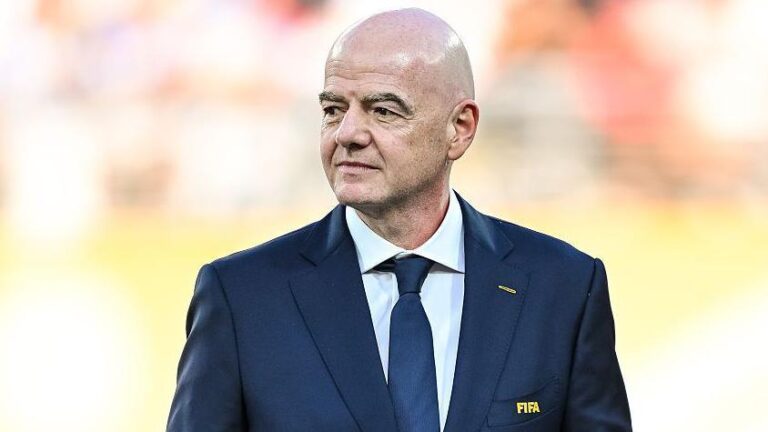
Two women sitting on UEFA’s executive committee have become the most visible faces of opposition to FIFA President Gianni Infantino as he confronts the toughest test of his ten years leading world football’s governing body, raising fresh questions about whether the sport is ready for female leadership at the top. Laura McAllister of Wales and Lise Klaveness of Norway, the only two women on UEFA’s executive committee, have taken outspoken public stances against Infantino during a crisis triggered by the collapse of his plan to push through a private equity backed venture called FIFA Football Enterprises. The backlash against that failed proposal has opened up a broader conversation about whether football, an industry historically run by men, could realistically be led by a woman. McAllister, who serves as a UEFA vice president, told a foreign news agency that seeing a woman elected FIFA president would be a welcome development, though she cautioned that the path there remains complicated. “I’d like to think we’re not far off having a female president,” she said, adding that she worries football still lags behind broader social progress on gender. The conversation gained additional traction after former FIFA President Sepp Blatter publicly said this week that the time had come for a woman to lead the organization, singling out Klaveness for praise. McAllister welcomed the sentiment but pushed back on the idea that installing a female president would be straightforward. She said a woman could well be the strongest candidate available, but stressed that FIFA’s global politics do not operate as a simple meritocracy. Her comments follow the unraveling of Infantino’s FFE plan, which fell apart after UEFA and several other regional federations mounted fierce resistance. Wales became the first national association to publicly withdraw its backing for Infantino’s re election bid, and opposition quickly spread through other parts of FIFA’s membership. Infantino was scheduled to hold an emergency meeting in Morocco on Wednesday as the fallout continued. McAllister, whose call for national associations to boycott FIFA events won unanimous backing at UEFA’s emergency meeting last week, said the current unrest points to governance failures that run deeper than any single controversy. She said the organization appears to be approaching a genuine crisis point, if it has not reached one already. She cited a string of episodes that have chipped away at confidence in Infantino’s leadership, including FIFA’s connections to the failed European Super League proposal, political controversies tied to the World Cup, and the federation’s decision to overturn a red card issued to American forward Folarin Balogun after President Donald Trump publicly urged Infantino to revisit the call. McAllister said these incidents collectively point to serious flaws in how FIFA governs itself. She framed the standoff as a fight to preserve football’s core principles, tracing her outlook and Klaveness’s back to their shared history as international players for their respective countries before they moved into administrative careers, Klaveness as a lawyer and McAllister as a political scientist. She said both are driven by a strong sense of values, warning that football risks losing its essential character if those values slip away. She added that women in the sport sometimes bring a clearer focus on football’s fundamental purpose rather than getting absorbed in its business side, arguing the game belongs to everyone, from grassroots participants to elite professionals, spanning wealthy and poor countries alike, and should remain free from private capital control or political interference. Only 10 of FIFA’s 211 member associations currently have a woman at the helm, Klaveness among them. Any serious bid for the FIFA presidency would require support stretching well beyond Europe, and McAllister urged patience rather than a rushed push for female leadership. She said building momentum gradually often proves more effective than trying to force rapid change. Michael Payne, a former marketing director at the International Olympic Committee, said football’s governing bodies have historically trailed other sports when it comes to advancing women into leadership positions. He drew a contrast with the IOC, now led by Kirsty Coventry, noting that the Olympic movement has spent roughly two decades pursuing gender equity and has reached full parity between male and female athletes at the Games, a benchmark football’s World Cup has yet to meet. The dispute over FIFA’s direction reflects broader tensions playing out across international sports governance, where longstanding institutions face growing pressure to modernize leadership structures and diversify decision making bodies that have remained largely unchanged for decades. As football’s global profile continues to expand, the question of who holds power at its highest levels, and how that power gets exercised, appears likely to remain a central point of contention well beyond the current crisis surrounding Infantino’s leadership.