Here’s all the times AI has gone rogue and hacked other companies
A recap of all the incidents involving LLMs made by Anthropic, Meta, and OpenAI, which went rogue and attacked real companies and individuals on the internet.

A recap of all the incidents involving LLMs made by Anthropic, Meta, and OpenAI, which went rogue and attacked real companies and individuals on the internet.
The company said that the dictation feature works across all apps, just like other tools such as Wispr Flow, Superwhisper, and Monologue.

Thousands of social media users found themselves locked out of their accounts on Wednesday morning. Meta’s primary networking platforms, Facebook and Instagram, suffered another major service disruption. The technical meltdown marks the second widespread failure for the tech giant within a short 72-hour window, frustrating millions of individuals and digital creators who rely heavily on these apps for daily communication, business operations, and content distribution. The disruption began escalating rapidly early Wednesday morning, with real-time outage monitoring platform Downdetector logging thousands of user complaints simultaneously. Reports reached a massive peak around 7:54 a.m. Eastern Time, as roughly 3,600 users submitted formal issue tickets across both platforms within minutes. The sudden spike highlighted a troubling trend of technical instability across Meta’s digital ecosystem. While both platforms experienced severe connectivity issues, the exact nature of the glitches varied slightly between Facebook and Instagram. For Facebook users, the operational breakdowns were distributed relatively evenly. Roughly 37% of reporting users stated that the dedicated smartphone application failed to launch or froze upon opening. Approximately 32% encountered connection errors while trying to load the desktop or mobile web browser versions. About 23% struggled with account authentication, encountering repeated login failures or session timeouts. Conversely, Instagram’s problems were heavily concentrated within its primary mobile software interface. A substantial 62% of complaints involved total application crashes or non-responsive user interfaces on mobile devices. Around 15% of users reported an inability to establish a stable connection with Instagram’s host servers. About 13% noted that their personal news feeds, stories, and direct messages failed to refresh or update properly. What makes this latest disruption particularly concerning for industry observers and users alike is its timing. Meta’s services suffered a similar widespread failure just three days prior, on Sunday morning. Experiencing two major platform breakdowns within 72 hours points to potential systemic vulnerabilities rather than an isolated, one-off server hiccup. Technology experts note that repeated infrastructure failures cast doubt on the robustness of Meta’s server architecture and automated monitoring systems. For a company that manages global communication channels for billions of daily active users, back-to-back outages raise critical questions about network redundancy and server load management. Despite the mounting complaints and widespread publicity surrounding the outage, Meta has yet to issue an official public statement or detail the underlying root cause of the disruptions. Cyber-security analysts advise users to remain patient during these service interruptions and avoid making repeated attempts to reset account passwords or click unverified account recovery links, as these actions can inadvertently trigger temporary account lockouts. Until Meta provides formal technical updates and permanently stabilizes its server networks, users and businesses relying on Facebook and Instagram will remain on edge to see if additional outages destabilize the platforms in the coming days.

For over four centuries, William Shakespeare’s plays have served for understanding human nature, politics, psychology, and empire. Yet, as scholars Xin Chen Chai and Xin Ying Lim argue, his work offers surprising insights into a decidedly modern phenomenon. The hidden human and physical infrastructure driving artificial intelligence. When millions of users enter prompts into generative AI chatbots every day, the experience feels weightless, instantaneous and virtual. However, behind every generated sentence lies a physical network of high-powered data centers. These facilities consume massive volumes of electricity and millions of gallons of water to cool servers. This illusion of effortless command reflects the dynamic in Shakespeare’s The Tempest. In the play, the exiled duke Prospero rules a remote island through sorcery. He forces the spirit Ariel and the native inhabitant Caliban into servitude. Prospero’s magical feats appear grand and detached from the labor and coercion required to maintain his power. Modern AI systems operate on a similar logic. The seamless magic of AI algorithms obscures the extractive resource demands and physical labor that sustain them. Prospero’s dominance depended on usurping Caliban’s land and subjugating its inhabitants. Similarly, the expansion of tech infrastructure often targets marginalized or rural territories. The reasons are land and natural resources that can be acquired with minimal resistance. A real-world example unfolded within the Mvskoke Nation in Oklahoma. A proposed legislative bill, NCA 25-077, sought to establish the Mvskoke Technology and Innovation Park. The bill was put on the table to bring major data centers to tribal lands. However, Indigenous citizens, including Jordan Harmon and Mackenzie Roberts, showed strong opposition. They highlighted the facilities’ ravenous water and energy consumption. They raised concerns regarding digital surveillance. Framing the development as a continuation of historical colonial exploitation. Due to community pressure and concerns, the tribal council ultimately rejected the proposal. Postcolonial scholars have long viewed The Tempest as a critique of colonial dynamics. They have drawn direct parallels between Prospero’s rule and imperial subjugation. In the play, Prospero surrenders his magical powers only after securing his own political goals. It demonstrates that rulers rarely give up power purely out of goodwill. The successful resistance within the Mvskoke Nation highlights an essential difference between literature and real-life action. Unlike Shakespeare’s characters, real communities are actively demanding accountability from corporate giants. Their resistance demonstrates that the unchecked expansion of data centers is not an inevitable trajectory. By pushing back against resource-extractive technology models, Indigenous and local communities are forcing a necessary public conversation about who truly benefits from artificial intelligence and who pays the hidden costs.

The app was ranking No. 57 on the App Store just before Meta AI’s new model launched. Now it’s No. 5 — and rising.

Now that Meta released its Muse Spark model, more people are downloading the Meta AI app. And if you join the app, your friends will probably get an Instagram notification about it.

Meta also announced on Wednesday that it is giving parents suggested conversation starters intended to help them talk openly and without judgment about their teens’ experiences with AI.

Appfigures finds visual model launches generate 6.5x more downloads — but most don’t convert that spike into revenue.

The feature is designed to help people get real-time context about trends and breaking stories, as well as receive recommendations, all within conversations.
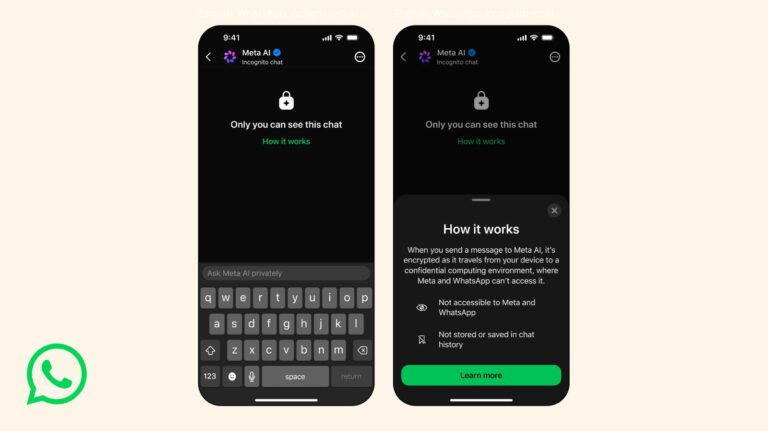
Meta said these incognito conversations are not saved, and messages will disappear by default once you close the chat.