China NEV retail falls for 7th month in July, yet penetration sets record: A Practical Look
2024
2025
2026
© CnEVPost
- China's NEV retail penetration rose to a record 65.1% in July as demand for gasoline-powered vehicles continued to collapse.
- NEV exports surged 147.8% year-on-year in July, accounting for 58.8% of China's total passenger vehicle exports.
China's retail sales of new energy vehicles (NEVs) continued to decline in July, even as their market penetration climbed to a record high amid a continued collapse in demand for gasoline-powered vehicles as fuel prices remained elevated.
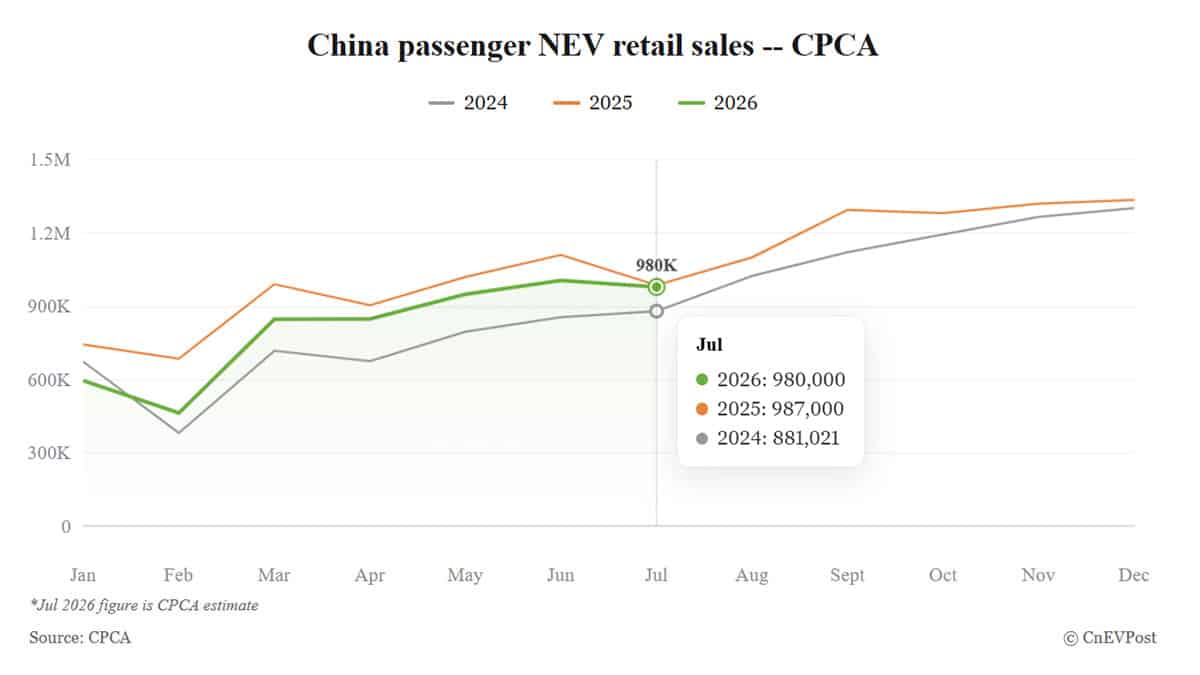
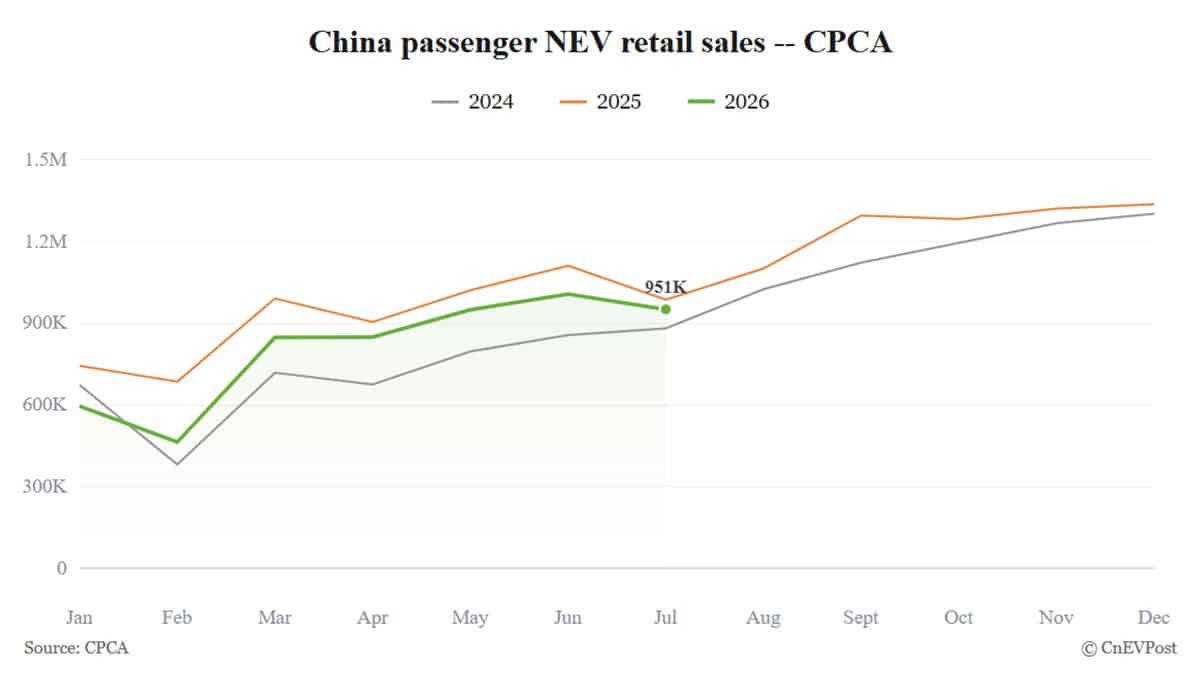
Retail sales of passenger NEVs in China reached 951,000 units in July, down 3.9% year-on-year and 5.8% from June, according to data released Tuesday by the China Passenger Car Association (CPCA).
That marked the seventh consecutive month of year-on-year declines in NEV retail sales. In the first 7 months of the year, cumulative retail sales totaled 5.668 million units, down 12.5% year-on-year.
NEVs continued to rapidly expand their market share despite the sales decline. Retail penetration reached a record 65.1% in July, up 11.6 percentage points from a year earlier and 2.1 percentage points from June.
2024
2025
2026
China's overall passenger vehicle retail sales totaled 1.461 million units in July, down 20.9% year-on-year and 8.8% month-on-month.
2024
2025
2026
The pressure came almost entirely from gasoline-powered vehicles. Retail sales of conventional internal-combustion-engine passenger vehicles fell 41% year-on-year in July, with pure gasoline vehicles down 44% and conventional hybrids down just 4%.
The CPCA said disruptions to shipping through the Strait of Hormuz had pushed up international oil prices, while domestic gasoline prices in China had risen by a cumulative 1,575 yuan ($232) per ton in 2026, significantly increasing vehicle operating costs.
Battery electric vehicles (BEVs) remained the main pillar of the NEV market. Retail sales reached 647,000 units in July, up 6.0% year-on-year but down 5.9% from June.
2024
2025
2026
Plug-in hybrid electric vehicle (PHEV) retail sales were 219,000 units, down 21.1% year-on-year and 9.1% month-on-month.
2024
2025
2026
Extended-range electric vehicle (EREV) retail sales totaled 85,000 units, down 16.5% year-on-year but up 4.3% from June.
2024
2025
2026
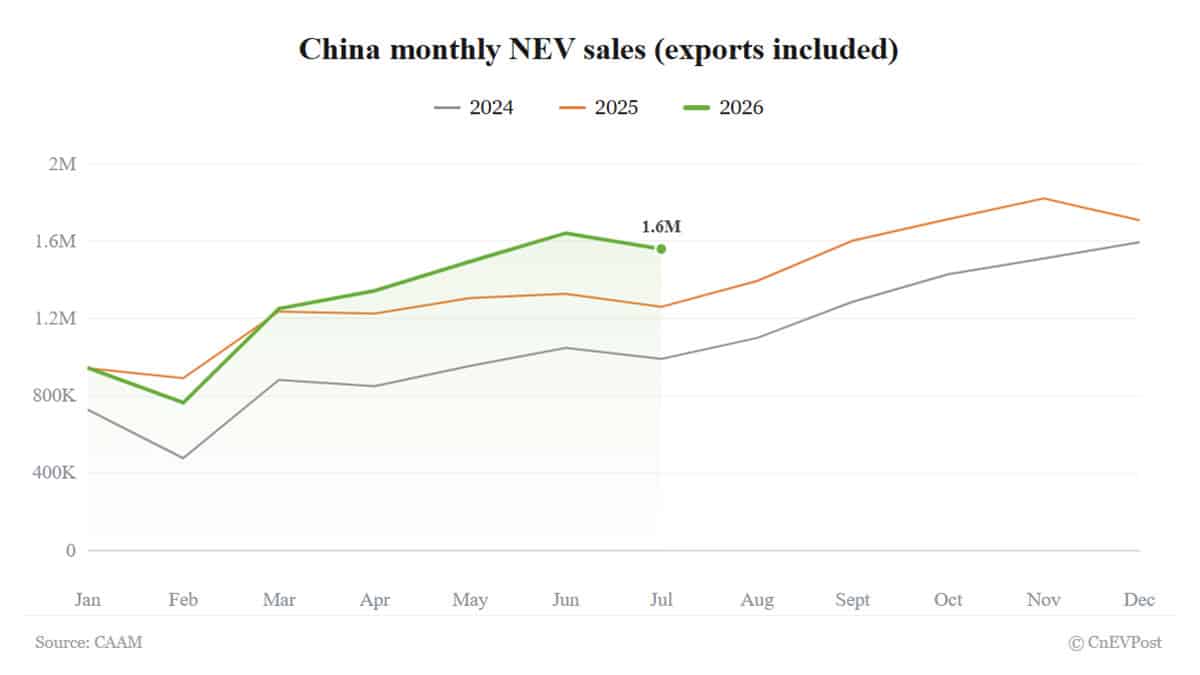
Exports continued to serve as a key growth engine for the industry. China exported 540,000 NEVs in July, surging 147.8% year-on-year and rising 8.1% from June.
NEVs accounted for 58.8% of total passenger vehicle exports, up 14 percentage points from a year earlier.
China's total passenger vehicle exports reached 918,000 units in July, up 87.8% year-on-year.
NEV wholesale sales totaled 1.446 million units in July, up 21.3% year-on-year, while wholesale NEV penetration reached a record 64.2%.
2024
2025
2026
© CnEVPost
2024
2025
2026
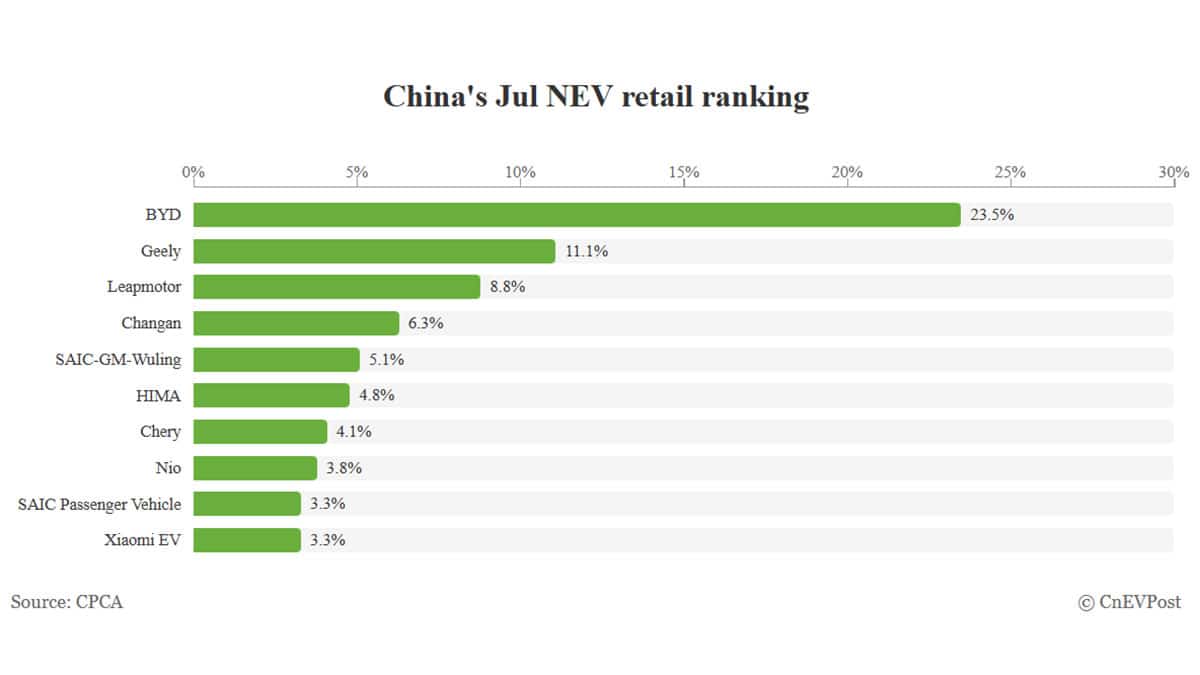
BYD (HKEX: 1211) retained its lead in July, with domestic NEV retail sales of 223,461 units.
Geely Auto (HKEX: 0175) and Leapmotor (HKEX: 9863) ranked second and third with 105,526 and 83,698 units, respectively.
Changan Automobile (SZSE: 000625) recorded domestic NEV retail sales of 59,907 units in July, followed by SAIC-GM-Wuling with 48,967 units and Huawei-backed HIMA (Harmony Intelligent Mobility Alliance) with 45,422 units.
Chinese EV startups accounted for 26.8% of retail sales in July, up 5.4 percentage points from a year earlier, driven mainly by Leapmotor and Nio (NYSE: NIO).
The CPCA expects the decline in China's auto market to steadily narrow in August as policies aimed at supporting consumption take effect and the comparison base becomes more favorable.

($1 = 6.7900 yuan)