China’s NEV sales rise 23.7% in July, with exports surging 1.5 times, CAAM data shows You Should Know
2024
2025
2026
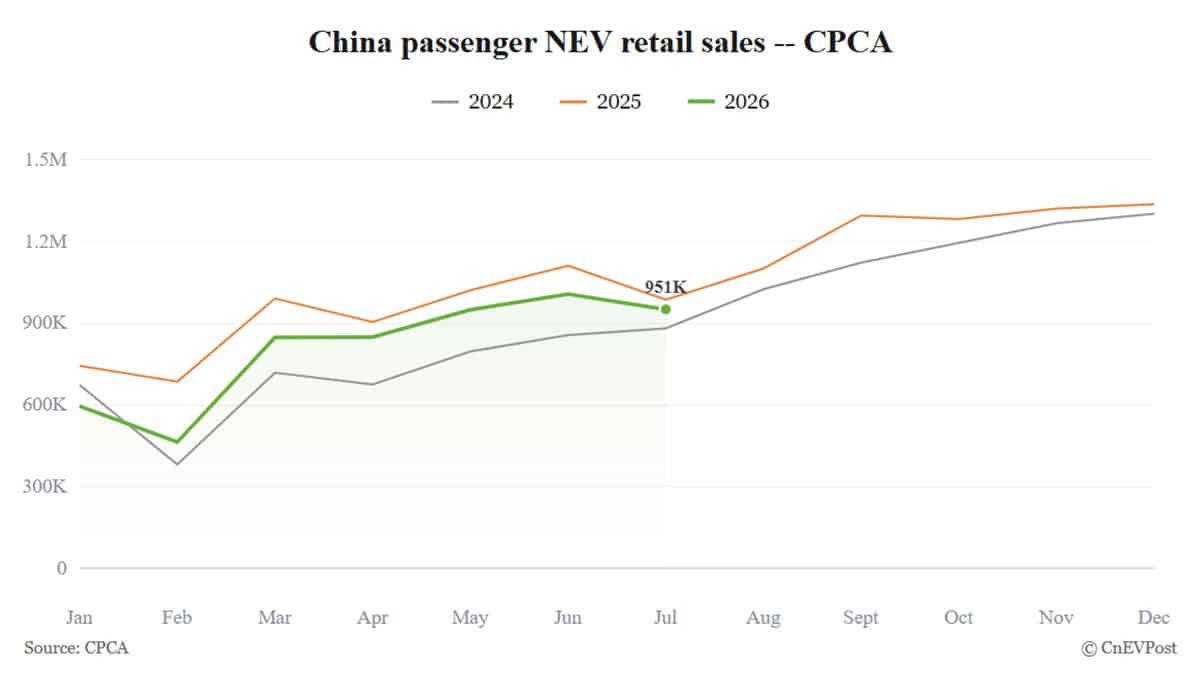
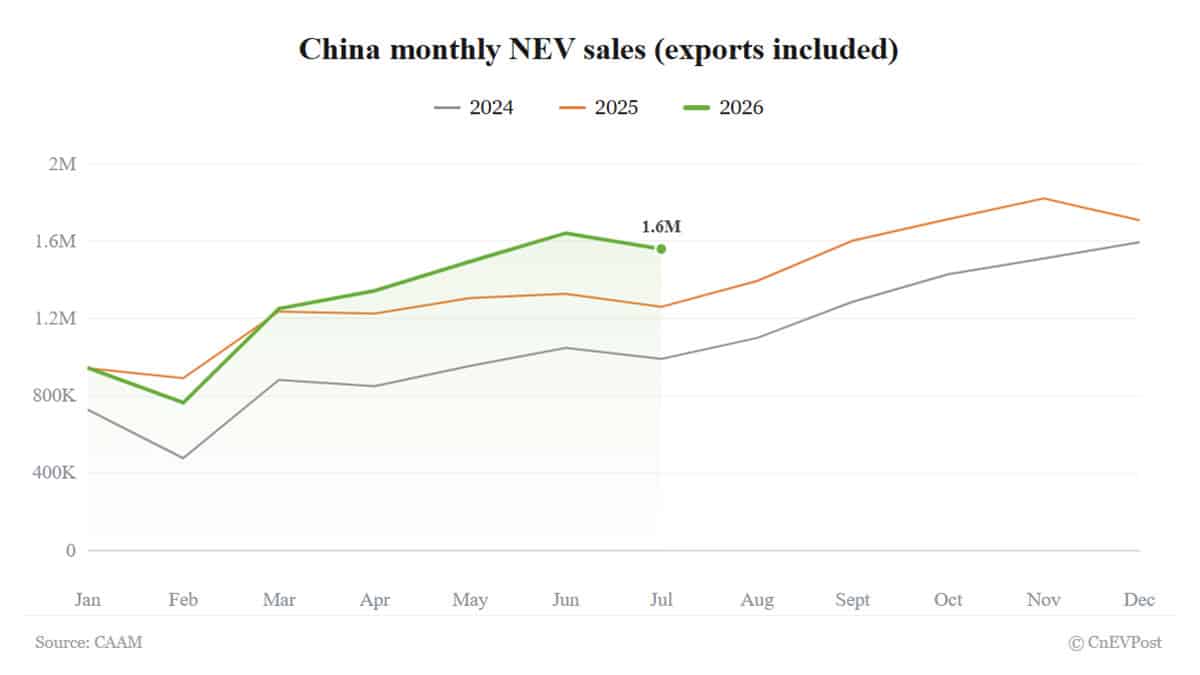
- NEV sales were 1,561,000 units in July, accounting for 60.4% of total new vehicle sales, topping 60% for the first time, according to CAAM data.
- NEV exports reached 553,000 units in July, up 1.5 times year-on-year, pushing China's vehicle exports above 1 million for a second consecutive month.
China's new energy vehicles (NEVs) accounted for more than 60% of new vehicle sales for the first time in July, as strong export growth offset weak domestic demand.
NEV sales, including domestic deliveries and exports, were 1,561,000 units in July, up 23.7% year-on-year while down 5% from June, according to data released Wednesday by the China Association of Automobile Manufacturers (CAAM).
NEV production was 1,576,000 units in July, up 26.8% year-on-year.
That brought the NEV share of total new vehicle sales to 60.4% for the month, breaking the 60% mark for the first time in CAAM's data. The cumulative share for the first seven months of the year also exceeded 50% for the first time.
2024
2025
2026
The NEV wholesale figures released by CAAM cover battery electric vehicles (BEVs), plug-in hybrid electric vehicles (PHEVs) and fuel cell vehicles.
BEV sales were 1,072,000 units in July, up 32.2% year-on-year but down 6.1% from June. BEV output topped 1 million units for a second consecutive month.
2024
2025
2026
PHEV sales were 489,000 units in July, up 8.4% year-on-year but down 2.2% from June.
2024
2025
2026
In the first seven months, NEV output and sales were 9,014,000 units and 9,007,000 units respectively, both up nearly 10% year-on-year.
The overall vehicle market continued its pattern of pressured domestic demand and strong exports. China's total vehicle sales were 2,584,000 units in July, down 0.3% year-on-year and down 8% from June.
2024
2025
2026
Chen Shihua, deputy secretary general of CAAM, said July is a traditional off-season for sales, with showroom traffic and orders naturally easing. A mid-year push pulled some demand forward, while persistent high temperatures and typhoons and flooding in some regions also weighed on offline sales.
The pressure was more evident in the domestic market. Domestic vehicle sales were 1,541,000 units in July, down 23.6% year-on-year and down 13.1% from June. Domestic sales of conventional fuel vehicles were 533,000 units, down a sharp 45.7% year-on-year.
Domestic NEV sales were 1,008,000 units, down a slight 2.8% year-on-year. In the first seven months, domestic NEV sales were 6,099,000 units, down 11.8% year-on-year.
2024
2025
2026
Exports have become the core growth engine holding up the industry. China exported 1,043,000 vehicles in July, up 81.3% year-on-year and up 0.6% from June, topping 1 million for a second consecutive month.
2024
2025
2026
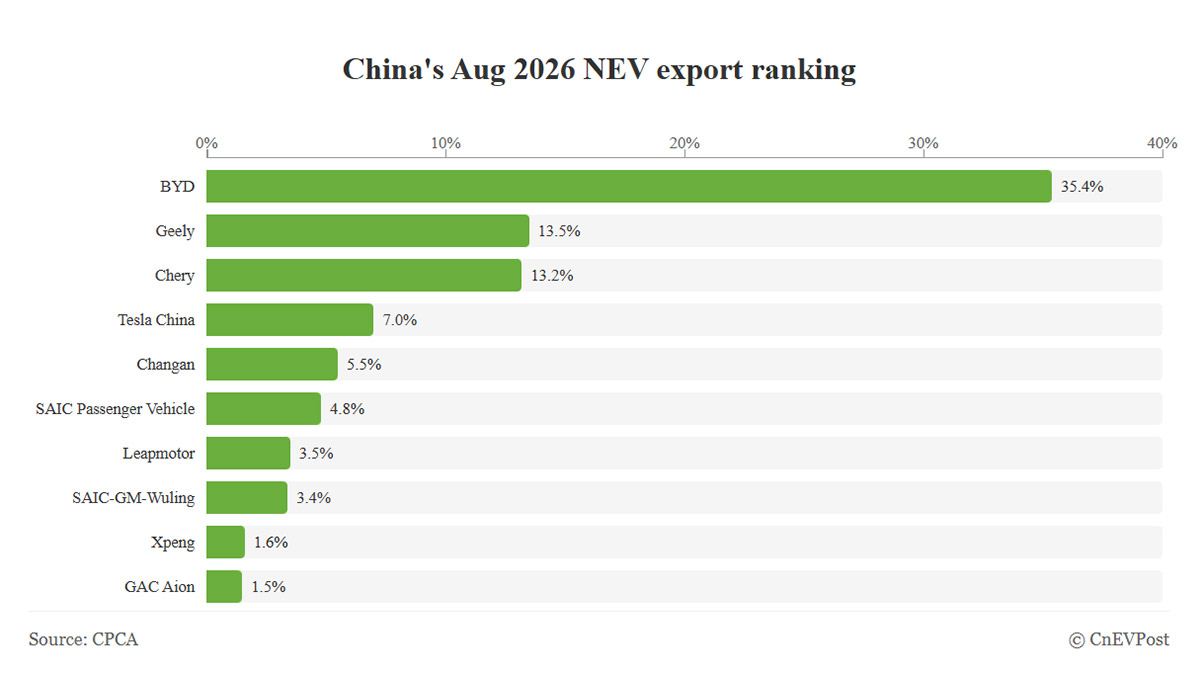
NEV exports rose 145.5% year-on-year to 553,000 units, up 5.7% from June. NEVs made up more than 50% of total exports for a second month.
2024
2025
2026
Exports of conventional fuel vehicles were 490,000 units, up 40% year-on-year while down 4.6% from June.
In the first seven months, NEV exports totaled 2,909,000 units, up 1.2 times year-on-year, while conventional fuel vehicle exports were 3,231,000 units, up 36.2 percent.
CAAM attributed the rapid export growth to China's complete automotive supply chain, from lithium ore processing and battery manufacturing to vehicle assembly, with ample capacity and controllable costs. The rapid iteration of smart driving and cockpit interaction features also helps Chinese automakers match overseas demand more precisely.