Here’s bYD targets over 2.5 million overseas sales in 2027, raises 2026 outlook

- BYD management raised this year’s overseas sales guidance to 1.9–2.0 million vehicles as the previously increased target comes within reach.
- A larger vehicle carrier fleet and an expanded overseas manufacturing footprint will support growth.
BYD (HKEX: 1211) aims to sell more than 2.5 million vehicles overseas in 2027, extending its rapid international growth through a larger shipping fleet and increased production abroad.
Deutsche Bank analysts led by Wang Bin disclosed the target in a research note on Monday, citing BYD management’s comments on a post-earnings call.
Management now expects overseas sales of 1.9 million–2.0 million vehicles in 2026. That is well above the 1.3 million target announced in January and the revised 1.5 million target set in March.
| Year | Overseas NEV Sales |
|---|---|
| 2023 | 242,765 |
| 2024 | 417,204 |
| 2025 | 1,046,083 |
| Jan-Aug 2026 | 1,162,260 |
| 2027 target | 2,500,000 |
| 2026 target (previous) | 1,500,000 |
Overseas markets have become a key counterweight to BYD's declining domestic sales. Overseas sales rose 85.72% year-on-year to 1,162,260 vehicles in the first 8 months, according to data compiled by CnEVPost.
Over the same period, BYD's domestic sales fell 32.72% to 1,505,755 vehicles, dragging total sales down 6.84% to 2,668,015.
Based on sales through August, BYD needs to average about 184,000–209,000 overseas sales per month over the remaining 4 months to meet its latest full-year guidance.
Its overseas sales reached a record 189,466 vehicles in August, up 134.45% year-on-year and accounting for 43.03% of total sales that month.
2024
2025
2026
Management said shipping capacity constrained overseas sales this year and that volumes could have been higher with sufficient capacity.
BYD plans to support its 2027 sales target by expanding its dedicated vehicle carrier fleet, market-share gains and increasing local production overseas.
Its Indonesian plant has started production, its Brazilian plant is ramping toward annual capacity of 300,000 vehicles, and its Hungarian plant is expected to begin assembly in November or December, Deutsche Bank noted.
Management is also evaluating additional overseas manufacturing locations to expand its local production footprint.
Overseas expansion is also supporting BYD's profitability. Management said profit per vehicle sold overseas was about 20,000 yuan ($2,950) in the first half of this year despite currency headwinds.
The company expects overseas profit per vehicle to remain broadly stable in the near term. Gains from higher volumes will be offset by continued investment in sales network expansion and the ramp-up of new factories.
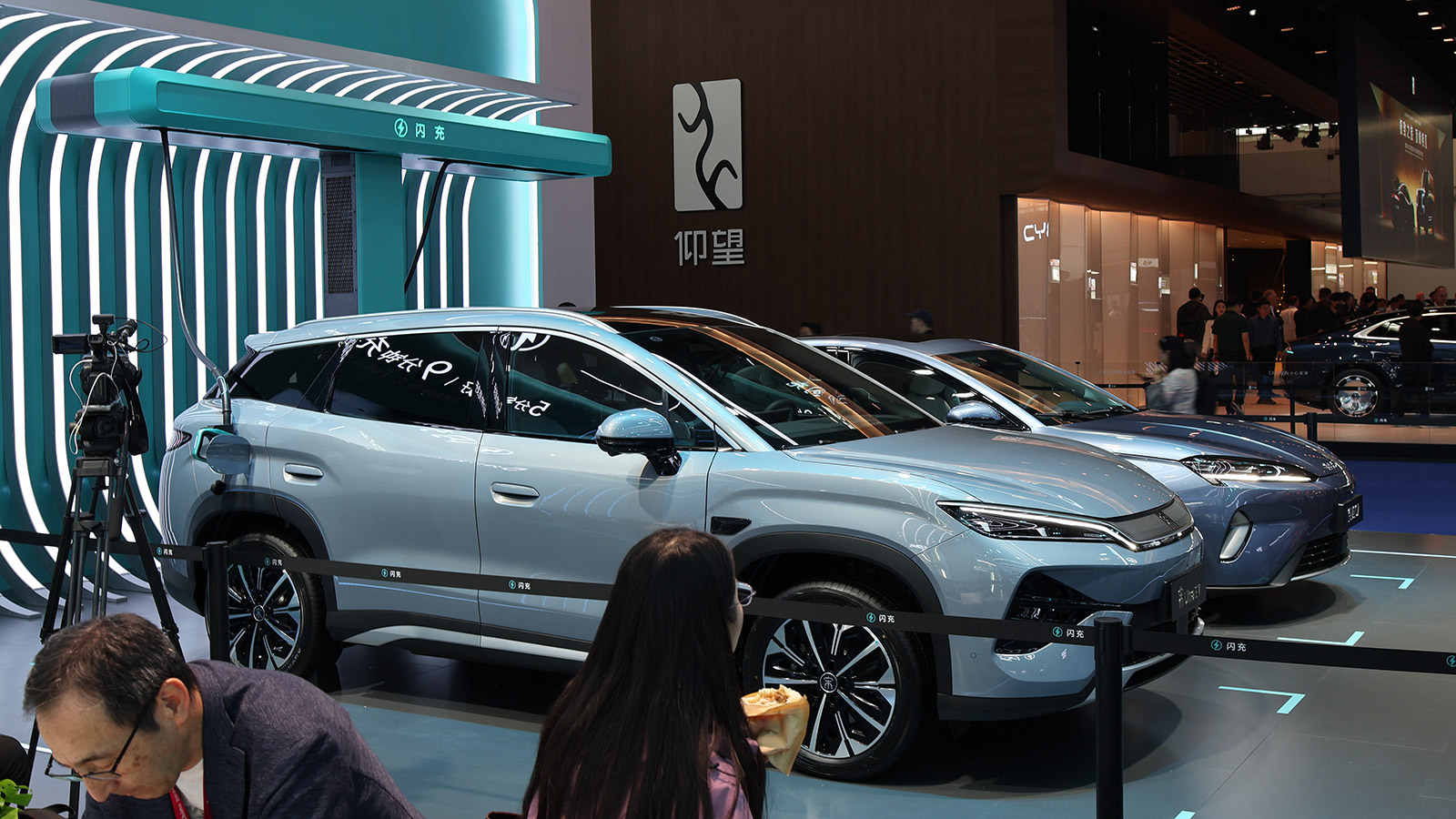
In China, BYD is counting on flash charging technology and its supporting network to drive sales, though battery supply remains a near-term constraint on deliveries.
Management said the order backlog for flash charging-compatible vehicles stood at about 250,000. Supply shortages of the second-generation Blade Battery are expected to be fully resolved in the first quarter of 2027.
The company reiterated its target of building 20,000 flash charging stations in China by the end of 2026, followed by 30,000 additions in 2027 and 40,000 in 2028, bringing the total to 90,000.
BYD also reiterated plans to deploy 6,000 flash charging stations overseas, without providing a completion timeline on the call.
In an interview in July, Li Yunfei, BYD's general manager of branding and public relations, said the company planned to complete 6,000 overseas flash charging stations by the end of March 2027. These would include 3,000 in Europe, 2,000 in the Americas and 1,000 in the Asia-Pacific region.
Deutsche Bank said faster charging and broader network coverage could strengthen BYD's competitive advantage, while customer word of mouth could support domestic sales growth.
Management said BYD's domestic market share had increased in successive months and outlined a target of about 25% of the Chinese market, without specifying a timeline.
Intelligent driving is another investment priority. Management expects a significant improvement in its in-house capabilities in 2027 and is preparing for China's anticipated introduction of Level 3 autonomous-driving regulations that year.
BYD will continue developing its own solutions while allowing external suppliers to compete for projects. Management believes R&D investment, the scale of its vehicle data and vertical integration of hardware and software will help extend its technological edge.

($1 = 6.7795 yuan)