Understanding this Week’s Weird and Wonderful—April 10, 2026
Welcome to the Weekly Weird and Wonderful, our list of the 10 most notable vehicles to appear on BaT this week in our estimation (along with a few more that we couldn’t bring ourselves to exclude). We are up over 1,000 auctions at the moment, so the vehicles below are just a few dishes out of the all-you-can-eat buffet that is our live auctions page, where you can gorge yourself on even more automotive content once you’re done here.

Enjoy this week’s Weird and Wonderful! If you don’t, that’s on you, because there’s some truly great stuff in here.


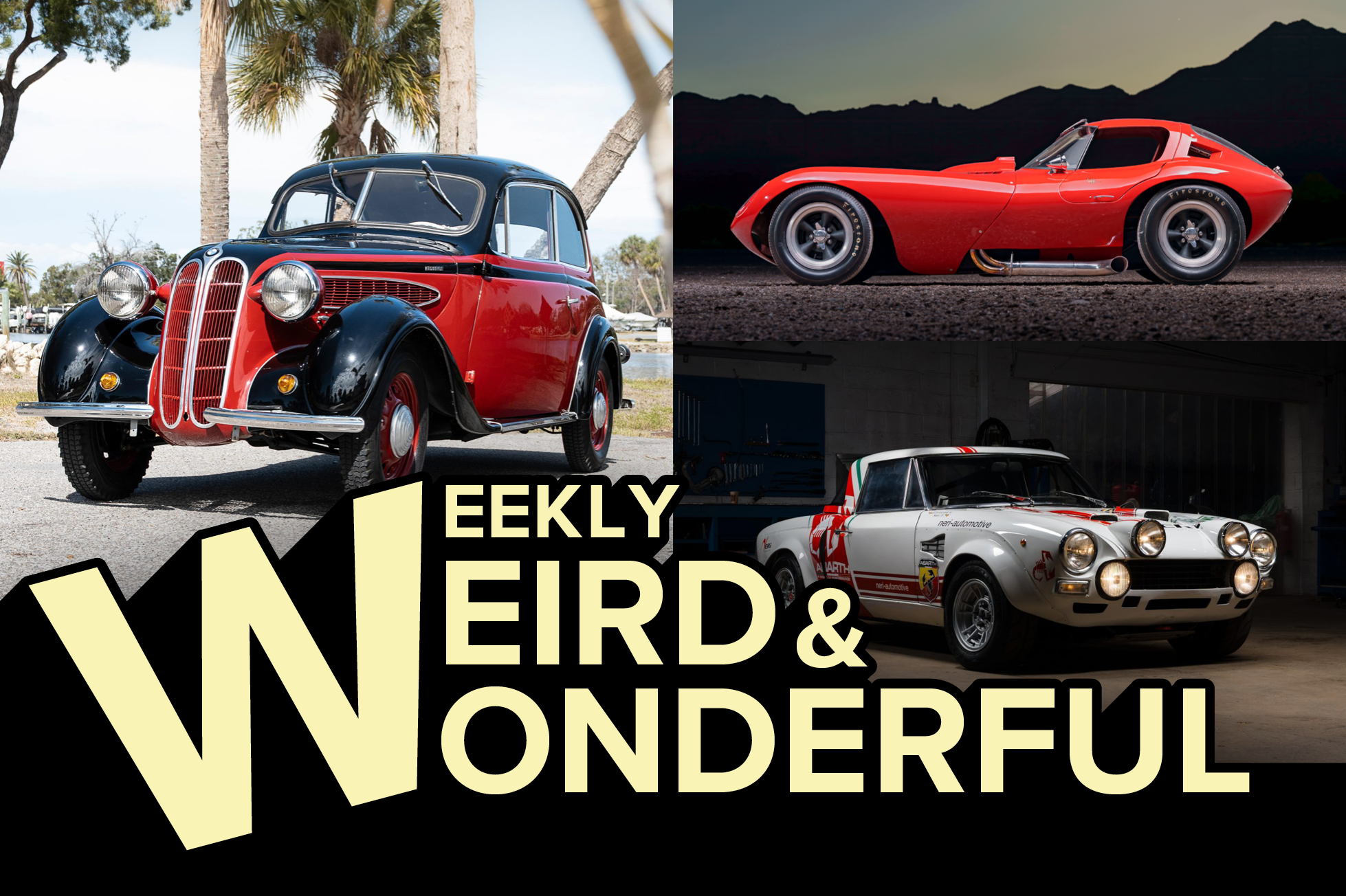
The BMW 320 followed the 329, which itself was an übergangsmodell (now you know how to say “transitional model” in German) that combined the mechanicals of the outgoing 319 with the updated styling from the 326. Compared to the 329, however, the 320 was smaller, more nimble on its feet, and more powerful thanks to a bigger 1,971cc inline-six. It was one of BMW’s last civilian models before World War II, and was produced from 1937 to 1938. This two-door sedan survived the war and eventually made its way into Canada by the mid-1980s. It was refurbished before the selling dealer’s acquisition in 2016, and is now offered out of New Port Richey, Florida, with records tracing back to Czechoslovakia in 1954.


We get a lot of Fiats and we get a lot of fire trucks, but we don’t see many Fiat fire trucks. This one served with the Vigili del Fuoco in the Piedmont province of Alessandria and now resides just east in Liguria, for any Italian geography nerds out there. These were initially military vehicles used primarily for transporting cargo, but the 6602 variant was designed for civilian use. Thus, the flatbed it currently wears likely reflects how a truck like this might have been configured during Italy’s shaky Cold War years.

Worth noting is that this truck is right-hand-drive, as is the Stepnose GTA also up for auction as of this writing. They’d make a handsome pair. Also, the cool Roman numeral shift knob is worth a gawk.
1966 Bill Thomas Cheetah Coupe


Bill Thomas and Don Edmunds built the Cheetah as a “Cobra Killer,” but that’s a story for another day. This example stands on its own. A bona fide coupe, this Cheetah is believed to be the last of its kind built out of Thomas’s Anaheim shop for one Eddie King in the mid-1960s. King traded it away in 1968 for $4,500 in cash and a split-window C2 Fuelie, and its second owner held onto it until 2007. And boy, did he hold on to it—after it was listed for sale in the pages of Autoweek in 1980, its next owner apparently spent more than 20 years negotiating the purchase.
It’s since been refreshed and shown on the green, but what matters is how it drives. Local Partner @911r has graciously provided us mere mortals with a motion picture of this Cheetah on an afternoon run, letting its 377ci Chevy V8 rawr through the streets of Arizona.
Multi-Gen Bodied, 392-Powered 1991 Ford Mustang LX Convertible


Behold the Omni-stang! This is a ’91 Mustang LX whose builder took a “one piece at a time” approach, combining the bodywork from multiple Mustang generations—including an S197-style nose and fenders and SN95-style rear bumper and quarter panels. Beneath its new skin it’s still all Fox, with a number of upgrades like QA1 front coilovers, Wilwood brake calipers, and a pushrod 392ci V8 to keep it moving along.
2023 Watersports Car Series M 16′
Open water performance was always the Achilles’ heel of the iconic Mercedes-Benz 300SL. The Watersports Car solves this longstanding problem once and for all by skinning a Yamaha-powered jet boat with a silhouette resembling MB’s mid-century masterpiece. Like the original, it has side-exit exhausts tips, wide sills to negotiate on entry, and a fuel-injected engine. And like many real 300SLs, it rides around on its own trailer!
3.0L Busso V6–Powered 1962 Ghia 1500 GT 5-Speed


The 1,481cc Fiat four originally stationed under the hood of the Ghia 1500 GT wasn’t a bad motor, but engine swaps are more common with these cars than one might expect with a limited-production coach-built Italian coupe from the 1960s. A previous owner of this car decided to go for broke by installing a sweet-sounding 3.0-liter Busso V6 with its own horn section in the form of three twin-choke Weber carburetors. The Ghia body sits pretty far back on its Fiat 1500 chassis, allowing plenty of room in front of the firewall for the larger motor. The removed stock drivetrain remains with the car, and amazingly, BaT user @Fiatplus (presumably associated with parts supplier fiatplus.com) states that they have the original tooling to reproduce the missing badges. Like everyone else in the comments, we need to hear this car in action, and thankfully the seller says that video is forthcoming.


The sporting nature of the Jowett Jupiter isn’t immediately apparent upon first glance, but look past its taxicab nose and you will see a blue-blooded British roadster. The construction of the car is on par with contemporary Italian sports cars: a well-braced tube-steel chassis with aluminum bodywork over a steel framework (dare we say superleggera?), an adjustable sway bar, rack-and-pinion steering, an aluminum engine, and torsion-bar suspension. The Jupiter was considered by auto journalists to be eminently tunable and chuckable, and it achieved class wins at Le Mans and the Monte Carlo Rally in period, making a race car conversion a logical if unusual choice. This car has a great history in vintage racing competition and an FIA passport good until 2034; its résumé includes the Le Mans Classic, Spa 6 Hours, and multiple appearances at Goodwood.
1951 Salmson S4-61 Saloon Project


Some prewar platforms continued on after the close of WW2 for expediency’s sake—there wasn’t money to develop new designs or tooling. But the Salmson S4 was sophisticated enough that its technology didn’t really seem dated when it was rebooted in 1946. This despite the fact that the British bombed their factory while France was under German occupation, likely to keep Hitler from taking advantage of their aviation manufacturing capabilities. This 1951 example, from the penultimate year of Salmson’s existence, is configured as a right-hand-drive pillarless saloon with some exotic-for-the-time equipment like a twin-cam four, a Cotal semi-automatic gearbox with electromagnetic clutch activation, an independent torsion bar front suspension, and rack-and-pinion steering. Postwar demand was for smaller cars, so these were rare even in their day. Finding and fabricating parts is going to be a labor of love, and we’re excited to see who steps forward to take on this project. At least the awesome Jaeger combination gauge set appears largely intact.


It wasn’t until five years after the Fiat 124’s debut that the Turin-based firm embarked on a works rally program. By 1972, Fiat was seeking to build a more competitive car, and of course enlisted Abarth to deliver on it. The resulting 124 Abarth’s rallying success was one of story and song, and this example is one of some 995 examples produced for homologation in FIA Group 4 competition between 1972 and 1975. Updated during the mid-2010s, this car proved its abilities on the Circuit Goodyear in Luxembourg with former F1 driver Arturo Merzario at the wheel. It has continued to play in the dirt, mud, and tarmac at events such as the Boucles de Spa and Ardenne Rally Festival, and is offered by BaT seller @RIGOLO in Beaufays, Belgium.
Ex–Carroll Shelby 1989 Shelby CSX-VNT #1 and Dodge Daytona Turbo Z Concept Car & PPG Indy Pace Car

These two special Dodges come out of the Straylight Collection, and were brought to us by @Bill_Noon. The CSX-VNT was Carroll Shelby’s personal car, and the first in the production sequence. The CSX was the sequel to the Dodge/Shelby Omni GLH and GLHS, and the VNT variant was released for the final year. Cool fact: the CSX-VNT was turbocharged and intercooled, and the Garrett turbo featured a variable nozzle and movable vanes in the impeller, which were controlled by computer and negated the need for a wastegate.

This Daytona doesn’t have Carroll Shelby’s name attached to it, but its performance accomplishments are far more impressive and show what the K platform was truly capable of when put to the test. It looks a little sleeker than the production Daytona Turbo Z because it was a concept car developed in partnership with PPG, and as such lacks road equipment like turn signals and marker lights. After serving as a pace car in the Indy Car World Series in 1983 and ’84, it was further modified. This humble front-driver clocked a top speed of 173.222 mph at Goodyear’s test track in San Angelo, Texas.
Honorable Mentions
2015 Volkswagen Passat TDI SE Limousine

Yes, the factory made a wagon variant, but the name Passat was taken from a famous trans-oceanic cargo ship—so there was precedent for the builder of this car to add some length to the hull.
1990 Ford Mustang LX 5.0 Ronnie Sox Signature Series 5-Speed

There’s no shortage of special edition Fox-body Mustangs; among the lesser-known is the one-year-only Ronnie Sox Signature Series LX. This Ford is said to be one of 87 examples modified by Shotgun Customs of Fayetteville, Georgia. Aside from a Hurst quick-throw shifter, the upgrades were largely cosmetic.
Jim Farley’s 1972 DeTomaso Pantera

This split-bumper Pantera was originally property of FoMoCo (specifically their Aeronutronic aerospace division), and returned to the fold when Ford CEO Jim Farley bought it off of BaT in 2024. The car was substantially spiffed up by its previous owner and received the royal treatment while in Mr. Farley’s care.
Ex-Charlie Sheen 1998 Prevost Marathon XL Tour Bus

The late 1990s was not the time for Charlie Sheen to be behind the wheel of an automobile, so this Prevost XL bus served as his chariot while he presumably Sheened out in the back. It has two red velour couches, two black toilets, and a cabinet full of empty whiskey bottles. More recently, it was acquired by hard-country-rock (aka “shredneck”) musician Tim Montana, who added a bunch of bunks to haul himself and his band around on tour. It should be noted that Montana—who is in fact from Montana—just released a new album, and is capably representing the bus himself in the comments.
Thanks for checking out this edition of the Weekly Weird & Wonderful! Follow this page to get updates when new installments post, and tell what caught your eye or what you think we’ve left out!