
Question of the Week: What’s Your Favorite Piece of Automaker Lore?—WINNER’S UPDATE — Explained
WINNER’S ANNOUNCEMENT:
We’re back to announce the winner for our Question of the Week, where our victor will accept a $25 credit for a hat or T-shirt from the BaT Gear Store and the acclaim of their peers.
Our question this week: What’s your favorite piece of automaker lore?
Thanks to everyone who wrote in! We’re leaning heavily on the People’s Choice, and this week’s winning nomination is a tale of a cash grab, in the literal sense. We’re handing the prize to BaT member @angushopper, who submitted the most-liked comment this week for the Carroll Shelby $100 Challenge:
Our compatriots over at Car and Driver tested a 427 Cobra in their November 1965 issue and noted that “[it] does accelerate and decelerate at unbelievable rates, as the figures should imply.” We’ll leave it at that. Either way, it’s a great piece of automotive lore.
Congratulations, angushopper! Be sure to check your email to claim the prize.
Now, let’s take a look at some other popular nominations from this week’s discussion thread:

“Enzo’s dismissal of Ford during the failed merger, and noting that they made ugly little cars in an ugly factory lit a fire that we still benefit from today. The GT40 is one of my favorite cars to hear, and see in motion and at a standstill.
P.S. – I wonder what he would think of the ugly little Luce ;)”

“Way back in time, there is the story of the guy that answered the newspaper classified, for a “1963 Chevy, two door manual, low miles. $2000 or best offer”.
The guy shows up expecting to find a Biscayne, but inside the garage is a 1963 Split window Corvette. Seems the divorcee wanted to get some revenge…”

“Before his rise to fame as a movie director, George Lucas turned wrenches for Carroll Shelby as a team mechanic on Allen Grant’s 289 Cobra. Grant inspired the character John Milner in Lucas’ American Graffiti.”

According to Shelby American, George Lucas was also Allen Grant’s crew chief and even helped design the livery for his Cobra.
@CarDogThreePedals with a lesson on malicious compliance:
The Chrysler Imperial Lamborghini Edition.
Bob Lutz and Tom Gale were tasked with Lee Iacocca’s order to make use of his latest purchase, Lamborghini. How so? To give their upcoming biggest K-Car variant ever produced even more flair. Upscale flair.

Well, they did. Lutz and Gale put together a Lamborghini Edition Imperial and made it so over the top, that even Landau-top Lido agreed that it was just too much. I’d pay money to see a real picture of it. I bet it looked good. Besides, having a Lamborghini Edition Imperial alongside a TC Maserati would have been “NVTS nuts.”
Lido’s purchase did actually pay off, but in a way nobody could have planned. For Lamborghini helped Chrysler tune the upcoming Viper V-10.
“Maximum” Bob Lutz tells it best.
@Ranchero65‘s tractor tale:
My favorite is the “handshake agreement” between Henry Ford and Harry Ferguson. I guess it counts since Henry Ford was an “automaker,” even though the story isn’t about cars.
Ford was an industrialist, but he always remembered his farming roots and strove to lessen the workload on the American farmer. That’s why he started building tractors in the teens (1916-ish). However, he got disenchanted by the cutthroat pricing competition and gave up tractor production in the US in the late 20s. Enter Harry Ferguson from Ireland in 1938. He had this invention called the three-point hitch that not only made attaching and using implements easier; it also transferred the weight of the working implement to the rear wheels in such a way that a small tractor could outperform a larger machine. He set up a meeting with Ford to demonstrate his invention.
Ford was sold and immediately wanted to buy the patent. Ferguson said no, it’s mine. Ford then wanted to buy licensing rights. Ferguson said no. What Harry wanted was for Ford to build tractors using his “Ferguson System,” as he called it, and Harry would set up a dealer network and sell the machines and the implements. They hammered out the agreement and shook hands on it. It was never put down in writing.

The result was the Ford 9N Tractor with Ferguson System. The three-point hitch went on to become the standard of the industry (once the patents expired and everyone could incorporate it into their tractors).
The second part of the story is after Henry died and The Deuce took over. He reviewed the entire company’s financial situation and realized the Ford was losing money on every tractor built while Harry was raking in the money with his dealership network. Henry II told Harry to take a hike. Ford was going to build their own tractor using the three-point hitch, sell them through their own dealers, and no, they weren’t going to pay Harry a dime for his invention. The redesigned Ford 8N was the result. Harry sued, won, and got paid $10 million, but it took years. He at first created his own tractor company, building a 9N look-alike called the TO-20 or TE-20 (tractor overseas or tractor England…depending on where it was going to be sold). He even used a set of Ford blueprints in his possession to design the tractor.
A few years later, he sold the company to Massey-Harris, which became Massey-Harris-Ferguson and was later shortened to Massey-Ferguson.
“I would have to go with Enzo Ferrari commenting that the Jaguar E-Type was “the most beautiful car ever made”.”

@soquelz writes in with some Datsun lore:
Win on Sunday, sell on Monday. In the ’60s and ’70s, this was the thinking among the big three US automakers. Enter a largely unknown company from Japan named Nissan. During the ’60s, Japanese cars were considered cheap and unreliable by many Americans. Nissan was eager to sell cars to the American market, but they were also concerned that if things didn’t work out, it would harm the company’s image. The solution? First, go with another name for the cars destined for the American market. Enter Datsun. Then take the new Datsun 240Z and 510 and go racing.


They picked a couple of American teams to do just that. Pete Brock, from Shelby fame, and Bob Sharp, a Datsun dealer on the East Coast. Just one problem, though: the crankshafts in their engines were not designed to take the high rpm’s of racing. This was discovered by the Americans, and so they sent the cranks back to Nissan for a redesign. This while not knowing if they would accept the failure in design and fix the problem. The Japanese executives swallowed their pride and had the cranks redesigned to withstand the rigors of racing. Had they not done this, the Datsuns would not have had the success on the track that led to Americans lining up to buy them. If they had stood pat, this could have, and probably would have, furthered the image of cheapness Americans had at the time about Japanese cars. One bad part design correction helped to put a whole country’s automotive industry in motion that is still here today.
@IsAlwaystheAnswer on how Porsche’s CEO helped save the 911 with nothing but a marker:
Porsche 911’s future saved by American CEO Peter Schutz with a marker.

Picture this: Stuttgart, 1981. In a conference room full of very serious German engineers, the kind who iron their socks, they’ve got a chart on the wall showing Porsche’s future models. The 928 line goes on. The 944 line goes on. And the 911 line? Stops. Dead. Peter Schutz walks in, sees this chart, grabs a big, fat Sharpie marker, and extends the 911’s line right off the chart, across the wall, and out the door. On the way out, Schutz turns to Helmuth Bott, head of engineering, and delivers the most American-German hybrid sentence ever spoken: “Do we understand each other?”
And we’ll end with the story of @trusted_one making friends with Harrison Ford:
After seller’s remorse for selling my NSX, I saw one listed but with some one-of-a-kind features like front and rear radar detectors, a Doeskin-like interior, and very, very low miles. I called the listed phone number, but the guy on the other end wasn’t the owner and couldn’t answer my questions, but said the owner was in the “entertainment business.” Said he would check with him on my questions. An hour later, my phone rang.

“Hi trusted_one, this is Harrison Ford, and I understand you have some questions on my car.” The name didn’t register in my brain as I was focused on the car. “Yes, Harry, why are you selling your NSX?” “It’s Harrison, not Harry, and I’m selling it because it draws too much attention, so I just drive my old Honda Accord,” I asked where the NSX was located, and he said it was on his ranch in Wilson, Wyoming. I said I grew up there as a kid and fished near his ranch. “Say, what was your last name again, Harrison?” Ding, ding, ding! Oh, you are that Harrison Ford! We ended up talking for quite a while about good fishing and secret hiking spots. Never bought the NSX but made a friend.
“Harry” was a straight-up, down-to-earth guy. If my memory serves me right, he received the car for doing a commercial in Japan for Honda. Anyone out there own this unique black NSX with a folklore ownership history?
There were so many other great stories—we wish we could feature them all, but they will remain in the comment thread below for posterity. Congratulations once again to our winner, angushopper. We’ll be back with a new Question of the Week soon!
ORIGINAL POST:
Welcome to the BaT Question of the Week! For those unfamiliar, here are the rules: we ask an automotive-themed question, and the author of our favorite answer from the comments is awarded a $25 credit to the BaT Gear Store.
This week’s question is: What’s your favorite piece of automaker lore?
The more interesting parts of automotive industry history contain countless obscure tidbits, stories of legendary rivalries, wild urban legends, and even a particular tale involving some illicit contraband. This week’s question focuses on these stories of yore, apocryphal or otherwise. Here are two examples to kick off the discussion:

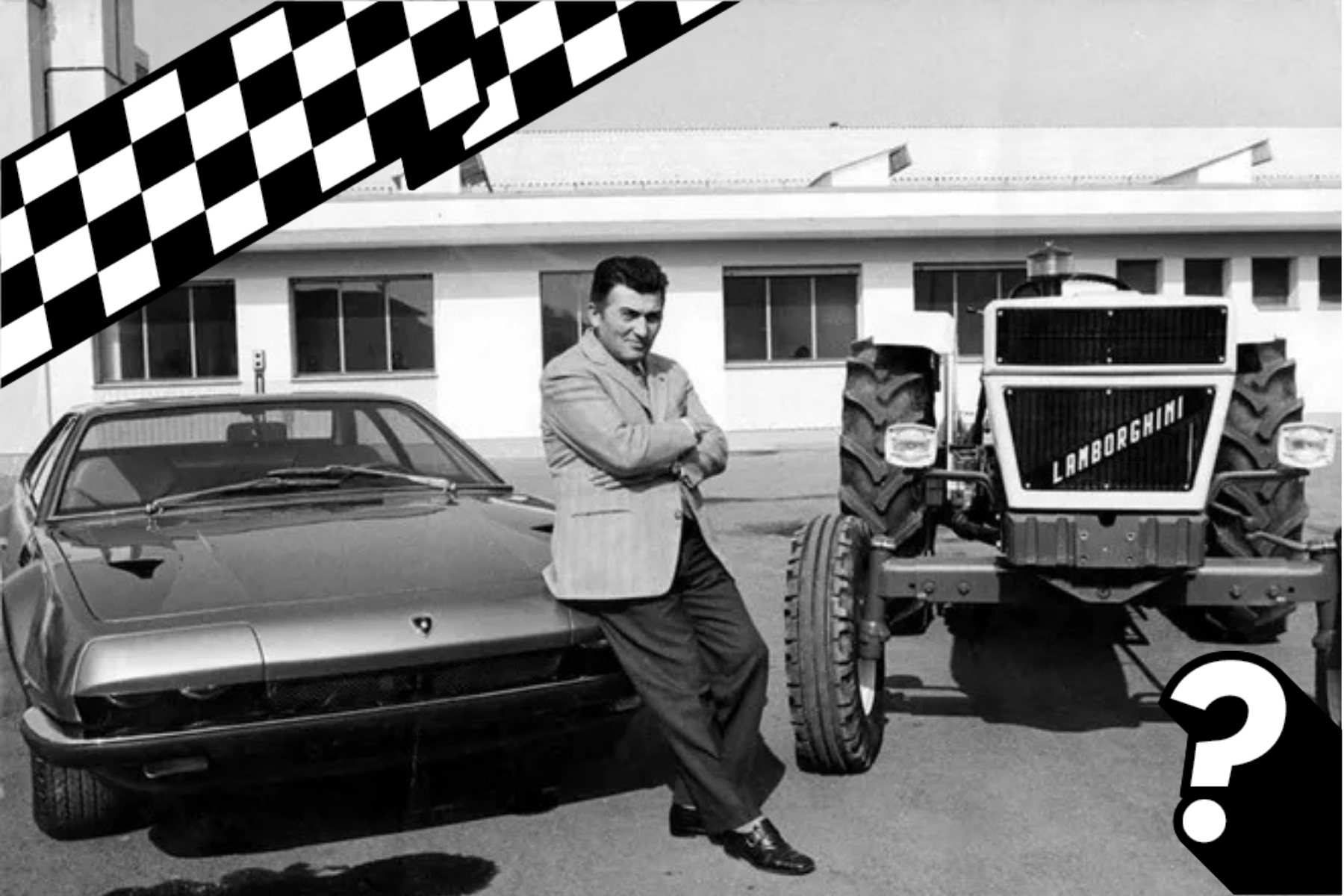
It is said that tractor tycoon Ferruccio Lamborghini set out to build the 350 GT out of spite after Enzo Ferrari dismissed his criticisms and told him to stick to making tractors. The insult ironically kicked off a longstanding rivalry, allegedly.

Another story involves GM styling chief Bill Mitchell ordering his staff to paint the “Mako Shark” Corvette concept car to match a a taxidermy shark trophy mounted on the wall of his office. After failing several times, the designers made the decision to steal the shark and paint it to match the car. Did it really happen? We don’t know, but it’s a great story.
We’ll save the rest of ’em for the comment thread and pass it off to you:
What’s your favorite piece of automaker lore?
Tell us your suggestions in the comments, and give a thumbs-up to any nominations that grab your attention. We’ll announce the winner on Monday.



“The Carroll Shelby $100 Challenge:
To demonstrate the raw power of his 427 Cobra, Shelby would tape a $100 bill to the dashboard and if a passenger could reach out and grab it while he launched the car under full acceleration the passenger could keep the money.
Allegedly no one was ever able to grab the bill.
I have no idea of the veracity of this story but have heard it most of my life.”
16
angushopper commented on Question of the Week: What's Your Favorite Piece of Automaker Lore?—WINNER’S UPDATE