What to Know About this Week’s Weird and Wonderful—February 6, 2026
Welcome to the Weekly Weird and Wonderful—the recurring Friday feature in which we highlight a small collection of the coolest, strangest, and most interesting cars currently on BaT. There is a distinct lack of snow in the photo galleries of our picks today, which we’re going to take as a good sign since we don’t think hole-dwelling rodents are competent meteorologists. Temperatures aside, we have noticed that the days are getting slightly longer, and we encourage you to spend your extra allotment of daylight perusing all of the other treasures on our live auctions page once you’ve gone through the collection of gems below.

Enjoy this week’s Weird and Wonderful, and let us know what else caught your eye in the comments!
427 SOHC “Cammer”-Powered 1959 Ford Thunderbird Coupe 3-Speed


Square ‘Birds are pretty distinctive to begin with, but this one has received the engine swap of all engine swaps—a Ford 427 cammer. Back in 1964, these mighty motors were made available to racing teams, professional builders, and a few dealership networks capable of fielding their own stock cars (the official count is unknown, but is thought to number between 500 and 1,000 complete engines and several dozen sets of heads). Fourteen years later, a large batch of engines and parts made their way into private hands through “The Holman & Moody House Cleaning Everything Must Go Yard Sale of the Century Catalogue.” If you find yourself in need of one of the engines, HM still traffics in their sales and maintenance.


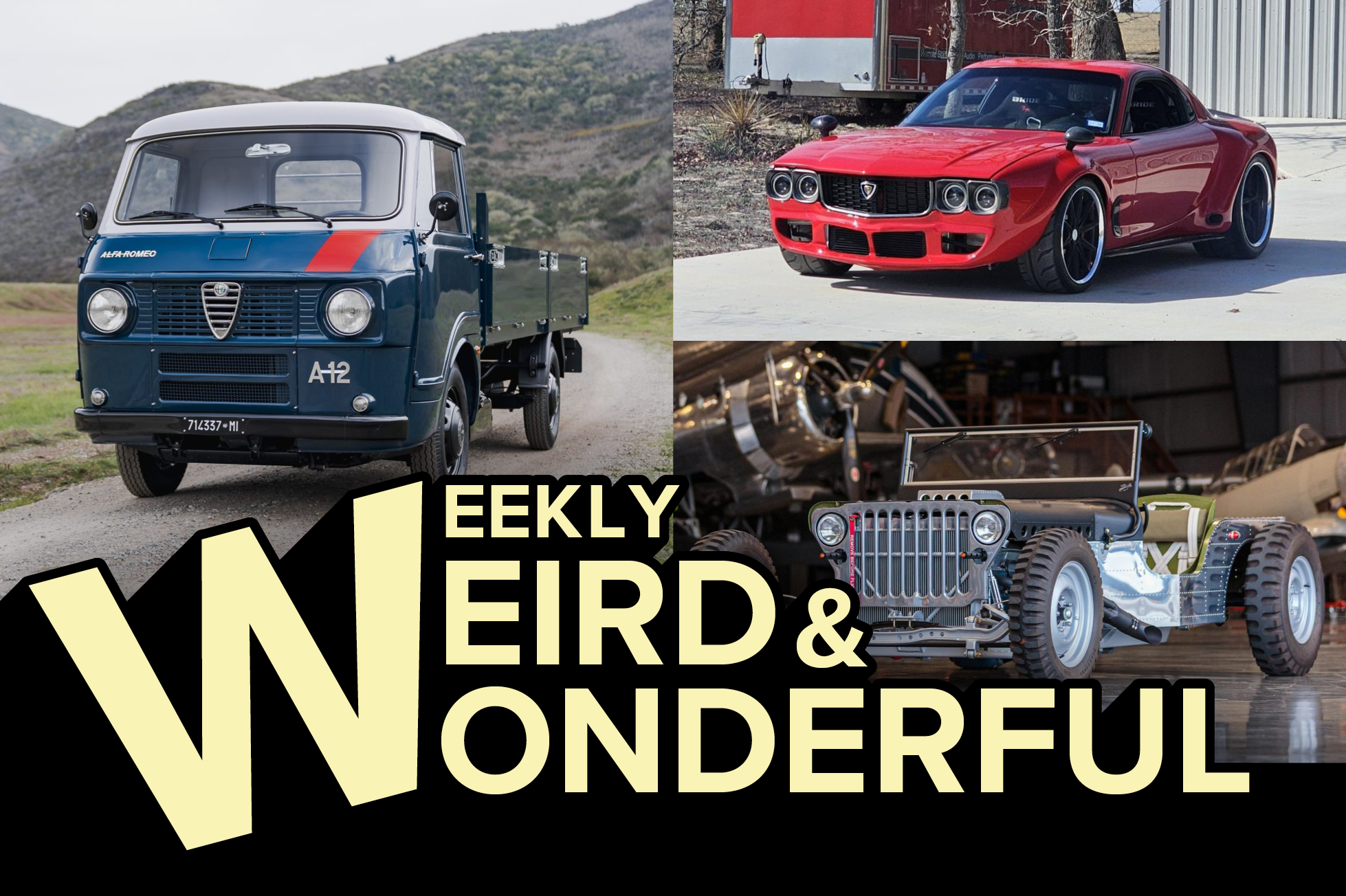
Alfa’s history with forward-control light-duty rigs dates back to the early 1950s, beginning with the Autotutto (all-purpose) series. This A12 flatbed pickup was built in 1971 and is powered by the only engine offered that year—a 1,2900cc Alfa twin-cam nestled in the doghouse like a very good boy. The truck underwent an extensive refurbishment before first crossing the BaT auction block in 2019, and now it’s back for a second run.

It can fit another Alfa piggyback like it’s nothing, as shown above at The Quail in 2024, but technically this is a utilitarian pickup and not a car hauler—not that you’re going to void the warranty or anything.
1922 Lincoln Model L Seven-Passenger Touring Car Project

Cadillac and Lincoln are like the Jacob and Esau of the American automobile industry. The two marques were birthed from the same father, Henry Martyn Leland, and their history together is complicated. Cadillac came first, when the investors backing the Henry Ford Company hired Leland as a consultant and ran Henry the First out of his own factory. Lincoln came later, when Leland split off from GM to build V12 aircraft engines for the war effort in 1917. Leland pivoted to luxury cars post-Armistice and built around 3,000 of the the pricey Model L before financial troubles got the better of the company in 1921. The following year, Ford Motor Company purchased Lincoln for a song and a smirk, and has owned it ever since.

The example above is an open touring car from the final model year of Leland’s tenure, and is the only Leland-build Lincoln we’ve seen on BaT to date. Predictably, the appearance of this car has brought some knowledgeable folks out of the woodwork, including a BaT member responsible for maintaining the Lincoln Owner’s Club L Registry—a good friend to have if one intends to take on this car as a project.


The Trail-Breaker, originally known as the Mototractor, was built for a variety of folks ranging from farmers to off-grid preppers. Charles Fehn’s patented innovation was an obstacle-tackling motorcycle with two driven wheels, but that’s only one of the features that made it unique. A series of shafts and chains matched grip by marrying the front and rear wheels together. That same system allowed the front disc brake—a first for a production bike—to stop both wheels, which doubled as 4.5-gallon drums storing the rider’s choice of water or fuel.
1914 Cartercar Model 7T Touring Project


Image: Mac’s Motor City Garage
This 1914 Cartercar Model 7T is the second vehicle from the marque that we’ve hosted on the site, and both featured versions of the famous “gearless” friction-drive transmission; conceptually, this was the CVT’s brass-era ancestor and was marketed as having 1,000 speeds! A lever at the driver’s right hand directed where the friction wheel made contact with a spinning disc attached to the engine, dictating speed and gearing. When moved forward, the friction wheel slid outward for increased speed; when moved rearward, the closer the friction wheel got to the center, resulting in lower speeds but higher torque. An attached chain translated every motion to the rear wheels. This example is in need of work, but the cosmetics look to have been well cared for.
Aircraft-Themed Willys-Style “Warbird Jeep” Custom

The seller and builder of this “Warbird Jeep” is an airframe structural mechanic at vintage aircraft specialist Aerometal International, and as such knows a thing or two about the substantial challenges and expenses of maintaining and operating WWII-era planes. Not that making one’s own warbird-themed Jeep-ish custom rod is any less labor intensive (the builder estimates ~3,500 man hours in an article about the project), but at least it should be more cost-effective to operate than, for example, the DC3/C-47 seen in the background of the photo gallery.


The seller’s commitment to period aircraft construction is more than cosmetic: the polished aluminum skin is button-riveted, dual controls are cabled like on a WWII bomber, the front turn signals are mounted at the ends of .50-caliber gun barrels, and a pitot tube and vacuum system power many of the instruments, including the compass gyro. We especially love that the Chevy small block is painted Pratt & Whitney Twin Wasp blue. Without wings, the driver is restricted to low-level strafing, which is fine so long as one can avoid friendly fire, and the lack of doors makes bailing out a fun stoplight pastime rather than a matter of life and death.
1988 Toyota Celica All-Trac Turbo and 1991 Toyota Celica GT-Four RC


These two racing-inspired Celicas were built for opposite reasons. The earlier car was produced to celebrate a racing victory, specifically the 1986 IMSA GTO championship won by Dan Gurney’s All-American Racers while driving Celica silhouette cars. Conversely, the gray car was built in anticipation of future racing success, being one of 5,000 made to homologate the new ST185 Celica for WRC competition.


Though the Celica All-Trac Turbo commemorated road racing victories, it was a model that had begun to enjoy success on the rally circuit, often with a young Carlos Sainz at the wheel. Its turbocharged and intercooled 3S-GTE four-banger made 190 horsepower in stock tune, which was right in line with other Japanese sports cars and GTs of the time, and its viscous-coupling AWD system gave it a sure-footedness that could go head-to-head with any Audi or Subaru from the era.


The GT-Four RC was produced exclusively for the Japanese market—an early example in a long line of cool RHD performance cars that Westerners could only experience in magazine pages throughout the ’90s. This car embraced its WRC intentions more openly than the All-Trac Turbo with equipment like OZ Racing wheels, extra lights, fender flares, and a variety of scoops and bulges about the hood. With a water-to-air intercooler and some other tweaks, another 40 horsepower was wrung out of the 3S-GTE motor, and within a couple years, the ST-185 model delivered back-to-back WRC Manufacturer’s championships for Toyota in 1994 and ’95.
SEMA-Displayed, Twin-Turbo 2.6L Four-Rotor 1993 Mazda RX-7 6-Speed


There’s no doubt about it—this is a polarizing car. But it’s worth noting that the FD RX-7 that underpins this build was a serially-wrecked project car deemed beyond restoration. The seller, here cast in the role of Victor Frankenstein, brought it back to life as an all-wheel-drive monster with the nose of an RX-3, C7 Corvette suspension, and a Lamborghini transaxle, grafted together with the aid of some dark magic.
In place of a heart is a twin-turbocharged, 2.6-liter barrel of fun housing four triangular rotors, said to make 1,182 horsepower and 775 lb-ft. of torque with boost set to “moderate.” Like Frankenstein’s monster, it is a confused beast both powerful and intelligent, and it certainly sounds like it’s out to destroy humankind. It has been spotted at SEMA, in the pages of Motor Trend, and all over the Internet, and it’s now seeking its next victim.
217-Mile 2023 Rewaco PUR3 Touring

We were saddened to see that this strange trike has ABS, because it makes our inner seven-year-old want to do spinouts at the end of our parents’ driveway, big-wheel style. But the Rewaco PUR3 Touring is kitted out for stable, comfortable, high-speed cruising, and that’s pretty fun too, so we shouldn’t be complaining. The recumbent seating position is lower than “Harley Softail,” and heads straight into “German engineering nerd” territory. This is entirely appropriate, since Rewaco is a German company that has been building trikes exclusively since 1991.

Though it is classified as a motorcycle, the PUR3 becomes more car-like the further one gets into its details; it is 12′ long, built on a tube frame, and motivated by a Mitsubishi passenger car engine paired with an automatic transmission that includes a reverse gear. It has a handbrake. And a glovebox. And a trunk.


The Touring package adds features like a front fairing, additional storage compartments, and cruise control—the rear seat even has armrests, fer cryin’ out loud! We don’t see a cupholder, but maybe we aren’t looking hard enough. We realize there is a big subset of motorcycle riders who are going to take issue with this trike, but here at BaT we believe in the adage “there’s a butt for every seat,” and the Rewaco blends luxury features and motorcycles in ways we haven’t seen before.


The Sapporo was among the many captive imports of the Great Malaise era, and was based on a Mitsubishi Galant Lambda. Like other Mitsubishi-based Chryslers, this first-year example used “Silent Shaft” technology (essentially a balance shaft). Unlike other Japanese-based captive imports, the Sapporo made no attempt to conceal its origins, and was proudly named after the city in Japan’s Hokkaido prefecture. Considering most Malaise-era cars have returned to the earth from whence they came, this Sapporo has stood the test of time.
Honorable Mentions:
Ex-Hunter S. Thompson 1972 Husqvarna 360C Enduro

We’ve listed many Yamahas and Kawasakis, Triumphs and Maicos, CZs and Bultacos. But this is Hunter S. Thompson’s Husky! The gonzo journalist bought this Swedish fireball in June 1972, a year after his infamous madcap coverage of the 1971 Mint 400. The bike was purchased by the seller in 2022 and subsequently refurbished by marque expert John Lefevre.
1957 Mercedes-Benz 300Sc Einspritzmotor Roadster

The 300SC comes from the early days of the fuel-injection era at Mercedes-Benz. A mere 53 300Sc roadsters were manufactured, and this example is the first open-top version on BaT. The car was once owned by Blue Angels pilot and television producer E. Duke Vincent, and today it’s wonderfully presented by @1600veloce.
1997 TVR Cerbera 4.2 LHD Conversion


Anyone who grew up playing the Gran Turismo franchise has most likely fantasized about a left-hand drive, hot rodded Cerbera. Well, the mad Austrians at Königseder made it happen! But they didn’t stop with the steering swap—a widebody kit was added along with a custom interior and upgraded suspension and braking components. The Speed Eight engine was rebuilt but seemingly deemed adequate at its stock 360 horsepower; if you feel otherwise, you are welcome to spend your Tune Shop credits however you see fit.
Thanks for checking out this edition of the Weekly Weird & Wonderful! Follow this page to get updates when new installments post, and tell what caught your eye or what you think we’ve left out!