
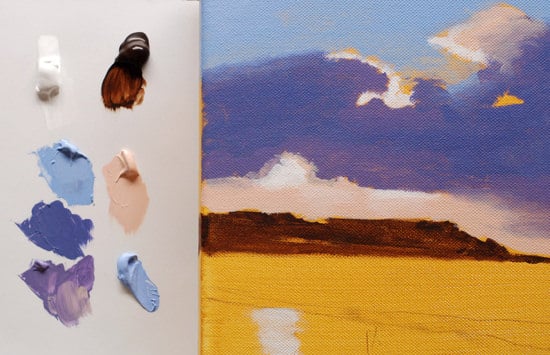
“Painting is very easy when you don’t know how, but very difficult when you do”
Edgar Degas
Lessons for an absolute beginner
A step-by-step approach to acrylic painting
In this series, I will be posting a weekly video on my YouTube channel to follow along at home. It’s free to subscribe to the channel so you can keep updated with the painting progress.
The image below can be ‘right clicked’ and ‘Save image as’, so you can use it as a guide.

Materials you will need:
- 10 x 10-inch pre-primed canvas. – I’m using a Winsor & Newton deep edge canvas
- Size 6 Isabey Isacryl acrylic brush – filbert
- Size 10 Isabey memory brush – round – Available from Jackson’s art
Paints
- Artist quality Titanium White. – Invest in this white even if you use student quality paint for the rest of the colours.
- Burnt Umber
- Ultramarine Blue
- Cadmium Yellow Light
- Permanent Alizarin Crimson – Winsor & Newton Artist Acrylic
- 3B pencil
- Kitchen roll
- A jam jar for cleaning brush.
- Small for or dipper for diluting paint
The Old Masters had it easy
Painting was seen as a craft; you had an apprenticeship or trained in an Atelier workshop.
Colour choice was limited, the vivid bright colours found in acrylics today just weren’t available, and pigment choice paid an integral part in the painting process.
Not just aesthetically but as a sign of power.
Often, the bluer the painting, the richer the patron. The pigment Ultramarine blue famously used to be more expensive than gold. It was extracted from lapis lazuli, a semi-precious stone used as the raw ingredient until the colourmaker Jean-Baptiste Guimet created a synthetic alternative to lapis lazuli in France in 1828.
This is why it is often referred to now as French Ultramarine.
Too much choice
These days choosing paints to start with can be a tough choice.
There are literally thousands of choices of different colours. Paint manufacturers have the urge to constantly produce a new variety or shade of pigment.
To tell you that this is the ‘magic bullet’, the wonder colour that will solve all your painting problems.
It won’t.
However, when we combine the principles from classical painting with the new modern materials of acrylic painting to create a method of painting that is both simple for the beginner to create pleasing results and broad enough for more practised artists to continue their study.
3 simple steps to begin:
Step 1. Apply a coloured ground.
This will help give you a unified tone to work on and give you a nice under glow of colour for this particular painting. See: How to apply a yellow ochre-coloured ground.
Step 2. Draw out the image.
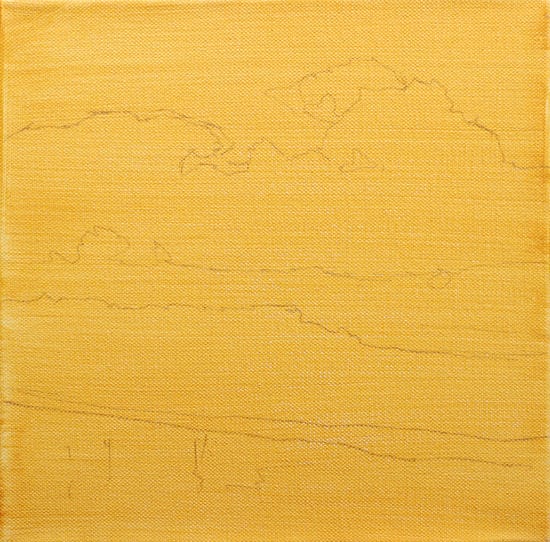
Using a 3B pencil, sketch out the image to work from. Don’t worry if it isn’t completely accurate. It is just a guide to get you started.
Step 3. Establish the darkest darks and lightest lights.
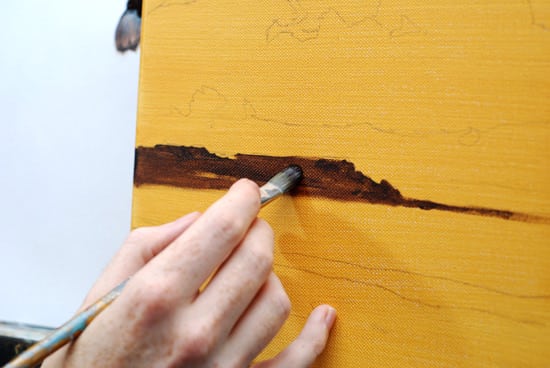
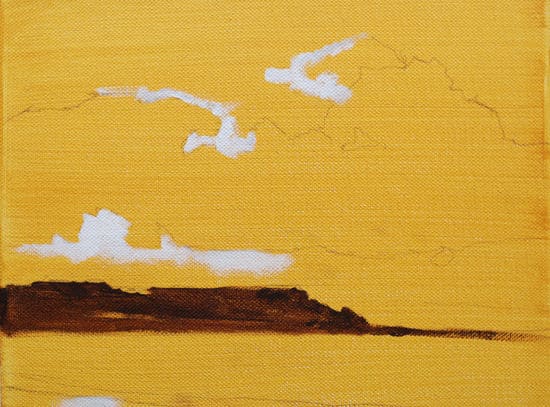
Using Burnt Umber & Titanium White, establish the darkest area of the picture. You can squint your eyes at the image to distinguish each area rather than getting hung up on the details. See: The importance of contrast in painting.
Acrylic landscape painting- Free video Course |Part 1
The video below shows the first steps I take to start the acrylic landscape painting. Make sure to subscribe to my YouTube Art school Channel to keep updated.
Video transcript
Morning class, I’m Will Kemp from Will Kemp Art School, and this is part one in a free series showing you how to get started in acrylic landscape painting. We’re going to start with this image, you can download it straight from my website, and I’m going to show you how to make this.
How to get this painting from the photograph so you can do it yourself at home. On the website, I’ve got a list of all the colours you need, the brushes that I use, but this video is just how to get started, get your drawing laid out so you can create a lovely landscape like this to have on your wall at home.
Step 1
So step one in starting this landscape painting is to block out your canvas to put a coloured ground onto it to work your paintings on top. I’ve already done that here, and you can watch a how to do it video on how to apply a coloured ground for acrylic painting video.
Step 2
Okay, the second step is to draw out the basic shapes that we’ve got here. We’re just after the line drawing. I’m using a 3B pencil here, which can be easily erased; it won’t smudge too much, yet it’s dark enough to make a mark.
See how it fairly easily makes a mark on the canvas without feeling that you have to really press into it and dent the canvas.
A quick tip to make sure you get a nice horizontal line is to use a piece of scrap paper, and you line up this edge to the edge of your canvas, so it’s like a set square, really. So there, line that up.
Step 3
Step three is to assess the tones in the picture to see where to start and the lightest and dark areas.
So the first thing to do is to squint your eyes at this picture.
Are they squinted?
Half close them just so everything slightly blurs a bit.
What you’ll find this does is it makes the dark look darker, the lights look lighter, and all these what are called halftones kind of disappear and what you really get to is the basic structure of the picture, and that’s what we are interested in.
For this, the darkest area is this area here of the land, so that’s what I’m going to paint to start with the burnt umber. All the information on the brushes that I use and how to choose a brush for acrylic painting is on my other video, or a list of other materials is on my website.
So if you notice how when I’m painting, I’m resting onto the canvas, which helps you give leverage and support so you can, with the finer lines, erm, it’s a lot easier to get a straighter line than if you’re hovering your hand in the air trying to balance it.
So once I’ve got that in, I’m now going to swap to this brush to block in that area.
The paint that I’ve got on here because acrylics dry so quickly, you want to make sure you get that off; otherwise, it will go solid on your brush, and you won’t be able to use it.
So I’ll dip it into some water and then, you know, rub it into the kitchen roll.
You get through loads of kitchen roll with acrylic and then squeeze it at the end, and you see how if I put that on there, nothing comes out. You know it’s completely clear, that’s just with plain water.
It’s always better to have more water and change it regularly than use the same pot; it will get mucky, and then what will happen that all that dirt in your water pot will come into your colours when your mixing and you won’t get a nice clean colour.
Even though we’re using brown, it’s still worth keeping it clean; it’s good professional working habits.
Okay, so now with the filbert brush. Okay, as simple as that. I often paint around the edge for my paintings, so I’ll paint around here.
You’ll notice how I haven’t been too heavy-handed, you can still see some of this underground glowing through, and that’s really nice, and I’ve left little bits where I’ve not been completely solid because I want a bit of texture, a bit of movement in this area.
So that’s all I do for this particular painting with the burnt umber. Now I’ll put in some of the highest highlights in the brightest area, which will be when we look at the picture. It’s going to be this area here where the sun is shining through.
For this, I’m just going to use titanium white.
So now, with the Titanium White, I’m just going to block in the very brightest areas.
You see how I’m keeping it quite loose and quite watery. You’ll notice if you’re not using an artist quality titanium white, it won’t be as thick as this. It will be a lot more translucent. You might have to use a couple of layers.
When you’re first starting with acrylics, I always recommend buying the best quality paints you can afford.
If you can’t afford to go artist quality for everything, try and invest in an artist quality white because it’ll have so much more opacity it’ll be able to see how it covered over the colour underneath really easily; this will be really beneficial in your future paintings.
There’s a slight bit of lightness down here but not as strong as the others, so I’ll dilute it with a bit of water and scrub it in with my finger.
Now we’ve got the lights and the darks; now we can back to the colours that we were mixing before to start blocking in some of the areas of colour.
Mixing the Colours
The video below shows how I premix and match a few key base colours to build the painting.
You might also like:
1. Part 2. Blocking in the sky – Acrylic landscape painting
2. How to choose a brush for acrylic painting
3. How your hairdresser can teach you to mix colour.


