
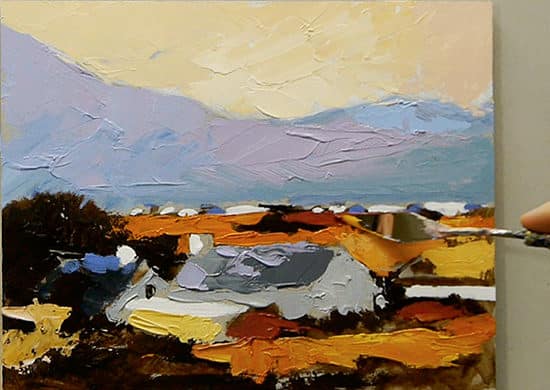
A step-by-step Palette Knife Acrylic Painting – Video Course Part 3
In this painterly, impressionistic palette knife study, I am posting a weekly video on my YouTube channel so that you can follow along at home.
It’s free to subscribe to the blog to receive updates so you can keep up with the painting progress.
Developing a Painterly Approach
When painting with a palette knife, one of the most valuable techniques you can apply is to loosen up and try and see shapes, rather than details.
If you’re coming to painting from drawing, comparing the control you can achieve with a sharp pencil with the ‘clumsiness’ of a palette knife, can be become your Achilles heel…
The palette knife can feel hard to handle and when you hit a slick of wet paint it doesn’t always behave as you’d imagined!
However, the lessons you can learn from being more expressive and carefree with your palette knife, can help to bring a freshness to your other paintings – even if you use a brush for the whole piece.
The tendency when using a brush is to try and always ‘neaten up’ an edge but as you become more comfortable with unplanned more gestural marks, you will learn when to leave, appreciate and stop ‘fiddling’ with your details, resulting in a painting with more energy and personality.
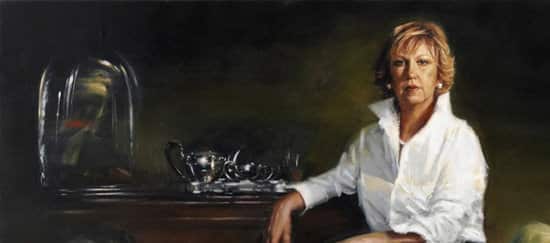
Will Kemp, Portrait of Liz (detail), Oil on Canvas, 95 x 160 cm
In the above painting, the stuffed parrot to the left of the composition was initially detailed, however, it began to ‘fight’ with the gaze of the sitter.
So I reworked that section of the painting by adding a touch of red and yellow with the palette knife. I was able to quickly blur the details, add a contemporary twist and some movement to the serious tone of the portrait.
With learning any new technique, there will always be that uncomfortable learning curve. Using a wet into wet technique can be helpful if you’re coming to acrylics from oils.
You can, of course, use the palette knife with oil paints as well as acrylics and with a lightness of touch you can apply clean colour on top of wet paint without it disturbing or muddying the colour underneath.
Pro tip: If you prefer to paint in a solvent-free studio, working with oils and a palette knife can be an effective method of moving paint around without the need for solvents.
Part 3 of 4
In this part of the painting, the brighter oranges bring our eyes forward and send the cooler hues of the mountains into the distance.
We also begin to work between the palette knife and the brush, you don’t need to add much detail, just a few finer lines or the odd sharp edge to give the illusion of a more detailed piece.
How to paint with a palette knife – Free acrylic video Course |Part 3
This video below shows the next steps of this palette knife landscape tutorial.
urlInvalid URL in url
detect_provider_and_id_from_url method needs url.
Make sure to subscribe (it’s free) to keep updated, you’ll get email updates when the next video is posted.
Next week, for the final Part 4, we’ll put in the finer details and finishing touches.
If you want to brush up on your colour theory, you should have a look at my Simple Colour Mixing Course.
You might also like:
1. Acrylic Palette Knife Painting Techniques – Free Video Course |Part 1
2. Acrylic Palette Knife Painting Techniques – Free Video Course |Part 2
3. Acrylic Palette Knife Painting Techniques – Free Video Course |Part 4


