
Ever looked at your drawing composition and something feels wrong?
You just can’t put your finger on it, 90% of the piece looks great but somethings not quite right.
You could have fallen prey to an easy slip-up, you might have drawn a ‘tangent’ by mistake.
A few simple changes can transform your drawings for the better…
What are tangents?
Tangents are where 2 lines just touch each other in a way that causes spatial ambiguity and a slight jarring on our eyes.
It’s not super obvious but can really ruin a perfectly good painting and can unwittingly change the composition in your drawing.
Tangents ain’t pretty!
So let’s look at a few simple examples to try and decipher any tangents hidden in your own works.
Tabletop line
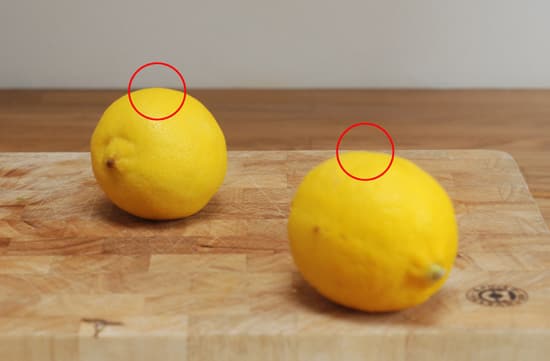
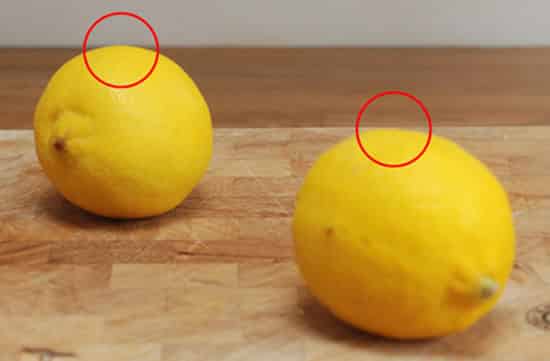
In the example above both tops of the lemons hit a horizontal line, it can start to make whatever is on the horizontal line feel like it is sitting ‘on top’ of the object.
You’ll often see it in landscapes where the top of the trees hit the ‘bottom’ of the clouds. This creates a weirdness, and it flattens the perspective in your drawing.
If you’re working from a reference photograph, these tangent lines can be harder to spot, but when anything is translated into paint, the effect is amplified.
It is worth taking a bit of time when selecting an image to paint from, to double-check that overlaps are in the image to help with depth.
See How to draw perspective for beginners for an example of how overlap can help your painting.
Edge to edge
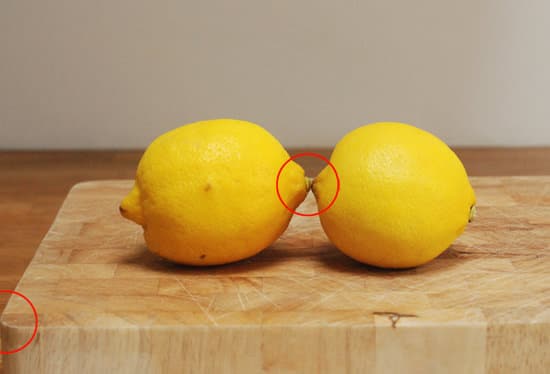
Here we have another couple of examples.
The edge of the chopping board (bottom left) hits the edge of the frame. This is a visual no no.
It draws the attention to that point and ‘charges’ it, equally, where the two lemons touch your eyes are really drawn to that point.
Notice how the space between them, the negative space, forms an x shape.
This also visually blocks the back edge of the chopping board so prevents your eyes from wandering through the piece.
On the positive, the top of the lemons are now looking loads better than in the first example as they break through the horizon line and each lemon is at a slightly different height.
Being at a slightly different height creates a slightly different shape, and the more varied you can make the shapes in your paintings or drawings, the more natural they will appear.
Parallel lines
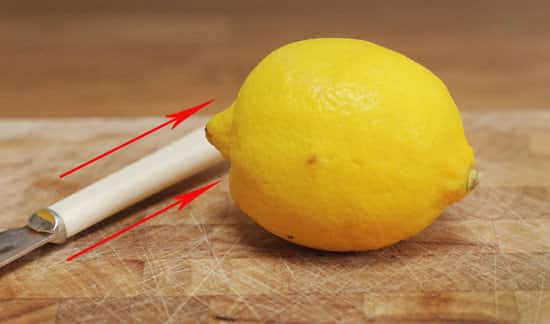
This particular tangent needs a lot of help!
The angle of the knife is the same as the tip of the lemon, this sends your eye to that focal point, but then there aren’t any gaps for your eye to go.
You can’t judge how long the knife is and thus creates an optical illusion where you’re unsure if the lemon overlaps the knife or is butted up to it.
When viewers are faced with these subtle questions, albeit on a subconscious level, it makes the finished painting feel forced even if you have loose brushmarks and great colours.
If the composition jars – you lose your audience.
Edge to edge
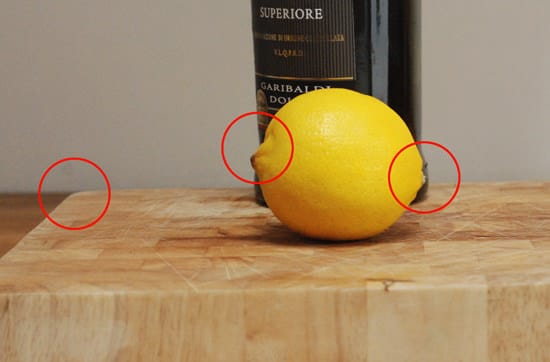
We have our old friend the ‘tabletop line’ back again, but this time we have an issue with our objects that are edge to edge.
Both sides of the lemon are hitting the wine bottles edges, which creates a solid pillar of focus.
If the lemon was moved to the left 1 inch, we would suddenly have good overlap, a view of the curve of the bottle’s base and more interesting negative space.
As it stands, it feels unbalanced and lacks interest.
Before & after a tangent composition

Before: Notice how awkward and squeezed in this image feels.
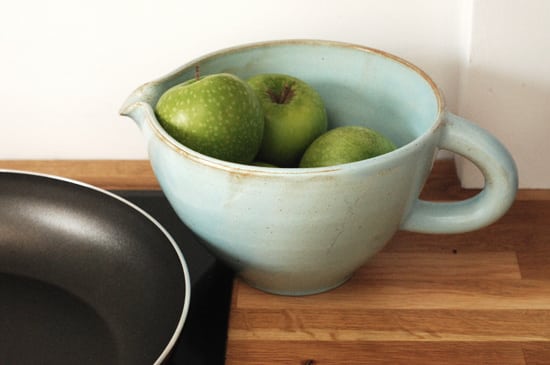
After: By slightly adjusting the viewing angle we now have a much more balanced and less jarring composition
Seeing spaces as shapes
Working between tangents and negative spaces can really improve the compositions of your paintings and drawings with the success of the piece.
A tangent is when two or more lines interact in a way that creates a relationship between them that the artist did not intend.
One of the most powerful of my ‘7 painting success principles’ is the simplest skills to learn and one of the most eye-opening.
It can give you an ‘aha’ moment in an instant and help to give you stronger compositions, balanced paintings and dramatically increase the professional look of your paintings.
The only problem with this technique is its name.
It doesn’t fill you with hope.
Negative space
I know, a negative before you’ve even got your paints out!
Negative space is the space around an object—the shape through a cup handle, the shape between two apples on a still life painting.
These spaces between objects help you arrange the composition, create an interest, or move the viewer’s focus.
When you are first beginning drawing or painting the tendency is the start simply with a single object, in the middle of the canvas.
The 3 things that are usually missing are as follows:
- An indication of what the object is sitting on.
- An indication of where the light is coming from.
- A variety in the spaces around an object.
Being aware of negative space helps to make you aware of all of these things and avoid the common mistake of tangents.
If you’d like to learn more about composition in drawing you should have a look at my Absolute Beginners Drawing Course.


