
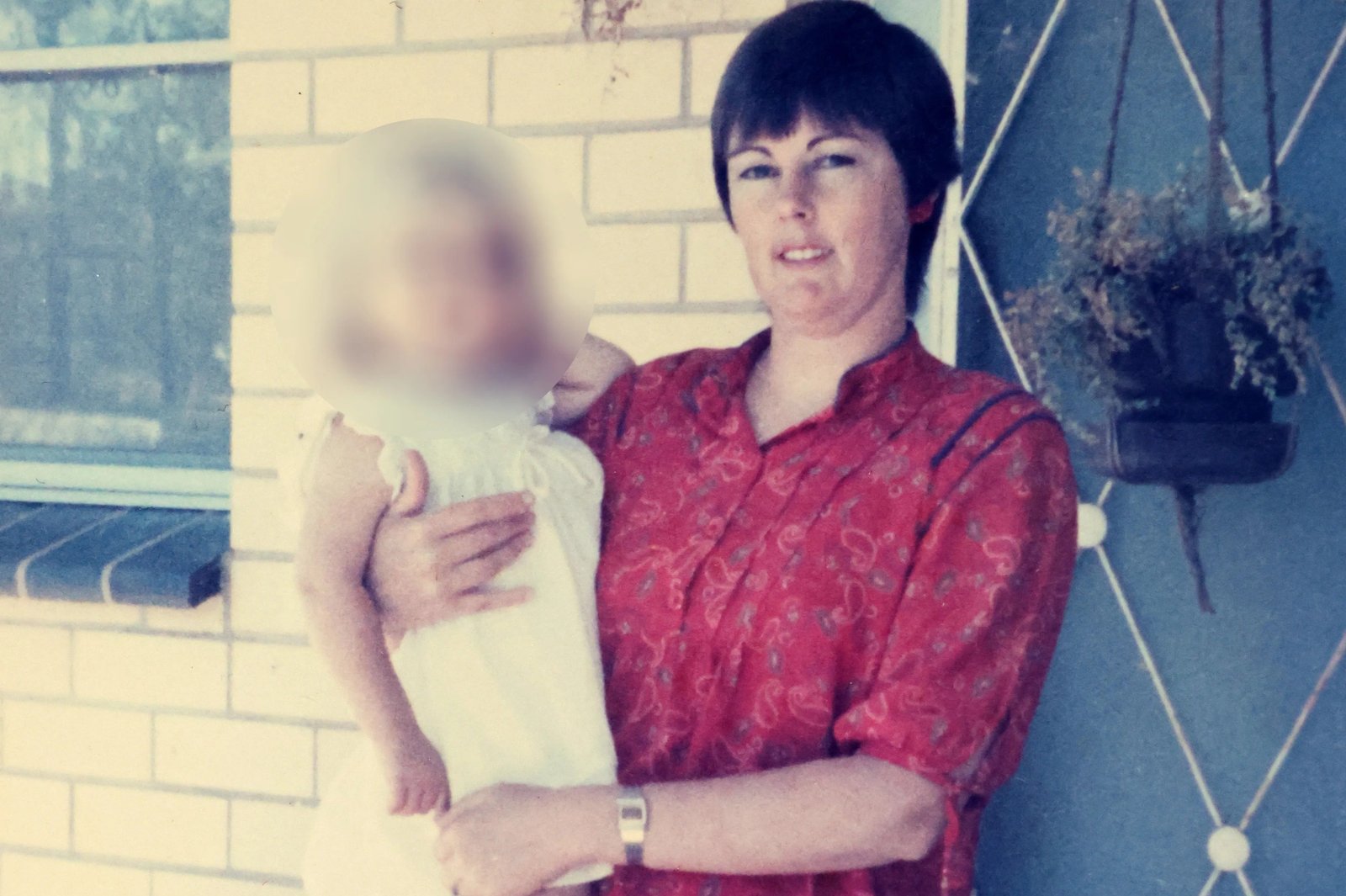

LISA Ashdown’s memories of her childhood friend’s funeral are clouded with grief. Unsteadied by emotion, she recalls stumbling on the slippery astroturf at the edge of Rosslyn ‘Roz’ McQueen’s grave.
Just a few days before, pregnant Roz was found dead at the home she shared with her husband Ray, her body – contorted and arched backwards over a chair – discovered by a neighbour in the kitchen. Their two-year-old daughter Jodie was in the house, too.


At the time of her death, on April 1, 1986, she was 30, seemingly healthy and 22 weeks pregnant with her second child – a son she planned to name Christopher.
“I was a blubbering mess,” recalls Lisa, now 71. “I was still in shock.
“I remember looking at Ray at the funeral and thinking: ‘He’s not showing much emotion.’ He was very cold. But I told myself that everybody deals with grief and death differently,” says Lisa, from Victoria, Australia.
A couple of months later, a toxicology report showed Roz had been poisoned with strychnine, a powerful toxin historically used to kill rodents and other pests. In humans, small doses can cause violent muscle spasms, convulsions and death.
On July 4, 1986, Ray was charged with his wife’s murder. The following year, a coroner found that he had murdered Roz – however, in 1988, the criminal case collapsed. No one has ever been convicted and Ray has always denied killing her.
Almost four decades later, the questions may finally be answered, thanks to a gripping new podcast series, The Poisoned Wife. Produced by The Australian, the podcast is a weekly live investigation run by award-winning investigative journalist and podcaster Hedley Thomas.
New witnesses and information are already emerging from early episodes.
“This case had fallen through the cracks,” Hedley says. “The aim is a conclusive answer, but even if that proves elusive, shining a light on the forgotten case offers some kind of justice.”
Hedley began working on the podcast with former coronial lawyer Karina Berger, after he was given a suitcase full of files by retired private investigator Rex Bakes.
During the initial investigation, Rex was hired by Ray’s defence to help prove his innocence, but while looking into it he became suspicious. He then spent almost 40 years trying to discover what happened.
When his efforts failed, he passed the documents to Hedley, who was credited with helping to solve the 1982 disappearance of Lynette Dawson thanks to his 2018 podcast Teacher’s Pet.
Hedley says: “For Rex, it was such a profoundly tragic and unfair situation, he wanted to make sure that someone solved it. If nothing else, there’s some kind of justice for the loved ones when they see people paying close and careful attention to a case that should have been resolved years ago.”
Roz was popular, charming and easy-going. She grew up in the small farming city of Swan Hill, on the Murray River in rural Victoria. When Lisa met her in their first year of high school, they soon became friends.
“We were both fairly quiet and had a similar sense of humour,” Lisa remembers.


Roz was a bridesmaid to Lisa when she married her first husband in 1973, aged 18. She eventually moved to Bendigo with another friend, Wendy Beattie, and worked in a bank. It was then that she met farmer turned bus driver and keen tennis player Ray.
At the time, Ray was married to his first wife Jeanette, but the pair grew close.
Hedley confirms: “He and Roz clearly had some sort of connection early on, and she would end up catching the bus even when Wendy wanted to drive.”
Ray denied any affair, but his marriage ended in divorce in 1979, which he later claimed had cost him around £52k. In April 1981, he married Roz, and the couple later moved to Lockwood, where Ray started work as an insurance salesman.
In 1983, their daughter Jodie was born. Roz adored being a mum, but money was tight. Wendy told the police that Roz used to complain that Ray would spend money on things they didn’t need, leaving her unable to buy food. Meanwhile, Ray blamed his financial difficulties on the settlement from his divorce.
A few years into the marriage, a 14-year-old girl called Donna Manallack became increasingly close to the family. The daughter of one of Ray’s former bus driver colleagues, she had known the couple since childhood and began babysitting Jodie, joining family outings and later taking tennis lessons from Ray.


By late 1985, Roz was pregnant again and overjoyed at the prospect of a second child. However, as the weeks went by, she couldn’t shake her growing concerns about the amount of attention Ray was giving Donna.
“There was definitely disharmony. Roz wasn’t happy, I could sense it,” says Lisa.
Members of the tennis club where Ray taught Donna started to talk, too, noticing the closeness between the teenager and the man twice her age. Some commented that they appeared to be a couple. Often, they would sit in Ray’s car together, rather than socialise.
By early 1986, Roz had become visibly anxious about the situation, and friends recall she was not sleeping. She discussed her concerns with Ray’s mother Beryl, as well as Donna’s parents. According to Ray’s 1986 police interview: “They all said there was nothing between Donna and I.”


Roz also confronted Donna directly. The teenager denied it, and later recounted another conversation with the older woman in a police statement, saying Roz told her: “I don’t know what to do. I found it very hard to talk to him and it seems like he doesn’t want to listen. I’m scared that he’s going to want to divorce me.”
On Easter Monday, March 31, 1986, Donna repeated that conversation to Ray. She says he told her he could not afford to divorce Roz. Less than 24 hours later, she was dead.
Ray maintains that on April 1, he left for work at 8am, leaving Roz and Jodie at the house. An hour later he tried calling her, but no one answered. He continued trying to reach her and, at around 9.45am, called their neighbour Vin McKenzie and asked him to check the house. The neighbour found Roz dead in the kitchen, twisted over a chair.
Police found no forced entry or obvious disturbance. A piece of toast with two small bites taken out of it remained on a plate near Roz’s body.
Ray told police at the scene that Roz had cancer – earlier that year, she had an abnormal smear result, but five days before her death she had been given the all-clear – and the senior constable initially surmised that she’d suffered a heart attack.
The house was not treated as a crime scene, and though tissue and organ samples were sent for toxicology testing, a post-mortem failed to establish the underlying cause of death.
Lisa says: “When I heard Roz was dead, I thought it was an April Fool’s joke. I couldn’t believe that she was gone. She was my first close friend. She was only young. When she died, I lost a part of myself.”
Around six weeks after Roz’s death, Lisa went to visit Ray with her children to check Jodie was OK. She stayed two nights.
“I remember him saying: ‘Oh, she thought she had cancer,’” Lisa recalls. “And that then she was depressed all the time.”
The picture Ray was painting jarred with the Roz that Lisa knew so well.
“She wouldn’t take her own life. She was pregnant. She wanted the baby. She had Jodie, and she wanted another,” says Lisa, who later gave evidence at the inquest. She said that Ray had: “led me to believe that she might have committed suicide”.
In June 1986, the toxicology results finally revealed that Roz had died from a fatal dose of strychnine.
When Ray was told this, he reportedly replied: “How could that be? She wouldn’t commit suicide.”
An investigation was launched, including a forensic examination of the house, but investigators found no source of strychnine there and could not establish how Roz had ingested it.
Ray denied any marital problems or knowing anything about strychnine, other than his suspicion that a neighbour owned some. His statement was contradicted by his own mother, Beryl, who said the toxin had been used on the family farm to kill foxes.
Only later, during questioning about Donna, did Ray acknowledge that Roz had raised concerns about their relationship and that after his wife had died, he had kissed Donna “passionately” several times.
He also acknowledged that he and Donna had discussed being together, and that he had asked her to live with him in a “de facto relationship as husband and wife”. At the time, Ray was 33 and Donna was 17.
Meanwhile, Donna also admitted to police that she was in love with Ray. She said that once she turned 18 she intended to live with him and “go anywhere he wants me to”. However, her parents were horrified and forbade it, and the relationship between the pair ended.
Ray was charged with murder on July 4, 1986, and strongly denied any wrongdoing. At the 1987 inquest, the coroner found that he had murdered Roz.
However, the criminal case against him was dropped just days before the trial was due to start in 1988, after the Crown’s original prosecutor became ill and a judge excluded key parts of the prosecution evidence, including material from Donna, as well as Ray’s first wife.
The prosecution remains in limbo and can be reactivated if new evidence emerges.
“I just drank more and smoked more [when the case was dropped],” says Lisa. “That was my way of dealing with it.”
The official investigation went cold, but for almost four decades, Rex Bakes pursued it by himself, spending his own money driving across south Australia, knocking on doors, tracking down witnesses and distributing leaflets appealing for information.
Eventually, with his health failing, he packed thousands of pages of evidence into a padlocked suitcase and sent it to Hedley.
Ray, now 73 and remarried, denies killing Roz, and when approached by The Australian he said he did not recall ever kissing Donna. Questioned about strychnine, he suggested a “monumental forensic science f**k-up” and claimed he had been warned he would be “dead meat” if he spoke publicly.
Donna, now in her 50s, spoke on the podcast for the first time about the guilt and shame she has carried since Roz’s death. In 1986, police scrutinised whether the teenager had played some part in the crime.
Today, she is viewed very differently, though – as a vulnerable teenager who had been groomed by a married man more than twice her age. It’s a distinction she understands.
“I was a 16-year-old girl who had a crush on an older, married man. Even though I know that I was young and naive, it’s still really hard. You feel guilty, ashamed, embarrassed – but it’s not about us, it’s about [Roz],” she said.
Lisa hopes the renewed attention on the unsolved case will finally bring some justice for Roz and her unborn son.
“I do feel sadness that she missed out on another 40 years of her life,” Lisa says.
“There needs to be justice in the world.”