
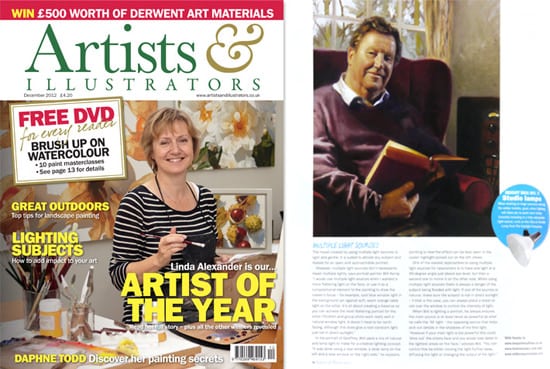
This week I’ve been featured in the U.K’s best selling artist magazine, ‘Artist & Illustrators‘.
The article was on understanding ‘How light sources can add impact to your portraits’.
It looked at three professional portrait painters and how they approach portrait lighting set ups of their subjects.
Below is the conversation I had with Martha Alexander from the magazine…
How do you approach the lighting when you first meet your sitter?
To make the decision on how to light a portrait painting, several considerations come into play.
The first meeting with the sitter is often very casual, and in this relaxed atmosphere, I can start to get a feel for the personality and I’m always looking to try and see an angle of their face that just looks right, take into account age and character.
Some peoples character suit a ‘face on’ more confrontational pose, whilst others are more gentle and require a more sensitive approach.
These are some of the first points I consider when planning the lighting set up.
The second meeting we discuss the sitters personal ideas of the style of portrait they would like, the location and the overall atmosphere the portrait would evoke.
This can vary from dramatic Chiaroscuro with ornate gold frame to a very natural, soft and demure final piece.
I would then start to get a feel for the piece and think about what would be the perfect lighting for the client.
What effect would you hope to achieve with using multiple light sources, as opposed to, say, a single light source or natural light?
So for example, if I had a strong character whose face I thought could handle a harder, directional light and enjoyed the idea of a dramatic portrait painting, then I would use a single light source.
This would give very dark shadows, very light lights and a form to the face, however, it’s not for the faint hearted as it’s not the most flattering light but you would achieve a very powerful portrait.
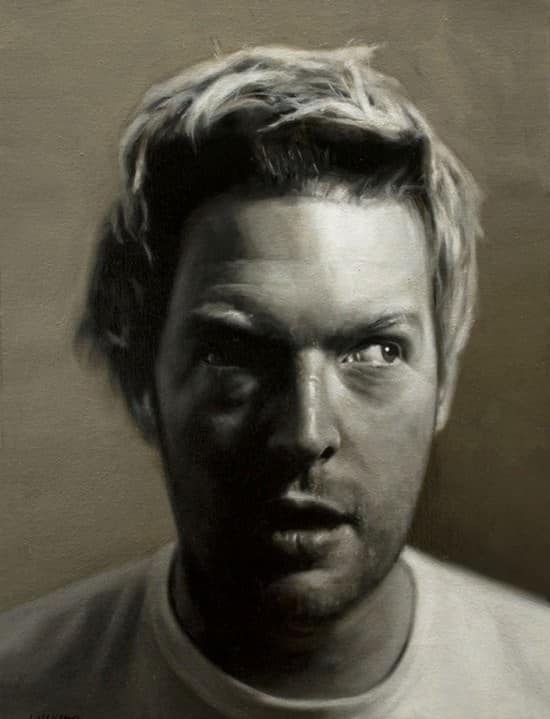
Self portrait (using a single light source), Will Kemp, Oil on Linen, 40 x 30 cm
Multiple light sources doesn’t necessarily mean multiple lights. You can achieve a good balance very easily by using bounce boards which are simply flat white boards that reflect the light back into the shadows of your subject.
I would use multiple light sources when I wanted a more flattering light on the face, or to use it as a compositional element to the painting to draw the viewers focus.
For example, cool blue window light in the background set against soft, warm orange table light on the sitter.
It’s all about creating a balance so you can achieve the most flattering portrait for the sitter.
Natural light is generally great for a more casual feel.
Children and group shots work really well in natural window light, it doesn’t have to be North facing (although this does give a nice constant light) just not in direct sunlight.
Do multiple light sources lend themselves to a certain kind of mood? Are they best used with a certain kind of person or character?
The mood created by using multiple light sources is generally uplifting, light and impressionistic.
I find it suits most women, as it’s very flattering and gentile, although most people would look great with this lighting.
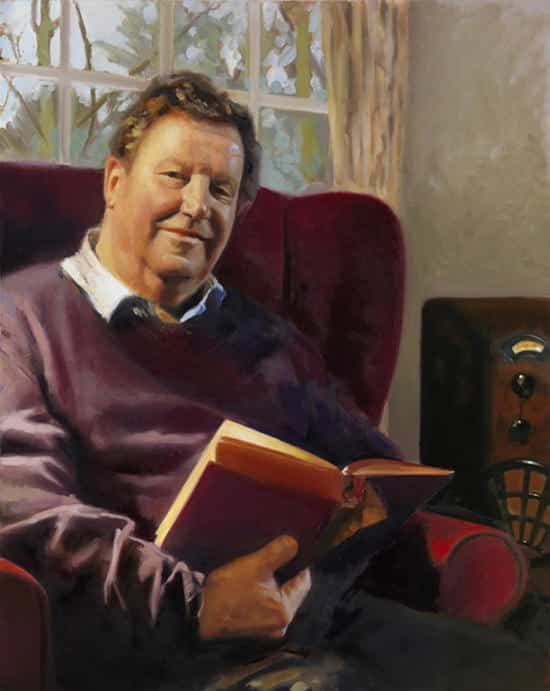
Portrait of Geoffrey (using a multiple light source), Will Kemp, Oil on Canvas, 60 x 50 cm
Is there a danger of the subject being flooded with light? How do you ‘control’ the light?
Yes, there is a danger of there being too much light.
To avoid this, it’s best not to work in direct sunlight if working with natural light, you can always soften the window with a thin sheet for diffused light.
If in a studio set up, the main light (called a key light in photography) should be twice as powerful than the fill light (the light that puts light into the shadows created by the key light) – however if your key light is too powerful this could ‘blow out’ the sitters face and you would lose detail in the lightest areas on the face.
You can control this be either moving the light further away, diffuse the light or change the output of the light.
What type of lamps/lights do you use? Is finding the correct position a case of trial and error, or are there formulas?
When first starting portraiture, simplicity is always key. A great place to start is with ‘Rembrandt lighting‘ and then modify from there.
To spot Rembrandt lighting on a portrait look out for a triangle of light underneath the sitters eye on the shadow side of the face.
Pro tip: The triangle of light should be about the same width of the sitters eye and length of their nose.
I personally use fluorescent lamps with a diffuser for softness.They give a constant cool light and a balanced for natural North light.
Start by setting up the main light (called a ‘key light’ in photography) facing the sitter at about a 45 degree angle. You want the light to be coming down on the subject, ideally so it’s just above the sitters head.
If the light is very harsh and you want to soften up the shadows the simplest thing to do is ‘bounce’ some of this light back into the shadows.
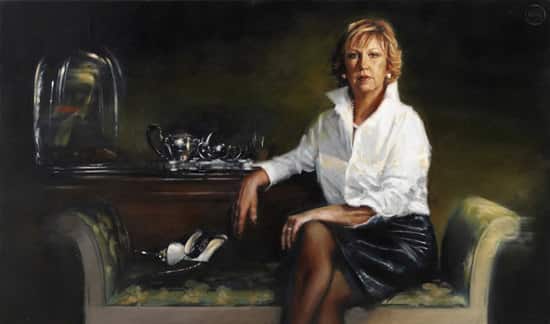
Portrait of Liz (using bounced natural light), Will Kemp, Oil on Canvas, 95 x 160 cm
Board reflectors
This is simply a flat surface used to reflect or bounce light onto the subject. Other colours can be used to enhance the subject, the two most commonly used are silver, and gold. Silver will reflect a cool light onto your sitter (blue light) whereas gold will give your portrait a warmer feel – (orange light).
You can go for a DIY approach with kitchen foil or invest in a collapsible photography that are double-sided.
I personally usually use a piece of white foam-board, as it helps to keep the colour temperature constant.
You might also like:
The other portrait artists featured in the article are Benjamin Sullivan & Helen Masacz.
A digital version of the magazine is available from Artists & Illustrators.
Black & White Oil Portrait Course for Beginners


