
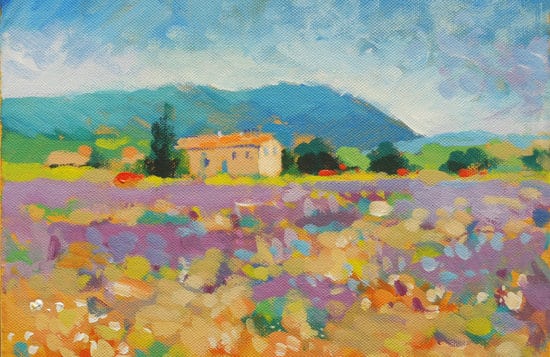
Lessons on the Techniques of the Impressionists
A step-by-step Impressionist Acrylic Painting
How do you achieve a more painterly impressionistic approach with acrylics?
In this series, I will be posting a weekly video lesson that you can follow along at home. It’s free to subscribe to the blog to receive updates so you can keep up with the painting progress.
The first technique in mastering an impressionist style of painting is in the actual name itself, ‘Impressionism‘.
We are trying to achieve an ‘impression’ of the subject, rather than a detailed copy, so squinting your eyes at the subject, to blur the details is one of the first tricks to adopt.
This tutorial is ideal to leave some of your fears at the door, have fun and loosen up a bit, ready to get started?…
The image below can be ‘right clicked’ and ‘Save image as’, so you can use it as a reference.
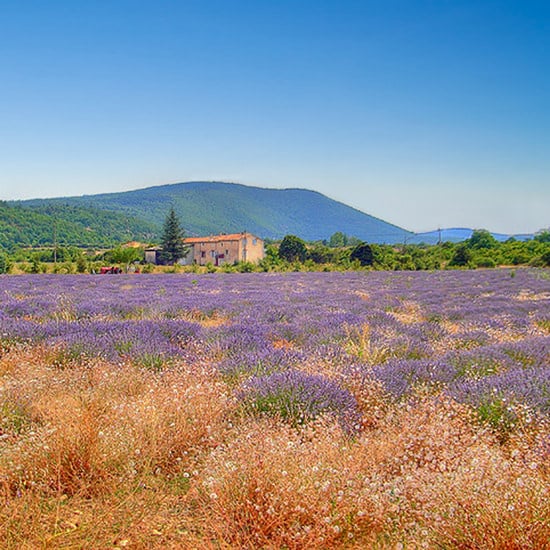
Materials you will need:
Brushes
- Size 4 black hog brush filbert (from Jackson’s Art)
- Size 8 or 10 round synthetic brush
- Size 3 round synthetic
Canvas
- 12 x 12 square pre-primed canvas. ( for this demonstration I’m using a Winsor & Newton deep edge canvas)
- Kitchen roll
- Clean water
- Tear-off palette or stay-wet palette
Paints – The colour palette
Artist quality acrylic colours ( I’ve used a mix of Golden Heavy Body colours & Winsor & Newton Artist Acrylic)
- Titanium White (modern equivalent to lead white)
- Cadmium Yellow ( medium or light, I’ve used Cadmium Yellow Medium for this example)
- Cadmium Red Light (this is an orange-red which is quite close to Vermillion used by Monet)
- Permanent Alizarin Crimson (W&N)
- Cobalt Blue Hue
- Permanent Green Light ( similar to Emerald Green, when mixed with the Ultramarine Blue will produce a dark green similar to Viridian)
- Ultramarine Blue
- Cobalt Violet Hue
To better illustrate the Impressionist technique and speed of painting, I am using a more extended palette than I would usually recommend for painters just starting out.
The acrylic paint colours I use during this tutorial, are modern equivalents to the paint colours used by Monet.
Some of the exact pigments he used are no longer available, and replacements have been man-made out of a combination of pigments to replicate the original colours.
When a Hue is not a Hue
When a modern paint colour has been developed to replicate a historical colour, the word ‘hue’ is used on the tube, for example, ‘Cobalt Blue Hue’.
This is not to be confused with ‘hue’ – as in a colour’s hue, for example ‘that colour has a red hue‘.
I appreciate it can be hard not to confuse them as they are the same word!
But ‘hue’ when used on a paint tube, indicates that the pigments used in the paint mixture are a combination.
Step 1 – Use a coloured ground.
From the Old Masters to Monet using a coloured ground is a technique that is often forgotten in the art room.
It helps to take away the glare from the white of the canvas and gives you a mid-tone to paint onto. The technique is so easy to implement and will rapidly improve your painting almost instantaneously – It’s number 1 in my painting principles.
For this demonstration, I’m using Yellow Ochre.
Monet would have usually used a more muted ground colour, but for the choice of image we’re working from this seemed to fit the bill.
Simply apply a watered-down mix of Yellow ochre onto a pre-primed canvas or board.
You can read more about the benefits of a coloured ground; there is also a video demonstration on how I apply the coloured ground below.
Step 2 – Drawing out
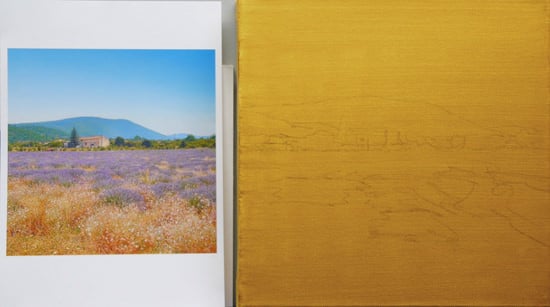
The next stage is to draw out the basic shapes in the piece.
As this demonstration is more of a study of impressionist techniques rather than an exercise in developing a more finished composition, you don’t have to spend too long on the drawing. I use a 3B pencil to roughly sketch in the main shapes.
Step 3 – Setting out the palette.
I then lay out my colours onto a tear-off palette. If you want a bit more working time with your acrylics, then you can set out your paints onto a stay-wet palette. There is a video tutorial below on how I would usually set out my colours on the stay-wet palette.
Plein air painting
Monet often began with a rapid blocking in of the colours, as he was working within the constraints of daylight.
When painting subjects ‘en plein air’ the colours in nature can change very quickly as the sun moves position throughout the day, the lower the sun is in the sky, the warmer the light, with sunrise and sunset having a warm colour in comparison to the cool blue light of north light.
Monet seemed to favor this warm light as it gives such a rich variety of tones in one scene. Some of the light techniques he was trying to achieve only lasted for less than 10 minutes, so we have to work quickly!
We are using a hog hair brush to move the paint around quickly and easily, it will also enable you to add thicker, impasto paint in future lessons on this painting and be closer to the materials he would have used with oil paint.
Here are my top 6 tips for achieving a successful Impressionist painting:
- squint
- use a hog hairbrush
- apply thick paint
- use complementary colours
- mix colour on the canvas
- adopt an impressionist palette
Step 4 – Wash in the sky
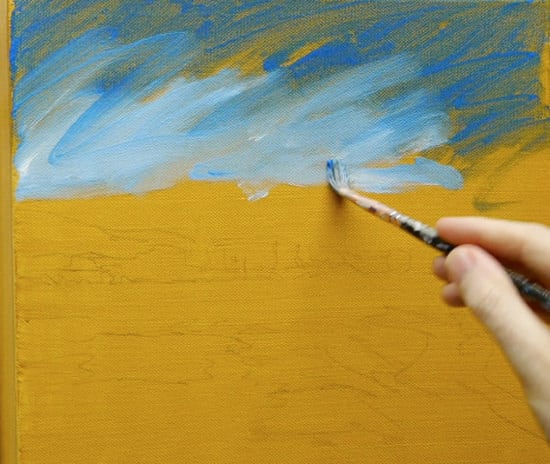
Using Cobalt blue hue and water, I add a very loose watery wash to the top of the sky. I’m just trying to establish some basic colours in the piece.
As the sky becomes lighter towards the horizon, I add Titanium White to lighten the mix.
During this process, I’m painting very quickly using gestural marks, and I’m not concerned with getting it spot on, it’s a case of getting it on there and getting a feel for the painting.
Step 5 – Block in the mountain.
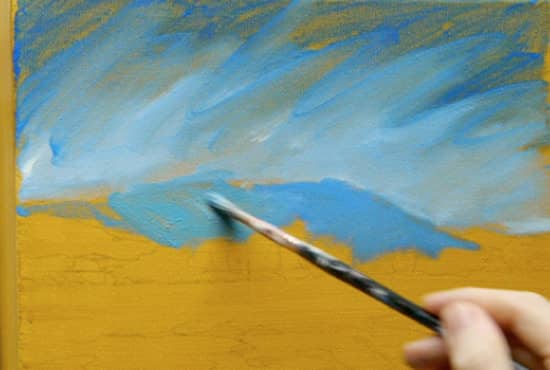
The mountain has 3 simple mixes; you can see how it changes from left to right.
The first mix is Cobalt Blue Hue and Titanium White which I paint with a thicker mix than the sky. I then mix a turquoise by adding the permanent green light to the cobalt blue hue.
I blend these colours ‘wet into wet’ and add more of the green to the mix as I get to the left-hand side of the painting to indicate trees.
Step 6 – Creating colour harmony.
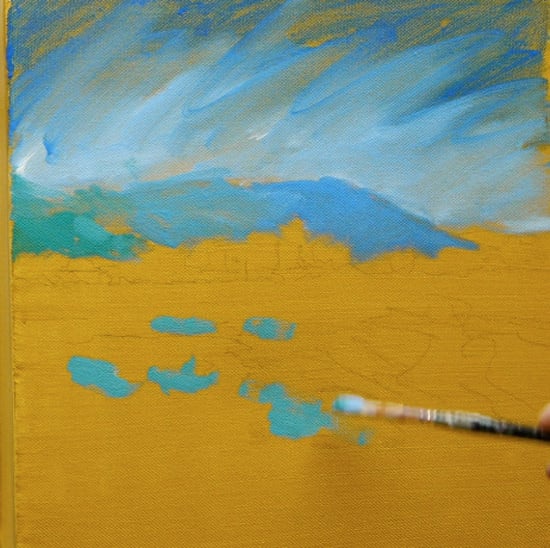
When this colour is mixed, I scan the reference image for any examples of this colour appearing in the foreground of the piece. This helps to unify the scene and give a movement of colours throughout the painting.
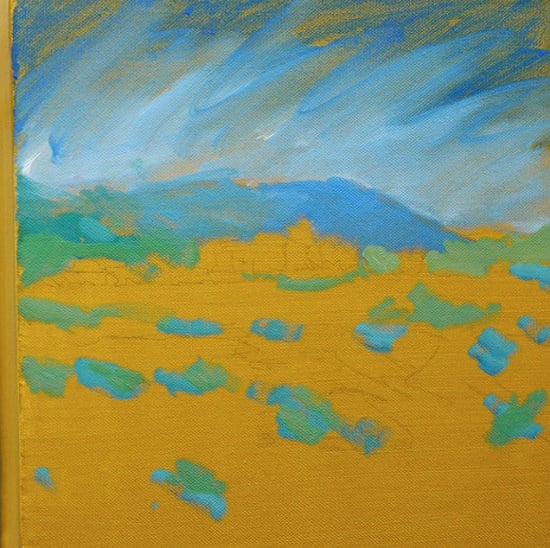
I use short strokes to apply the paint slightly more impasto (thicker) than the initial wash in we used for the sky.
These dabs of colour help to move the viewer’s eye around the painting.
I then add Cadmium Yellow Medium and a touch of Titanium White to the mixture to vary the tints slightly.
How to paint like Monet – Free video Course |Part 1
This video below shows the first steps I take to start the painting process of this impressionistic landscape painting.
Make sure to subscribe (it’s free) to keep updated; you’ll get email updates when the next video is posted.
Next week, for Part 2, we’ll start to add the violets to bring the lavender to life and add some warm colours to the foreground.
You Might Also Like:
How to Paint like Monet – Part 2
How to Paint like Monet – Part 3
How to Paint like Monet – Part 4


