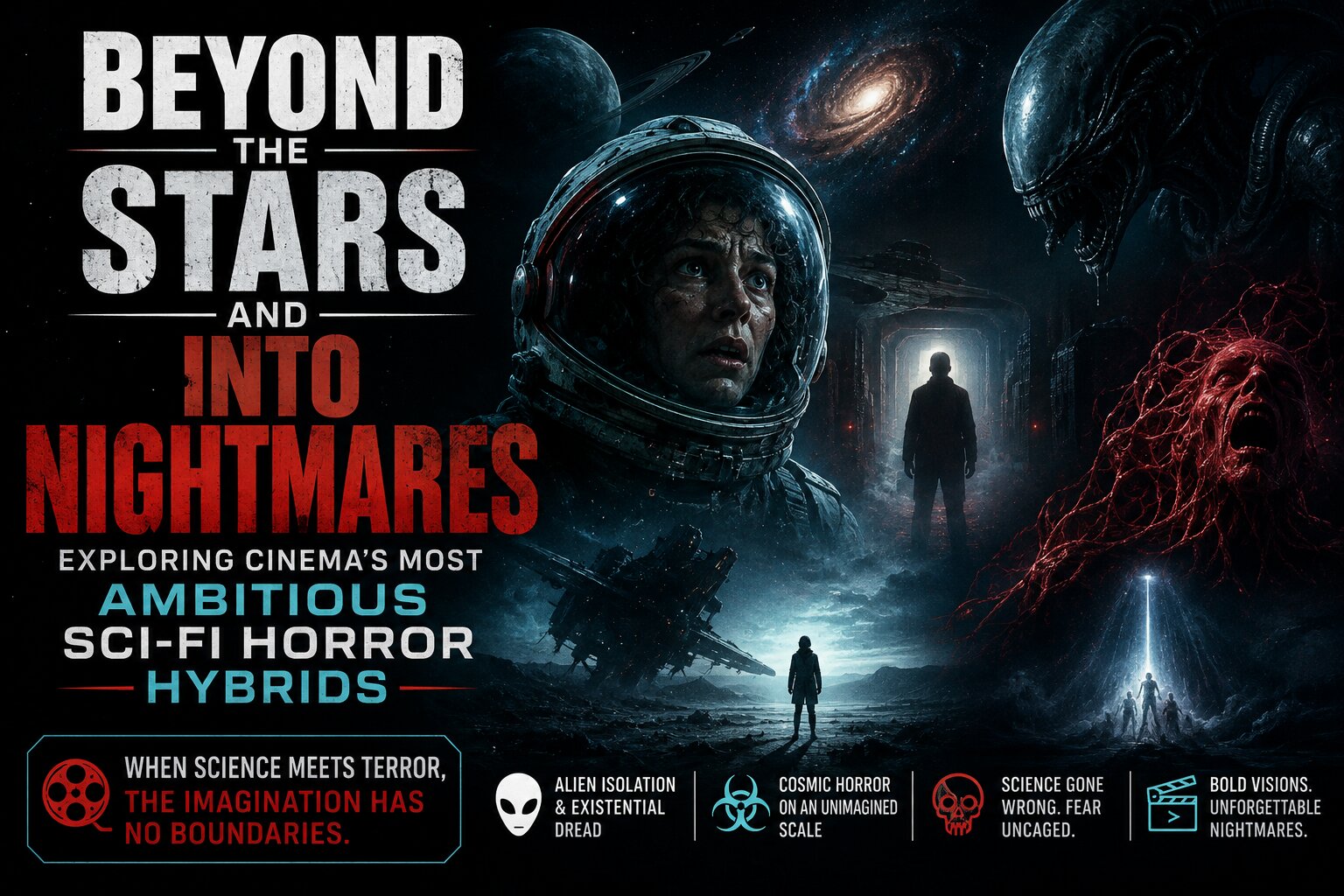
Beyond the Stars and Into Nightmares: Exploring Cinema’s Most Ambitious Sci-Fi Horror Hybrids
The intersection of science fiction and horror has long been fertile ground for filmmakers willing to push narrative and visual boundaries. When Collider recently published its ranking of the eight most ambitious entries in this hybrid space, it reignited conversation about what makes these films resonate — and why so many attempts fall short.
Defining Ambition in Genre Fusion
Ambition in sci-fi horror isn’t merely about budget or spectacle. It’s about conceptual reach: the willingness to grapple with big ideas — identity, evolution, the limits of human knowledge — while delivering genuine dread. The best examples don’t just juxtapose spaceships and monsters; they use speculative premises to deepen the horror, and horror to ground the speculation in visceral consequence.
Filmmakers working in this space face a unique structural challenge. Science fiction demands world-building and internal logic; horror thrives on the inexplicable and the loss of control. Balancing both requires discipline — and a clear thesis about what the fusion serves.
Pioneers That Set the Template
Ridley Scott’s Alien (1979) remains the gold standard not because it was first, but because it understood that the Nostromo’s industrial corridors were as essential to its terror as the xenomorph itself. The film’s genius lies in its commitment to a lived-in future — blue-collar workers, corporate indifference, malfunctioning systems — that makes the creature’s intrusion feel like a violation of contract as much as biology.
John Carpenter’s The Thing (1982) took a different approach: paranoia as epistemological crisis. Its Antarctic research station becomes a pressure cooker where the scientific method collapses under an enemy that perfectly mimics its observers. The film’s practical effects — still startling decades later — serve a deeper purpose: they visualize the horror of unknowability.
Body Horror and the Limits of the Self
David Cronenberg’s The Fly (1986) and Videodrome (1983) explore transformation not as metaphor but as literal, agonizing process. In The Fly, Seth Brundle’s teleportation accident becomes a meditation on mortality accelerated — each physical degradation a reminder that the body is not a vessel but the self. The film’s ambition is emotional as much as conceptual: it asks us to witness a lover’s disintegration with clinical intimacy.
More recently, Alex Garland’s Annihilation (2018) refracts body horror through ecological surrealism. The Shimmer — a zone where DNA refracts and recombines — becomes a canvas for exploring self-destruction as biological imperative. Its final lighthouse sequence, a dance between human and doppelgänger, refuses easy resolution. The film’s ambition lies in its refusal to explain; it offers only the horror of transformation without purpose.
Cosmic Scale and Existential Dread
Andrei Tarkovsky’s Solaris (1972) and Steven Soderbergh’s 2002 remake both use a sentient ocean planet to externalize grief and memory. The horror here isn’t pursuit or violence — it’s the return of the repressed given physical form. Tarkovsky’s version, steeped in Soviet-era austerity, treats the station as a confessional; Soderbergh’s leans into clinical detachment. Both understand that the most ambitious sci-fi horror asks not “what’s out there?” but “what’s in us?”
Danny Boyle’s Sunshine (2007) shifts the scale to stellar engineering: a mission to reignite a dying sun. Its third-act pivot into slasher territory divided critics, but the film’s core ambition — juxtaposing the sublime (the sun’s surface) with the intimate (a crew unraveling) — remains striking. The horror emerges from hubris: the belief that humanity can repair what it did not create.
Contemporary Voices Expanding the Canon
Brandon Cronenberg’s Possessor (2020) updates corporate espionage with neural implantation, turning assassination into identity theft at the cellular level. Its violence is deliberate, almost clinical — each kill a violation of autonomy that echoes its premise. The film’s ambition is formal: it uses editing and sound design to simulate the disorientation of borrowed consciousness.
Jordan Peele’s Nope (2022) reconfigures the UFO narrative as a critique of spectacle itself. The entity — not a ship but a biological organism — feeds on attention. The film’s set pieces (the Gordy’s Home flashback, the “bad miracle” of the barn) build a thesis: that looking is complicity. Its ambition is meta-textual, asking audiences to interrogate their own consumption of trauma as entertainment.
Why the Hybrid Resists Easy Ranking
Any ranked list — including Collider‘s — inevitably reflects the criteria of its moment. Some prioritize visual innovation; others, thematic density; still others, influence on subsequent work. A film like Event Horizon (1997), dismissed on release, has gained cult status for its unapologetic fusion of gothic haunted-house tropes with deep-space setting. Pandorum (2009) and Life (2017) offer efficient, if derivative, variations on established formulas.
What distinguishes the truly ambitious from the merely competent? Often, it’s the refusal to resolve. Alien ends with Ripley drifting in stasis, the threat contained but not erased. The Thing closes on two men freezing, unsure if either is human. Annihilation offers a shimmering duplicate and a question: “Are you Lena?” The answer — “I don’t know” — is the most honest ending the genre permits.
The Future of Fear in the Final Frontier
As streaming platforms greenlight more genre experimentation and practical effects enjoy a renaissance alongside AI-assisted visualization, the sci-fi horror hybrid is poised for another fertile period. Upcoming projects from directors like Coralie Fargeat (The Substance) and Zach Cregger (Barbarian) suggest a willingness to blur bodily autonomy, technology, and the unknown in new configurations.
The best of these films will understand what Collider‘s ranking implicitly acknowledges: that ambition in this space isn’t about scale. It’s about the courage to follow a premise into darkness — and to leave the audience there, changed.
Topic source: Collider — Read source