Dennis Hopper’s ‘The Hot Spot’ Returns to Spotlight with Radiance Blu-ray and New York Times Reappraisal
When The Hot Spot arrived in theaters on October 12, 1990, it entered a marketplace crowded with high-profile crime dramas. Directed by Dennis Hopper from a screenplay by Charles Williams and Nona Tyson—adapted from Williams’ novel Hell Hath No Fury—the film starred Don Johnson at the height of his Miami Vice fame, alongside Virginia Madsen and a young Jennifer Connelly. Despite a distinctive Texas noir atmosphere and a sultry Jack Nitzsche score, the picture grossed a modest $1.3 million domestically and faded quickly from cultural conversation.
Fast forward to summer 2026: Radiance Films has released a meticulously restored Blu-ray edition complete with a new trailer, and The New York Times has published a retrospective review branding the movie a “baffling dystopia.” The renewed attention invites a fresh look at a work that sits at the intersection of classic film noir tropes and late-20th-century erotic thriller sensibilities.
Dennis Hopper’s Directorial Vision
Hopper, an icon of American counterculture cinema, brought a restless energy to the director’s chair. His previous directing credits—most notably The Last Movie (1971) and Out of the Blue (1980)—showcased a willingness to fracture narrative conventions. With The Hot Spot, Hopper operated within a more commercial framework, yet his fingerprints remain visible in the film’s off-kilter pacing, sudden bursts of violence, and a visual style that emphasizes the oppressive heat of the Texas setting.
Cinematographer Ueli Steiger, a frequent collaborator of Hopper’s, bathes the small-town locations in amber and ochre tones, making the heat feel like a character itself. The bank robbery sequence—staged around a deliberately set fire—exemplifies Hopper’s knack for blending procedural detail with surreal undertones. The result is a crime story that feels both grounded and dreamlike, a duality that likely fuels the “dystopia” descriptor in the recent Times piece.
Don Johnson’s Career-Defining Performance
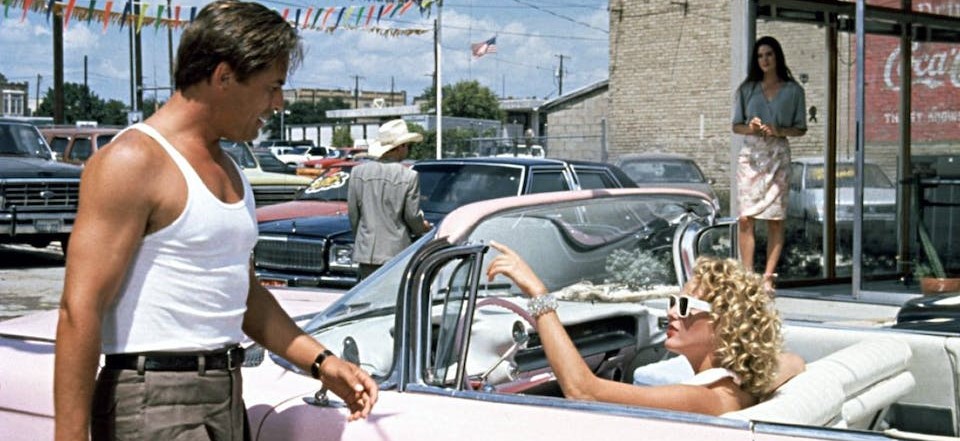
Don Johnson’s Harry Madox is a drifter who rolls into town with a past he never discusses and a plan that unfolds in real time. Johnson, shedding the pastel suits of Sonny Crockett, delivers a performance of quiet menace and calculated charm. Harry is not a master criminal; he’s an opportunist who reads the room—whether it’s the unattended bank during a fire drill or the vulnerabilities of the women around him.
Critics at the time noted Johnson’s restraint. He plays Harry as a man who speaks little but observes everything, a trait that makes his eventual unraveling all the more compelling. The role demonstrated range that his television work only hinted at, and in retrospect it stands as one of the strongest leading turns in 1990s neo-noir.
The Femme Fatales: Madsen and Connelly
No neo-noir succeeds without its women, and The Hot Spot offers two distinct archetypes. Virginia Madsen’s Dolly Harshaw is the classic femme fatale: married to the dealership owner (Jerry Hardin), she initiates an affair with Harry, then uses her knowledge of the robbery to blackmail him into continuing the relationship. Madsen, fresh off The Rainmaker and Candyman, brings a mix of vulnerability and steel that keeps Dolly from becoming a mere schemer.
Jennifer Connelly, in only her third feature, plays Gloria Harper, the dealership’s bookkeeper. Gloria is the “good girl” with a secret—she’s being extorted by the loathsome Frank Sutton (William Sadler). Connelly’s performance, poised and intelligent, provides the film’s moral center. The triangle between Harry, Dolly, and Gloria drives the narrative’s second half, culminating in a climax that subverts expectations about who holds the power.
Neo-Noir in the Texas Heat
Setting a noir in contemporary Texas was a deliberate choice. The genre’s traditional urban nightscape—rain-slicked streets, Venetian-blind shadows—is replaced by dusty highways, honky-tonk bars, and the relentless sun. This displacement creates a sense of dislocation; the moral ambiguity of noir feels even starker under unforgiving daylight.
Production designer Cary White and art director John Frick populate the frame with period-specific details: the used-car lot, the diner, the bank with its alarmingly lax security. These spaces feel lived-in, not dressed, which grounds the more outlandish plot turns. The film’s tagline—”Sex is never safe. It’s dangerous.”—captures the ethos: in this world, desire and deceit are inseparable from survival.
Jack Nitzsche’s Sultry Score
Composer Jack Nitzsche, whose credits include The Exorcist and One Flew Over the Cuckoo’s Nest, crafted a score that blends slide guitar, moody synth pads, and orchestral swells. The music underscores the film’s dual nature: part sweaty Southern gothic, part modern thriller. Nitzsche’s main theme, a languid guitar motif, recurs at key moments, binding the narrative’s disparate threads. The Radiance Blu-ray includes an isolated score track, allowing listeners to appreciate the composition’s nuance without dialogue or effects.
Radiance Films’ New Restoration
The Radiance Films release, which began shipping in July 2026, represents the most comprehensive home-video presentation to date. Sourced from a 4K scan of the original camera negative, the transfer restores Steiger’s color palette and fine detail that were compromised on earlier DVD and standard-definition Blu-ray editions. The disc includes the theatrical cut (130 minutes) and a newly produced documentary featuring interviews with surviving crew members, including editor Wende Phifer Mate and production designer Cary White.
Special features also encompass the original trailer, a 2013 clip reel, and the new Radiance trailer that premiered on YouTube July 31, 2026. The packaging features reversible artwork and a booklet with an essay by a contemporary film scholar—though the author’s name has not been publicly confirmed as of this writing.
Critical Reassessment Over Three Decades
Initial reviews in 1990 were mixed. Variety praised the performances but called the plot “overheated.” Roger Ebert gave it two-and-a-half stars, noting “a certain fascination in watching these characters destroy each other.” The film’s Metacritic score sits at 55, reflecting the divided reception.
In the intervening years, The Hot Spot developed a cult following among neo-noir aficionados. Academic writing has examined its gender dynamics, its revision of noir conventions, and its place in Hopper’s erratic filmography. The new New York Times review—published August 20, 2026—appears to be part of a broader critical re-evaluation, though the specific arguments in that piece remain behind the publication’s paywall and have not been independently verified here.
What is clear is that the film’s reputation has shifted from “forgotten misfire” to “flawed but essential.” The Radiance release and the high-profile review suggest a growing consensus that The Hot Spot deserves a place in the neo-noir canon alongside Blood Simple, The Last Seduction, and Devil in a Blue Dress.
For viewers encountering the film for the first time on the new Blu-ray, the experience may feel like discovering a time capsule—one that captures a specific moment when an actor-turned-director, a TV star seeking credibility, and two rising actresses converged on a dusty Texas backlot to make a movie that refused to play by the rules. Whether that refusal constitutes a “baffling dystopia” or a bold genre experiment is a debate that, thirty-six years later, remains very much alive.