admissions top colleges
|

93% admissions at top colleges go to private-schoo…

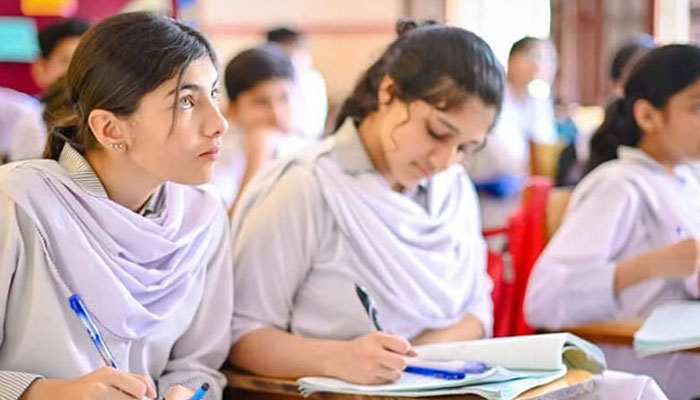
Concern has been raised over the quality of education in Karachi’s government schools and the ability of their students to gain admission to the city’s leading government colleges.

According to admission data, the overwhelming majority of students admitted to Karachi’s top 10 government colleges completed their matriculation from private schools.

Despite these institutions being government colleges, around 93 out of every 100 students admitted to them are graduates of private schools, while only about seven come from government schools.

Data obtained from the colleges shows that a total of 13,211 students were admitted to these institutions. Of them, 12,264 had completed their matriculation from private schools, while only 947 were graduates of government schools.

This means that 92.8% of admissions were secured by students from private schools, while government school students accounted for just 7.2%. In other words, for every 100 students admitted to these government colleges, approximately 93 come from private schools and only seven from government schools.

At Adamjee Government Science College, 613 students were admitted. Among them, 585 had completed matriculation from private schools, while only 28 came from government schools.

Similarly, Government D.J. Sindh Science College admitted a total of 1,258 students. Of these, 1,214 were graduates of private schools and only 44 had studied at government schools.

At Delhi Government Science College, 801 students were admitted. The figures show that 773 came from private schools, while only 28 were graduates of government schools.

Government Boys College for Men, Nazimabad, admitted a total of 1,317 students. Of these, 1,257 had completed their matriculation from private schools, while only 60 came from government schools.

The same trend is even more visible among government girls’ colleges.

Government Sir Syed Girls College admitted 2,507 students. Among them, 2,266 had completed matriculation from private schools, while only 241 were graduates of government schools.

At St Lawrence Government Girls College, 691 students were admitted. Of these, 631 came from private schools and only 60 from government schools.

Similarly, at PECHS Government College for Women, 1,517 students were admitted. A total of 1,420 had studied at private schools, while only 97 had completed matriculation from government schools.

At Khatoon-e-Pakistan Government College for Women, 2,107 students were admitted. Of these, 1,876 were graduates of private schools, while only 231 came from government schools.

The figures for boys and girls at Government Degree College Malir Cantonment were also included. According to the data provided, 402 students were counted in the combined figures, while the reported breakdown listed 1,316 students from private schools and 86 from government schools.

Meanwhile, Government Degree Boys and Girls College Stadium Road admitted a total of 998 students. Of these, 926 had completed matriculation from private schools, while only 72 were graduates of government schools.

The situation at government girls’ colleges is similarly concerning. At Sir Syed Girls College, 2,266 students from private schools secured admission compared with only 241 from government schools. At PECHS Government College for Women, the ratio was 1,420 private-school graduates against 97 government-school graduates. At Khatoon-e-Pakistan Government College for Women, 1,876 private-school graduates were admitted compared with just 231 from government schools.
Similar Posts

  • | | |

    US can’t isolate Iran without China, NYT says

    WASHINGTON: The United States may find it difficult to economically isolate Iran completely unless China cooperates with Washington, according to a New York Times analysis, which highlights Beijing’s growing role in Iran’s oil exports and trade. China is Iran’s largest trading partner and a major buyer of its crude oil, giving Beijing considerable influence over the effectiveness of any US campaign aimed at cutting Tehran’s access to international revenue. According to figures cited in the analysis, China and Iran conducted around $41.2 billion in trade in 2025, while Chinese buyers imported approximately $31.2bn worth of Iranian crude during the same year. At times, Chinese customers have accounted for as much as 90 per cent of Iran’s total oil exports. That dependence creates a significant challenge for Washington. The United States can impose sanctions on Iranian banks, companies, oil traders and vessels, but cutting off those channels may not be enough if Chinese businesses continue buying Iranian crude. A particularly important role is played by China’s small independent refineries, commonly known as “teapots”. These private operators have relatively limited exposure to the global financial system, potentially making them less vulnerable to traditional US sanctions. The arrangement has allowed Iran to maintain an important source of revenue despite years of American restrictions. Continued Chinese purchases could therefore provide Tehran with the financial breathing room needed to withstand additional economic pressure. But Beijing has its own economic leverage over Washington. The New York Times analysis noted that China could potentially restrict exports of critical minerals needed by American technology and defence industries. Beijing has previously used restrictions on strategic minerals during periods of trade tension with the United States, demonstrating the potential economic cost of confrontation. That creates a difficult calculation for Washington. Increasing pressure on Iran could put the United States in a position where it also has to confront China, potentially widening an already complicated economic rivalry. The geopolitical equation is further complicated by developments in the Middle East. The analysis pointed to US military activity in the region and the movement of some American military assets from the Pacific. Chinese observers have interpreted such moves as potentially creating vulnerabilities in America’s strategic position in Asia. For Washington, the central question is therefore not simply how many sanctions can be imposed on Tehran. It is whether those measures can succeed while Iran retains access to one of its most important economic partners. If China continues purchasing Iranian oil and maintaining commercial ties with Tehran, Iran is unlikely to become completely isolated economically. The analysis suggests that Beijing’s decisions could ultimately determine how far the US pressure campaign can go — and whether Washington can tighten the economic screws on Tehran without opening another front in its increasingly complex relationship with China.

  • | | | |

    Iran rejects talks on ceasefire extension

    Pakistan is making diplomatic efforts to help extend the ceasefire between the United States and Iran, as the current truce is scheduled to expire on Sunday, August 16. Sources said Islamabad is trying to use the understanding reached under the Islamabad Memorandum of Understanding to encourage both sides to maintain the ceasefire and return to negotiations. According to the sources, mediators believe additional time is needed to bridge differences between Washington and Tehran. Diplomatic efforts are therefore continuing to prevent the situation from deteriorating after the current ceasefire period ends. However, an Iranian senior official gave a different assessment of the situation. The official said there have been no discussions between Iran and the United States regarding an extension of the ceasefire. Iran has maintained that Washington must return to the agreement and honour its previous commitments. Tehran has also demanded a clear and credible timeline for the implementation of those commitments before any further understanding can be reached. Meanwhile, US President Donald Trump has made strong statements about the strategic Strait of Hormuz. Trump claimed that the United States now has complete control over the vital waterway and said Iran has limited options to challenge the American naval blockade. The Strait of Hormuz remains a major international shipping route and plays a crucial role in global energy supplies. Any prolonged disruption in the waterway could have serious consequences for oil and gas markets and international trade. Iranian military officials have warned that a renewed US offensive could lead to a wider confrontation. An Iranian military spokesman said energy transmission networks, power plants and infrastructure connected to the global internet could become targets if American military action resumes. The warning has raised concerns that any collapse of the ceasefire could expand the conflict beyond conventional military targets and affect critical infrastructure. Meanwhile, Turkish President Recep Tayyip Erdogan has expressed hope that additional countries will join the Makkah Defence Agreement. He indicated that broader participation could strengthen regional security cooperation. In another development, US Central Command said a Panama-flagged cargo vessel attempting to breach the naval blockade was disabled after a US helicopter fired a missile at the ship. The incident has further highlighted the risks facing commercial shipping in the region amid continuing tensions between Washington and Tehran. Separately, Japanese Prime Minister Sanae Takaichi discussed the situation with Iranian President Masoud Pezeshkian in a telephone conversation. Takaichi called for the Strait of Hormuz to be reopened once negotiations between Iran and the United States reach a successful conclusion.

  • |

    Huma Qureshi and Saqib Saleem join students at Delhi protest

    Actors Huma Qureshi and Saqib Saleem visited the ongoing student protest at Jantar Mantar in New Delhi during the early hours of Thursday, expressing support for demonstrators calling for accountability over alleged irregularities in the country’s education system. The sibling duo was accompanied by actor Rachit Singh as they walked alongside students who have been camping at the protest site for weeks. The demonstrators are demanding the resignation of Education Minister Dharmendra Pradhan, alleging misconduct and irregularities linked to the NEET examination process. Videos circulating on social media showed the actors arriving at the protest around 2:13 a.m. Huma, dressed casually in a black top and blue jeans, was seen interacting with protesters and walking through the gathering with a smile. Rachit Singh, wearing a white shirt, stayed close to her, while Saqib Saleem was also spotted joining the march and speaking with students. The visit quickly drew attention online, with many social media users praising the actors for showing solidarity with the students during the late-night demonstration. Others viewed their presence as a significant show of support from members of the film industry for a movement that has continued to gain momentum across the country. Huma and Rachit recently collaborated on the film Baby Do Die Do, which was produced by Huma Qureshi and Saqib Saleem under their production banner. Their appearance together at the protest marked an unexpected reunion, this time in support of a public cause rather than a film project. The student demonstrations, reportedly led by the Cockroach Janta Party (CJP), have expanded to several cities in recent weeks. Protesters have continued to demand greater transparency and accountability regarding the alleged examination irregularities, while urging authorities to address their concerns. Organisers have maintained that the movement will continue until their demands are met. In a statement shared on social media, representatives of the protest said they would remain united in their campaign and continue pressing for action. The protests have witnessed moments of heightened tension. Earlier this week, clashes reportedly broke out after police attempted to disperse demonstrators using batons and tear gas. Several protesters were removed from protest sites during security operations, while opposition leaders participating in demonstrations outside Prime Minister Narendra Modi’s residence were also detained during a separate sit-in. Despite the tense atmosphere, student groups have continued their demonstrations, attracting support from activists, public figures and members of the entertainment industry. The appearance of Huma Qureshi and Saqib Saleem adds to the growing list of Bollywood personalities who have publicly voiced solidarity with the students and their demands. As the protests continue, attention remains focused on the government’s response and whether officials will address the concerns raised by demonstrators. With public support growing and demonstrations showing no signs of slowing down, the movement has become one of the country’s most closely watched developments in recent weeks.

  • |

    Gold price in Pakistan rises by Rs1,700 per tola

    Gold prices moved higher across Pakistan on Monday, tracking an upward trend in the international bullion market, according to the latest rates issued by the All-Pakistan Gems and Jewellers Sarafa Association (APGJSA). The price of 24-karat gold per tola increased by Rs1,700, taking the new rate to Rs428,436. The recovery comes after a sharp decline recorded in the previous trading session, when the precious metal had fallen by Rs3,700 per tola to settle at Rs426,736 on Saturday. The price of 10 grams of 24-karat gold also witnessed an increase, climbing by Rs1,457 to reach Rs367,314 in local markets. Market analysts said the rise in domestic gold prices reflects the positive movement in global bullion markets, where investor demand strengthened amid ongoing uncertainty surrounding the global economic outlook and expectations regarding interest rate policies. In the international market, the price of gold gained $17 per ounce, pushing the bullion rate to $4,060 per ounce, including a premium of $20. The increase in global prices was mirrored in Pakistan’s local market, where gold rates are largely influenced by international trends and fluctuations in the value of the Pakistani rupee against the US dollar. Meanwhile, silver prices also registered a notable increase. The price of silver per tola rose by Rs54, reaching Rs6,291 in the domestic market.

  • | | |

    Video of Sunil Dutt’s ancestral home in Pakistan…

    A video showcasing the ancestral home of legendary Bollywood actor Sunil Dutt in Pakistan’s Jhelum district has gone viral on social media, attracting widespread attention from audiences in both Pakistan and India. The video was shared by Pakistani social media influencer Sameel Atif, who visited the historic house located in the village of Khord in Jhelum. According to the video, the property is the childhood home of Sunil Dutt, who was born as Balraj Dutt before the partition of British India in 1947. Following the video’s circulation, many social media users tagged Bollywood actor Sanjay Dutt, Sunil Dutt’s son, encouraging him to visit the family’s ancestral home and reconnect with his roots. The video has generated thousands of comments highlighting the shared cultural and historical ties between the two neighbouring countries. Reports state that Sunil Dutt spent his early years in the village before his family migrated to India during Partition. He later became one of Bollywood’s most respected actors and went on to serve as a member of the Indian Parliament. The story is further connected to Sanjay Dutt’s mother, legendary actress Nargis Dutt, whose family roots trace back to Rawalpindi. As a result, both of Sanjay Dutt’s parents had ancestral links to regions that are now part of Pakistan. In his social media post, Sameel Atif claimed that Sunil Dutt visited his ancestral village years after Partition. According to the post, the veteran actor requested the current owners of the house to preserve its original structure so that future generations could remember their shared history and heritage. This account has been widely shared online, though it reflects the information presented in the post. The viral video also includes a past interview in which Sanjay Dutt recalled his father’s emotional attachment to his birthplace. He said that whenever Sunil Dutt felt nostalgic, he would express a desire to return to what he considered his real home in Jhelum rather than Mumbai. Sanjay Dutt has also reportedly expressed a wish to visit Pakistan one day to see his father’s ancestral village and experience the place that held such deep emotional significance for him. The video has resonated with viewers on both sides of the border, many describing it as a reminder of shared history, cultural heritage, and enduring human connections beyond political boundaries. https://www.instagram.com/sameelatiff/reel/Dbs49YvKl5w/

  • Thai Government to Curb Fare Hikes Amid Middle East War

    BANGKOK — Thailand’s Ministry of Transport is set to announce a ministerial regulation on Thursday to prevent public transport providers, including taxis, motorcycle taxis, and on-demand ride-hailing services, from arbitrarily increasing their fares in response to the ongoing conflict in the Middle East, Transport Minister Phiphat Ratchakitprakarn confirmed on Wednesday. Thailand has enough oil for […]

Leave a Reply

Your email address will not be published. Required fields are marked *