
bpi asked amlc
| | | |

Why BPI asked AMLC to delete P2-B worth of transactions from Duterte-Carpio records

If the Bank of the Philippine Islands’ (BPI) records are to be believed, some eye-popping transactions linked to Vice President Sara Duterte’s husband, Manases Carpio, may not have been quite so eye-popping after all.

BPI wrote the Anti-Money Laundering Council (AMLC) in April asking it to delete 13 covered transaction reports (CTRs) after discovering that a “system bug” had caused incorrect amounts to be reported, according to a document earlier obtained by Rappler.


Why BPI asked AMLC to delete P2-B worth of transactions from Duterte-Carpio records

In the April 6, 2026 letter addressed to then-AMLC officer-in-charge Arnold Kabanlit, BPI said a “system bug from a source application system resulted in inaccurate amounts on the said records.”

After checking the transactions, BPI said several of the corrected amounts actually fell below P500,000, meaning they should not have been filed as CTRs at all. (READ: EXPLAINER: What makes a transaction ‘covered’ or ‘suspicious’ under AMLA?)

Under the Anti-Money Laundering Act, banks generally have to report transactions exceeding P500,000 within one banking day. A CTR is triggered by the amount and does not by itself mean that a transaction is suspicious or illegal.

Some of the discrepancies in BPI’s letter were huge.

inside track logo

Among the entries that can be read clearly in the copy reviewed by Rappler, an amount initially reported at around P269 million was corrected to P300,000. Other entries appearing to show transactions worth hundreds of millions of pesos were likewise revised to amounts below the P500,000 reporting threshold.

The document explicitly refers to transactions involving Carpio, using table headings including “number of MCs [Manager’s Checks] in favor of Manases” and “amount of check issued to Manases.”

In the letter, BPI said its technical team resolved the issue, and asked AMLC to delete the erroneous CTR records.

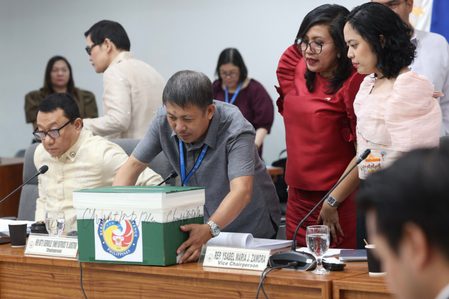
The correction surfaced again on Monday, October 5, as prosecutors began putting AMLC’s financial records before the Senate impeachment court.

Private prosecutor Mae Divinagracia referred to the BPI error in offering AMLC Executive Director Ronel Buenaventura’s testimony, but argued that billions in suspicious and covered transactions remained even after the bank corrected its records.


Why BPI asked AMLC to delete P2-B worth of transactions from Duterte-Carpio records

“Even after a bank corrected its own error, P4.4 billion in aggregate transactions remained,” Divinagracia said on Monday. “P6.77 billion ang iniulat ng AMLC sa House noong Abril 2026. Sa kabila ng pagtatama ng BPI sa diumano’y sarili nitong pagkakamali sa sistema, P4.4 billion suspicious at covered transactions pa rin ang natitira.”

(Even after a bank corrected its own error, P4.4 billion in aggregate transactions remained. AMLC reported P6.77 billion to the House in April 2026. Despite BPI correcting what it said was its own system error, P4.4 billion in suspicious and covered transactions still remained.)

‘Nangyayari ba talaga ito?

The magnitude of the correction did not escape senator-judges. During AMLC Executive Director Ronel Buenaventura’s testimony on Tuesday, October 6, Senator-judge Tito Sotto asked whether a banking glitch could really turn roughly P2 million into P2 billion. 

“Nangyayari ba talaga ito?” he asked, and later pressed further on the glitch. “Paanong nangyayari ang glitch sa issuance ng manager’s check?” (Does this really happen? How do you have a glitch in the issuance of a manager’s check?)

Buenaventura said banks do request corrections to erroneous reports and that AMLC validates them before acting. But a correction involving billions was the first of that size he could recall since becoming AMLC executive director in April. AMLC had audited BPI’s request and accepted the correction, he said, although he could not explain how BPI’s underlying system glitch occurred. 


Why BPI asked AMLC to delete P2-B worth of transactions from Duterte-Carpio records

A day later, Senator-judge Joel Villanueva raised the same question to Metrobank anti-money laundering division head Niña Feren Aguilar, asking whether her bank had encountered a similar reporting error. Aguilar said she had not encountered one during her tenure, although Metrobank does have a procedure for correcting mistakes by filing an amended covered transaction report with the AMLC. 

BPI itself finally took the witness stand on Wednesday, October 7, through Central Metro Manila branches division head Marwin Galvez. But Galvez was presented to authenticate and explain account records, not as a bank technology or AML reporting specialist, and simply told senator-judges that he had no knowledge of what caused the system bug.

So what could a “source application system” bug mean? A senior technology executive involved in digital systems testing at another Philippine bank told Rappler that banks can have separate systems handling customer transactions, core banking records, compliance checks, and regulatory reporting. 

In general, a bug in a source system or in the way data are passed between systems could result in incorrect information reaching a downstream system even if the actual transaction was different.

The defense, for its part, seized on BPI’s correction to argue that the AMLC figures should be treated with caution.

In a chance interview with reporters on Monday, the Vice President’s spokesperson Paolo Panelo said the P6.7-billion figure presented before the House had included transactions that BPI itself later said were erroneous. He claimed around P2.2 billion of the amount was being disputed by the bank due to a “glitch,” and accused the House justice committee of failing to disclose that qualification when the figure was first presented.

Panelo said the issue was “not fatal” to the impeachment case, but argued that it showed how “raw data from the AMLC can be misleading or inaccurate” if the underlying bank records are not first verified and placed in context.

During Monday’s hearing, Buenaventura also clarified that the aggregate value of transactions covered by CTRs and suspicious transaction reports had been revised to about P4.4 billion, in part because of the correction flagged by BPI.

“There was a request for correction by one covered person regarding 13 CTRs filed in relation to that,” Buenaventura said in a mix of English and Filipino. “We did some validation so when we made our submission on July 30 to this honorable court, it was already corrected.”

Buenaventura did not identify any other bank or covered person reporting a similar glitch or correction.

The prosecution is presenting the AMLC records as part of Article II of the impeachment case, which accuses Duterte of unexplained wealth and inaccurate declarations in her Statements of Assets, Liabilities, and Net worth (SALNs).

BPI’s appearance in the Duterte money trail is not entirely new. The bank also surfaced during the 2016 presidential campaign, when then-senator Antonio Trillanes IV alleged that then-Davao City mayor Rodrigo Duterte maintained accounts at BPI, including a Julia Vargas branch account jointly held with Sara. Rodrigo Duterte initially denied the allegation, later acknowledged having accounts at the Julia Vargas branch, but disputed Trillanes’ claim of the amounts that passed through them.

BPI at the time also denied that its systems had been breached and did not validate the transaction amounts publicly released by Trillanes. – Rappler.com
Must Read

BSP senior official hits bank secrecy limits in Sara Duterte subpoenas


BSP senior official hits bank secrecy limits in Sara Duterte subpoenas

Similar Posts

  • |

    Pakistan posts Rs3.6tr primary surplus as fiscal position improves in FY2025-26

    ISLAMABAD: Pakistan closed the financial year 2025-26 with a primary budget surplus of around Rs3.6 trillion, marking the third consecutive year of a surplus and allowing the country to comfortably meet a key fiscal condition agreed with the International Monetary Fund (IMF). The improvement came despite the government falling short of its tax collection targets, with stronger petroleum levy receipts, tighter expenditure controls and lower-than-expected debt servicing costs helping offset the revenue shortfall. According to the latest fiscal operations data released by the Ministry of Finance, the unadjusted primary surplus reached Rs3.63 trillion, equivalent to 2.6% of the country’s gross domestic product (GDP). The figure was approximately Rs464 billion higher than the IMF’s target of Rs3.16 trillion. The primary balance is considered an important indicator under Pakistan’s IMF programme because it measures the government’s fiscal position before interest payments on public debt. The latest figures indicate that the government maintained fiscal discipline despite continued pressure on revenues and expenditure. Overall fiscal deficit below target Pakistan’s overall budget deficit, after accounting for provincial cash surpluses, stood at approximately Rs3.3 trillion during FY2025-26. This was around Rs1.7 trillion lower than the amount initially projected in the federal budget. The federal government’s own deficit was recorded at Rs4.8 trillion, also significantly below the budgeted level. The better-than-expected outcome was primarily attributed to lower interest payments, stronger petroleum levy receipts and restrained development expenditure. Interest payments were around Rs1.3 trillion below the amount originally allocated in the budget. The government also collected approximately Rs101 billion more than its petroleum levy target, while federal development spending remained Rs82 billion below the initially approved allocation. The fiscal improvement also contributed to a moderation in the growth of public debt. Public debt increased by around 7% during the year, bringing some relief after several years of double-digit debt expansion. Provinces narrowly miss IMF cash surplus target The four provincial governments collectively generated a cash surplus of around Rs1.45 trillion during the fiscal year. Although the amount fell marginally short of the IMF’s combined requirement, the shortfall was only around Rs14 billion. Punjab contributed the largest share, recording a cash surplus of approximately Rs914 billion. Sindh posted a surplus of around Rs350 billion, followed by Khyber-Pakhtunkhwa with Rs165 billion and Balochistan with approximately Rs21 billion. Provincial governments, meanwhile, performed slightly better on revenue collection. Their combined tax receipts exceeded the IMF condition by around Rs18 billion, with collections crossing Rs1.2 trillion. FBR misses tax target Despite the overall improvement in the fiscal position, tax collection remained a major area of concern. The Federal Board of Revenue collected approximately Rs13 trillion during FY2025-26, falling nearly Rs1 trillion short of the IMF’s revised target. FBR tax receipts increased by about 11% compared with the previous year. However, this increase was broadly in line with nominal GDP growth, indicating that the tax-to-GDP ratio remained largely unchanged at around 10.3%. The figures suggest that additional revenue expected from new taxation and enforcement measures did not fully materialise. The government had anticipated around Rs700 billion in additional revenue from such measures. Non-tax revenue also remained below expectations by approximately Rs63 billion. Total non-tax receipts stood close to Rs5.1 trillion, including around Rs2.4 trillion in profits transferred by the central bank. Petroleum levy becomes key revenue source A major contributor to the stronger fiscal outcome was the petroleum levy. Collections under the petroleum levy climbed to around Rs1.567 trillion, representing an increase of approximately 28% over the previous year. The amount was also Rs101 billion above the target agreed with the IMF. The additional collection effectively represented roughly 25 days of petroleum price relief at a levy rate of Rs80 per litre on petrol and high-speed diesel. For the current financial year, the government has committed to collecting approximately Rs1.7 trillion through the petroleum levy. Meeting this objective is expected to require maintaining the levy at around Rs80 per litre, subject to the applicable petroleum pricing mechanism and market conditions. Development spending remains restrained The government’s fiscal consolidation strategy also affected development expenditure. Federal development spending was recorded at around Rs918 billion, approximately Rs82 billion below the originally approved budget allocation. However, the amount was still around Rs100 billion higher than the subsequently revised allocation. The figures reflect the government’s efforts to contain expenditure and prioritise fiscal targets amid pressure from debt servicing and revenue mobilisation. Debt servicing costs fall Lower-than-expected debt servicing provided another significant boost to the government’s fiscal position. The Ministry of Finance reported that debt servicing remained around Rs6.95 trillion during the year, compared with the budgeted amount of approximately Rs8.2 trillion. The government attributed the savings to tight fiscal management, improved cash handling and the early retirement of around Rs1.9 trillion in domestic debt. These measures helped reduce domestic debt servicing costs by nearly Rs1.97 trillion compared with the original estimates. Statistical discrepancy highlighted The fiscal operations report also identified a statistical discrepancy of around Rs853 billion across the federal and provincial accounts. According to the Ministry of Finance, the discrepancy was linked largely to changes in cash balances and differences in the recording and reporting of financial data. The negative discrepancy indicated that cash inflows were higher than recorded outflows. At the federal level, the discrepancy stood at approximately Rs448 billion. The ministry attributed the difference mainly to changes in commercial bank deposits as well as variations in reporting and accounting adjustments involving the State Bank of Pakistan, FBR and Economic Affairs Division. Provincial accounts showed a combined statistical discrepancy of approximately Rs405 billion. Punjab accounted for around Rs266 billion, Khyber-Pakhtunkhwa Rs95 billion, Balochistan Rs72 billion and Sindh around Rs28 billion. The ministry said movements in commercial bank deposits were among the principal factors behind the provincial differences. IMF review ahead The improved fiscal performance is expected to strengthen Pakistan’s position ahead of the next IMF assessment. An IMF mission is expected to visit Islamabad in the third week of September to review Pakistan’s economic performance during the previous fiscal year. The mission is also expected to

Leave a Reply

Your email address will not be published. Required fields are marked *