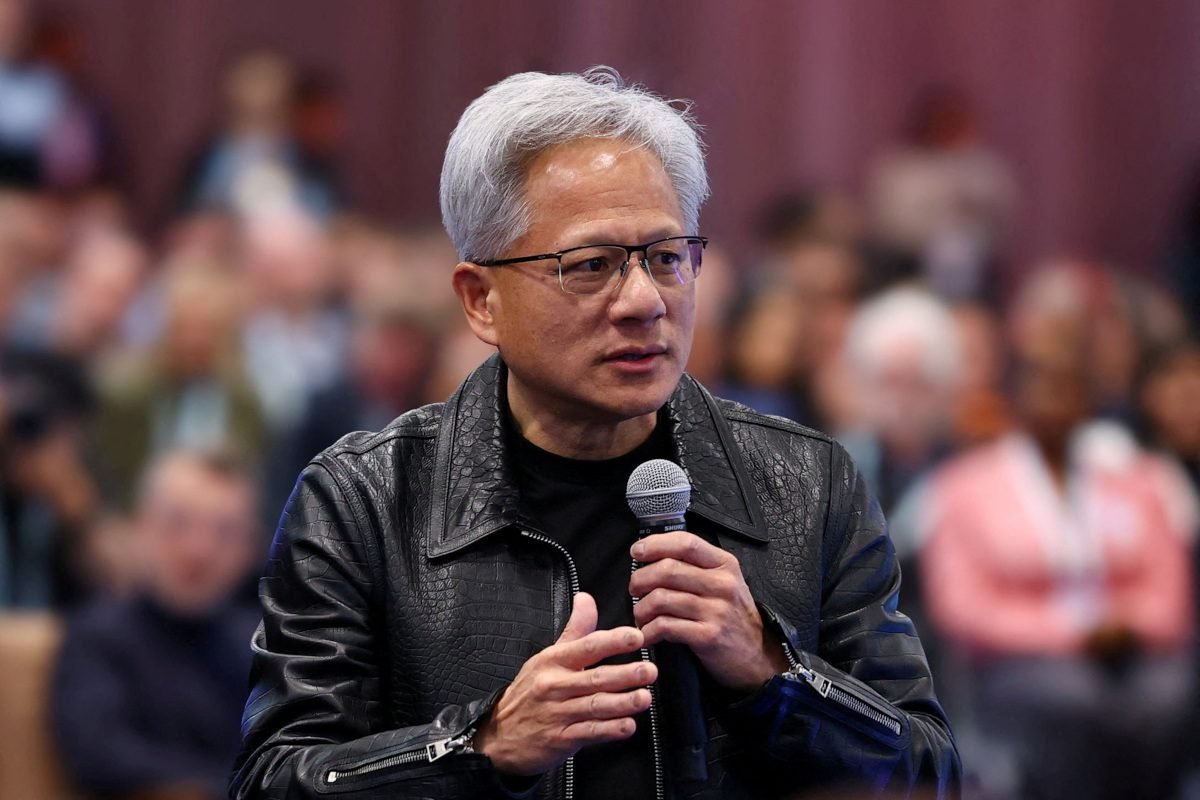
nvidia board meets

Nvidia board meets to decide CEO Huang’s future, source says

Nvidia’s board is meeting on Wednesday, November 11, to decide whether to oust CEO Jensen Huang, a source familiar with the matter told Reuters, as the world’s dominant supplier of AI processors grapples with reports of two extramarital affairs involving its longtime leader.

Nvidia did not immediately respond to a request for comment on the board meeting.

Huang’s potential departure would leave a leadership vacuum at the roughly $4-trillion chipmaker he co-founded and built over more than three decades to become the top supplier of AI chips at the center of the global artificial-intelligence boom and US-China technology rivalry.

Huang, 63, has no obvious successor and owns about 3.6% of Nvidia’s stock. He also has dozens of direct reports, underscoring the tight control he maintains over the company.

“Huang being removed immediately could be challenging for Nvidia since it does not have a succession plan in place … If Mr. Huang broke the law or violated company policies, the board is likely to act as soon as they have proof,” Gil Luria, head of technology research at D.A. Davidson, said.

The company’s shares slid about 8% in after-hours trading after the Wall Street Journal first reported that Nvidia was preparing to oust Huang. Including Wednesday’s after-hours selloff, Nvidia has lost about $600 billion in stock market value this week since the board announced its investigation into his relationship with a Chinese businesswoman.

Earlier in the day, the New York Times reported that Huang had also had an extramarital affair with a company executive who reported to him.

The relationship was with Kimberly Powell, Nvidia’s vice president of healthcare, the New York Times said, citing five people who worked at the company.

When reached by phone Wednesday and asked about his relationship with Ms. Powell, Mr. Huang said, “I don’t think you should be talking to me directly.” He then hung up, the New York Times reported.

Nvidia and Powell did not immediately respond to requests for comment. Reuters could not immediately verify the report.

Leadership uncertainty

The reports mark a sharp escalation in a controversy that began with revelations about Huang’s relationship with Alice Huang, a woman US intelligence has said was involved in facilitating shipments of Nvidia chips to Chinese firms.

US stock futures sank, with Nasdaq futures down 1%. However, shares of rival chipmakers AMD and Broadcom rose 4% and 3%, respectively, in after-hours trading, which an analyst said reflected the view that those chip producers would pick up market share.

Investors and analysts said while demand for Nvidia’s chips would be unlikely to drop in the near term, the broader universe of companies backed by the company might suffer.

“Nvidia is also at the center of the circular financing which is providing capital to the investment boom,” said Nick Ferres, chief investment officer at Vantage Point Asset Management in Singapore.

“They are financing their customers. In these types of booms or bubbles, sometimes all it takes is a slowdown to shift it into the bust phase.”

In a memo to employees on Sunday, Huang acknowledged being unfaithful to his wife and took “full responsibility,” but gave no details about the relationship.

The same day, Nvidia’s board launched an investigation into whether Huang had been targeted by a foreign intelligence operation. The probe is being overseen by independent directors with outside legal counsel. At the time, the board expressed confidence in Huang.

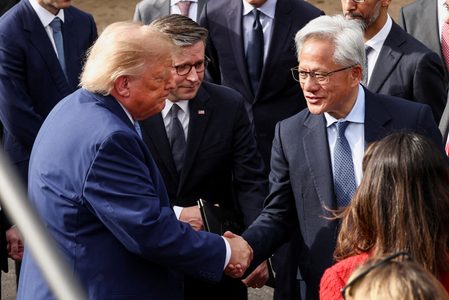
US President Donald Trump has said he had not discussed the allegations with Huang but voiced support for the Nvidia chief, calling him “an honorable guy” who had “done an amazing job for our country.”

Huang faces a potential congressional subpoena if he doesn’t respond to a request to provide a closed-door briefing about the allegations that he had a close relationship with the Chinese businesswoman who passed information to Beijing.

Separately, Axios reported on Wednesday, citing high-level sources, that US Commerce Secretary Howard Lutnick stalled President Donald Trump’s crackdown on companies suspected of diverting Nvidia’s chips to China.
Must Read

Trump’s close ties to Nvidia’s Huang scrutinized after foreign intelligence concerns


Trump’s close ties to Nvidia’s Huang scrutinized after foreign intelligence concerns

The White House and a spokesperson for Lutnick did not immediately respond to requests for comment.

Huang co-founded Nvidia in 1993 with Curtis Priem and Chris Malachowsky. Its early hits were graphics chips for computer games, before its CUDA software opened the processors to general computing and, later, AI. – Rappler.com

Similar Posts

  • | | |

    Pakistan’s defence tech breakthrough: PM Shehbaz

    Prime Minister Shehbaz Sharif has said Pakistan has achieved significant progress in developing its own defence technologies and autonomous systems. Addressing the Indus Robotics and Autonomous Systems (RAS) Expo 2026 in Islamabad, the prime minister praised the country’s growing capabilities in robotics, artificial intelligence and advanced defence technologies. PM Shehbaz said Pakistan’s armed forces have made major advancements in indigenous defence production and autonomous systems. He credited the progress to strong leadership and the efforts of national institutions. He said modern technologies displayed at the exhibition reflected Pakistan’s ability to develop advanced systems locally. The prime minister highlighted that several defence-related technologies, including simulators and autonomous platforms, were designed and manufactured within the country. During his visit to the exhibition, PM Shehbaz reviewed various locally developed technologies. He said the production of advanced equipment inside Pakistan was a major achievement and demonstrated the country’s growing technical expertise. The prime minister noted that drone technology had achieved significant levels of local production, while several other important machines and systems were also being developed domestically. He said Pakistan’s armed forces have successfully used modern autonomous systems to strengthen the country’s physical and cyber security. He added that advanced technologies have enhanced the ability of security institutions to respond to emerging challenges. PM Shehbaz emphasized the importance of innovation, research and technological development for Pakistan’s future. He said continued investment in artificial intelligence, robotics and modern defence systems would help strengthen national security and technological independence. The Indus Robotics and Autonomous Systems Expo brings together experts, researchers, defence professionals and technology developers to showcase advancements in robotics, automation and artificial intelligence. The prime minister said such initiatives would encourage local innovation and support Pakistan’s journey toward self-reliance in advanced technologies.

  • |

    AI builds 16 brand-new viruses in world-first genome experiment

    Artificial intelligence has designed 16 entirely new viruses that have never existed in nature before. Researchers in the US are calling it a genuine scientific breakthrough. According to the team behind the project, these newly designed viruses are fully functional and can replicate successfully in lab conditions. Scientists are describing the achievement as a major turning point for the field. This marks the first time AI has managed to design a complete viral genome from scratch. The viruses were specifically built to target bacteria, particularly drug-resistant strains of E. coli, and pose no risk to humans. The work was led by Dr Brian Hie and his team at Stanford University. They relied on genome language models, including systems called Evo1 and Evo2, trained using data from roughly two million bacteriophages. To keep the research safe, the team deliberately excluded any genetic data linked to viruses capable of infecting humans, animals or plants. That precaution was built into the training process from the very start. Hie explained that this represents a new level of complexity for what generative AI can design. He noted that building a complete, functional genome capable of replicating inside cells was completely uncharted territory for his team. Out of thousands of AI-generated designs, researchers narrowed the list down to around 300 for lab synthesis. After testing, only 16 of those proved effective at killing antibiotic-resistant E. coli. Scientists have framed the achievement as a potential breakthrough with real medical applications ahead. Tom Ellis, a synthetic genome expert at Imperial College London, called the work impressive but pointed out its current limitations. He noted that this particular genome remains one of the simplest and smallest to design successfully. Ellis added that concerns around AI-designed pathogens are often overstated compared to more realistic risks. He explained that modifying existing pathogens through gain-of-function techniques remains a far easier and more likely biosecurity threat. Still, some researchers in the wider scientific community remain cautious about where this technology could eventually lead. Experts at the Johns Hopkins Center for Health Security warned that proper oversight for this kind of AI-driven genome design doesn’t fully exist yet. Dr Filippa Lentzos from King’s College London argued that regulation needs to focus on multiple layers, including lab safety and DNA synthesis screening, rather than restricting AI models alone.

Leave a Reply

Your email address will not be published. Required fields are marked *