pakistans defence tech
| | |

Pakistan’s defence tech breakthrough: PM Shehbaz

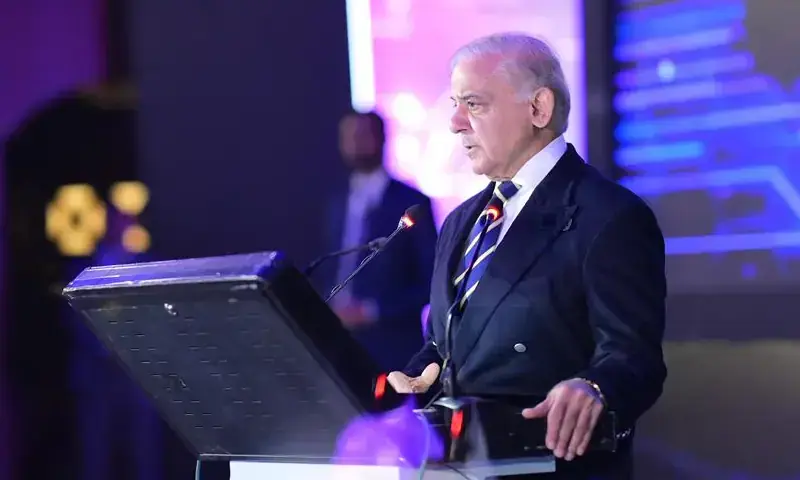
Prime Minister Shehbaz Sharif has said Pakistan has achieved significant progress in developing its own defence technologies and autonomous systems.

Addressing the Indus Robotics and Autonomous Systems (RAS) Expo 2026 in Islamabad, the prime minister praised the country’s growing capabilities in robotics, artificial intelligence and advanced defence technologies.

PM Shehbaz said Pakistan’s armed forces have made major advancements in indigenous defence production and autonomous systems. He credited the progress to strong leadership and the efforts of national institutions.

He said modern technologies displayed at the exhibition reflected Pakistan’s ability to develop advanced systems locally. The prime minister highlighted that several defence-related technologies, including simulators and autonomous platforms, were designed and manufactured within the country.

During his visit to the exhibition, PM Shehbaz reviewed various locally developed technologies. He said the production of advanced equipment inside Pakistan was a major achievement and demonstrated the country’s growing technical expertise.

The prime minister noted that drone technology had achieved significant levels of local production, while several other important machines and systems were also being developed domestically.

He said Pakistan’s armed forces have successfully used modern autonomous systems to strengthen the country’s physical and cyber security. He added that advanced technologies have enhanced the ability of security institutions to respond to emerging challenges.

PM Shehbaz emphasized the importance of innovation, research and technological development for Pakistan’s future. He said continued investment in artificial intelligence, robotics and modern defence systems would help strengthen national security and technological independence.

The Indus Robotics and Autonomous Systems Expo brings together experts, researchers, defence professionals and technology developers to showcase advancements in robotics, automation and artificial intelligence.

The prime minister said such initiatives would encourage local innovation and support Pakistan’s journey toward self-reliance in advanced technologies.


Similar Posts

  • |

    Kendall Jenner shares powerful lesson about facing rejection

    Rejection is often one of the most difficult experiences anyone can face while pursuing a dream. It can leave a person questioning their abilities, choices and even their place in an industry or environment they desperately want to be part of. For Kendall Jenner, rejection was not something that simply disappeared once she entered the world of fashion and entertainment. Instead, it became part of her journey and taught her an important lesson about persistence. Jenner has spoken openly about how difficult it can be to pursue a career when other people are not convinced that you have what it takes. She recalled facing closed doors and encountering adults who were hesitant to work with her. Some people, she said, even laughed at her behind her back. Such experiences can be particularly painful when someone is young, ambitious and trying to establish themselves in a highly competitive field. Her words offer an honest look at a side of success that is often hidden from the public. People usually see the glamorous moments, major opportunities, successful projects and achievements that come after someone has established a name for themselves. What is less visible are the disappointments that came before those achievements. Every successful person has faced moments when someone said no, overlooked their potential or decided they were not the right person for an opportunity. For anyone chasing a dream, rejection can feel deeply personal. When an opportunity is lost, it can be easy to believe that the rejection reflects a lack of talent or ability. However, Jenner’s experience suggests that one person’s opinion does not necessarily determine someone’s future. A closed door can simply mean that the timing, circumstances or people involved were not right. There are also moments when rejection is not expressed directly. Sometimes opportunities disappear without an explanation. Other times, people make it clear that they do not believe in you. Hearing that someone has doubted your abilities can be discouraging, especially when you are already struggling with self-doubt. Yet continuing despite those opinions can become an important part of building confidence. Jenner’s quote serves as a reminder that belief in yourself does not always come from other people first. There may be times when nobody around you understands your goals or sees the potential you believe you have. That does not necessarily mean the dream is unrealistic. It may simply mean that you have to keep moving forward before others recognize what you are capable of achieving. Her journey also highlights the importance of resilience. Success rarely happens because every opportunity works out perfectly. More often, it develops through a combination of patience, hard work, learning from setbacks and remaining committed when circumstances become difficult. The most powerful message in Jenner’s words is that rejection does not have to be the end of the story. Doors may close, people may doubt you and opportunities may not arrive when you expect them. But those moments do not have to define your future. Sometimes, the beginning of success is simply refusing to stop after someone else has told you no. Continuing to believe in yourself, improving your skills and pursuing your goals can eventually lead to opportunities that once seemed impossible. In that sense, rejection may hurt, but it can also become part of the journey toward proving to yourself what you are capable of achieving. You have no idea how many doors closed on me and how many adults were either initially reluctant to take a chance working with me.

  • |

    Use of Pellet guns in Delhi protests revive Kashmi…

    Cockroach Janta Party protests in Delhi has sparked a nationwide debate while reopening old wounds in occupied Kashmir, where the weapon has been used extensively against peaceful protesters for years. The incidents in the capital have drawn attention to the long-standing suffering of Kashmiris, who have borne the brunt of pellet gun injuries, with many left blinded or permanently disabled. The Delhi protests, led by students demanding education reforms, ended successfully with the resignation of Education Minister Dharmendra Pradhan. However, the use of pellet guns against demonstrators has overshadowed the victory, raising concerns about the government’s approach to handling dissent. Critics have questioned why such force was used against peaceful protesters in the capital, drawing parallels to the devastation caused in occupied Jammu and Kashmir. Rahul Gandhi, a prominent opposition leader, expressed deep sorrow over the use of pellet guns, highlighting the tragic toll they have taken in Kashmir. Human rights organizations have repeatedly condemned pellet guns as a “cruel weapon” that causes disproportionate harm, and the international community has raised concerns about their use in the region. The Delhi incident has reignited calls for a ban on pellet guns, with activists urging the Indian government to adopt less lethal methods of crowd control. The controversy has also drawn attention to the broader issue of human rights violations in occupied Kashmir, where the use of such weapons has been a persistent concern. Hospital records from the region highlight the devastating impact of pellet gun injuries, with countless young Kashmiris left with permanent disabilities. The use of pellet guns in Delhi has not only sparked outrage but has also brought the Kashmir issue back to the forefront of national and international discourse. Human rights groups have called for a thorough investigation into the incidents and for the government to ensure that such weapons are no longer used against citizens exercising their fundamental rights. As the debate continues, the victims of pellet gun injuries in both Delhi and Kashmir await justice and accountability. The incident serves as a reminder of the urgent need for reforms in crowd control measures and the importance of protecting the rights of all citizens. The international community continues to monitor the situation closely, urging India to uphold its human rights obligations. The time for change is now. The government must act decisively to ensure that the rights of all citizens are protected and that such incidents are never repeated. The victims of pellet gun injuries, both in Delhi and Kashmir, deserve justice, and the government must take concrete steps to ensure that their voices are heard and their grievances addressed. The fight for justice continues, and the nation must stand united in its commitment to upholding the rights and dignity of all citizens. The use of pellet guns in Delhi has once again exposed the harsh realities of India’s approach to law and order, and the need for meaningful reform has never been more urgent.

  • Thailand Braces For Severe Weather

    BANGKOK, Thailand — The Thai Meteorological Department has issued severe weather warnings, forecasting very heavy rainfall across the northern and upper northeastern regions of the country, which carries a high risk of flash flooding and dangerous water runoff in several provinces. Meteorological Department Issues Storm Alert For Multiple Regions The department reported on Sunday that […]

  • |

    King Felipe VI breaks protocol to hug Lamine Yamal…

    Spain’s King Felipe VI, Queen Letizia, and their daughters welcomed the national team to celebrate their FIFA World Cup victory, but it was a warm embrace between the monarch and teenage star Lamine Yamal that stole the show. A video of the team’s arrival at the royal palace went viral after eagle-eyed fans noticed something unusual: while most players followed protocol by shaking hands with the King, Yamal went a step further and hugged him. The King and his family queued up to welcome the team, shaking hands with each player and patting them on the shoulders to acknowledge their achievement. However, when Yamal approached, the monarch not only shook his hand but also embraced him warmly, breaking with the usual royal protocol. The moment captured the hearts of fans, who took to social media to share their reactions. “All the players respectfully greeted the King, then Lamine Yamal greeted him like one of the boys,” joked one user on X. Another wrote, “Actually, what’s cooler is that it’s the KING who greeted HIM like that.” A third added, “Man knows the next 20 years are his,” referring to Yamal’s rising stardom in world football. The gesture reflected the immense pride and admiration Spain holds for its World Cup-winning team, particularly Yamal, who played a pivotal role in the tournament. The 17-year-old forward, born to a Moroccan father and a mother from Equatorial Guinea, has become a symbol of racial and social integration in Spain, earning admiration both on and off the pitch. The meeting between the royals and the team was part of the official celebrations for Spain’s second World Cup crown, following their 1-0 victory over Argentina in extra time. The players were greeted as heroes, with the King praising their dedication and sportsmanship. The hug between King Felipe and Yamal has been widely celebrated as a moment of genuine connection, breaking down the formal barriers that often characterize royal engagements. It also highlighted Yamal’s growing influence and the respect he commands, not just as a footballer, but as a young man who has captured the nation’s imagination. As Spain continues to celebrate its World Cup triumph, the image of King Felipe embracing Lamine Yamal will be remembered as one of the most heartwarming moments of the victory tour, symbolizing the unity and pride of a nation united by the beautiful game.

  • | |

    PTI backs new provinces with constitutional consen…

    PTI Chairman Gohar Ali Khan has voiced support for the creation of new provinces, saying administrative reforms are needed to improve governance, but stressed that any such move must be carried out strictly under the Constitution and with broad political consensus. Speaking during a television interview on Thursday, Gohar described the formation of new provinces as a national necessity. However, he emphasized that constitutional requirements must be fulfilled, including securing a two-thirds majority in the relevant provincial assemblies before any proposal could move forward. The PTI chairman also expressed skepticism about Prime Minister Shehbaz Sharif completing his full five-year constitutional term, though he did not elaborate on the reasons behind his remarks. The debate over creating new provinces gained momentum after Interior Minister Mohsin Naqvi recently argued that Pakistan’s governance system had become ineffective and required major structural reforms, including the establishment of additional administrative units. Naqvi later clarified that his comments reflected concerns about the country’s governance over several decades rather than criticism of the current government. The proposal has drawn mixed political reactions. Murad Ali Shah firmly rejected any suggestion of dividing Sindh, stating that the provincial assembly has repeatedly passed unanimous resolutions opposing such a move. He maintained that any change would require constitutional approval through a two-thirds majority in the concerned assembly. Meanwhile, Prime Minister’s Adviser Rana Sanaullah distanced the government from Naqvi’s remarks, describing them as the minister’s personal opinion. He said any discussion on creating new provinces should take place in parliament and follow the constitutional process. Sanaullah noted that establishing new provinces involves complex constitutional, financial and administrative considerations, including representation in parliament and resource distribution.

  • | |

    Ghazi University, Chinese academy sign MoU for agr…

    By MIR HUNBAL BIRMANI DG Khan: Ghazi University has formally signed a Memorandum of Understanding (MoU) with the Chinese Academy of Agricultural Sciences (CAAS), China, establishing a strategic partnership aimed at advancing agricultural research and academic excellence.The agreement was officially signed by Dr. Muhammad Asif (Registrar, Ghazi University) and Dr. Zahoor Hussain on behalf of Ghazi University, alongside Prof. Dr. Xiaohui Zhang and Prof. Dr. Haiping Wang representing CAAS According to details , Department of Horticulture at Ghazi University, Dera Ghazi Khan, successfully organized a comprehensive one-day international workshop attended by scientists from china titled “Sustainable Vegetables Production Under Changing Climate” to address the growing challenges posed by global climate fluctuations on agricultural security. Registrar of Ghazi University, Dr. Muhammad Asif, who underscored the immense value of the event in enhancing the technical capacity and research aptitude of the university’s faculty members and senior students in attendance. The workshop’s core highlight featured keynote addresses delivered by a delegation of distinguished international agricultural scientists from the Chinese Academy of Agricultural Sciences (CAAS) in Beijing, China. The visiting panel included Prof. Dr. Xiaohui Zhang, Prof. Dr. Haiping Wang—Director, Chief Scientist of the Department of Vegetable Germplasm, and Curator of the National Vegetable Germplasm Resources Bank—and Dr. Jiangping Song, also a scientist and curator at the institution. During the technical sessions, these experts presented advanced, climate-resilient strategies tailored to modern horticultural demands, focusing on improved cultural practices, vegetable forcing techniques to optimize growth cycles, and controlled greenhouse production systems designed to maintain high yield quality despite extreme weather conditions. An interactive question-and-answer session was also part of the workshop, providing attendees with a valuable opportunity to engage directly with the keynote speakers and clarify complex concepts. The event concluded with a vote of thanks from Dr. Zahoor Hussain, Chairperson of the Department of Horticulture, who expressed deep gratitude to the honorable international guests, administration, and participants for contributing to the event’s success. Ultimately, the workshop served as a vital academic platform for knowledge transfer and scientific exchange, strengthening bilateral ties between Pakistani and Chinese agricultural researchers while setting a clear path forward for sustainable vegetable cultivation in the region. Ghazi University has formally signed a Memorandum of Understanding (MoU) with the Chinese Academy of Agricultural Sciences (CAAS), China, establishing a strategic partnership aimed at advancing agricultural research and academic excellence. The agreement was officially signed by Dr. Muhammad Asif (Registrar, Ghazi University) and Dr. Zahoor Hussain on behalf of Ghazi University, alongside Prof. Dr. Xiaohui Zhang and Prof. Dr. Haiping Wang representing CAAS. This bilateral agreement lays the groundwork for joint research initiatives, faculty and student exchange programs, and the provision of specialized scholarships. Additionally, the collaboration will focus on hosting joint workshops, technical training sessions, and capacity development programs designed to build expertise and strengthen global academic cooperation in agricultural sciences.

Leave a Reply

Your email address will not be published. Required fields are marked *