| | | |

Piattos Snow Cheese? Just another hit for URC as sales top P130B

You can’t have lunch with the head of the country’s biggest snack company without sampling some of those goodies at the table.

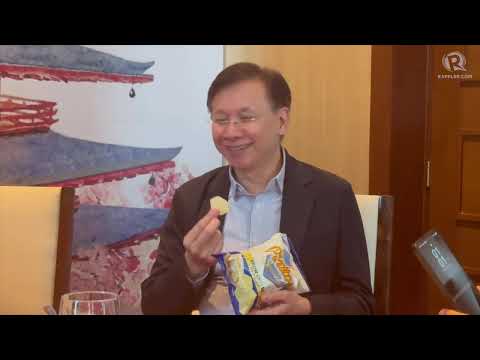
And no less than Universal Robina Corporation (URC) president and CEO Irwin Lee was ready to show off his latest product, Piattos Specials Snow Cheese, a limited-edition flavor packaged in a white and blue bag. 

Sweet, creamy, and lightly cheesy, the new chips take inspiration from the Korean snack trends that have become popular among younger consumers.

Piattos Snow Cheese? Just another hit for URC as sales top P130B

“It’s flying off the shelves,” Lee told reporters on Friday, November 20. “We’re out of stock in a lot of places. We have to make more of it. We’re catching up on supply.”

“‘Pag pumatok ‘yan (If it’s a hit), and if there’s a clamor for it, we’ll make it permanent,” he added.

By then, the bag was empty. After all, it’s not every day you get to share chips with the man in charge of making them.

inside track logo
Biscuits, beverages, billions

Of course, there’s much more to URC’s business than this bag of Piattos might betray.

The Gokongwei-led food manufacturer is on track to surpass P175 billion in revenue this year, having already raked in P130.7 billion in the first nine months of 2026, up 5% year-on-year.

One particularly bright spot has been URC’s international business, which now accounts for roughly 20% to 25% of sales.

Take C2, for example. The ready-to-drink tea beloved by Filipinos has apparently won over hearts in Vietnam too, jockeying for the top position against a local brand for the past six months.

“It’s number one in urban Vietnam. And we’re number two in rural,” Lee said, adding that it was the Philippine flavors — lemon and apple in particular — that were topping the charts. 

Over in Malaysia, URC’s P24.6-billion acquisition of Munchy’s in 2021 has been “very, very, strong,” according to Lee, solidifying its position as the country’s leading biscuit player.

“We’re running very tight on our biscuit line capacities, so we have to really expand in Malaysia,” he said. 

URC expects to maintain its annual capital expenditures of around P6 billion to P8 billion in 2027, with about 15% to 20% allocated to its overseas operations and the biggest chunk of that going to Malaysia.

Back home, however, Filipino consumers have been more cautious.

Lee said inflation has bifurcated growth across categories. Chip sales have slowed down to a low 2% to 3% increase.

Meanwhile, biscuits and bakery products are still enjoying double-digit growth, as are premium drinks like Vitasoy and Blu. And even though chips in general are having a slow year, premium snacks like Calbee potato chips are still selling briskly, with growth in the strong double-digits.

A fan of Vico

Speaking of treats, URC also has a hand in making Christmas a little sweeter for residents of a certain slice of the metro. And it turns out Lee is quite fond of the man running the place too.

It’s Pasig Mayor Vico Sotto, whose reputation for good governance has earned him admirers well beyond the city.

URC has longstanding ties to Pasig, where founder John Gokongwei Jr. established the company’s predecessor. It still operates flour milling and animal feed facilities there.

Among the goodies that have found their way into Pasig’s annual Christmas giveaway packs are sachets of Swiss Miss hot chocolate, distributed locally by URC. A warm cup of that rich, milky drink with marshmallows is the highlight of many a holiday get-together.

Lee said he had given the Pasig local government a good price for its purchases. But it turns out that the real treat — at least for URC employees — is the job of delivering the goods to city hall. After all, that delivery run might just come with a chance to meet the mayor himself. – Rappler.com


Similar Posts

  • |

    CPEC 2.0: Pakistan, China shift focus to B2B investment

    ISLAMABAD: Pakistan and China are moving toward a more business-driven model of cooperation under the second phase of the China-Pakistan Economic Corridor (CPEC), with greater emphasis on Business-to-Business (B2B) partnerships, industrial development, exports and productivity rather than large-scale Government-to-Government (G2G) financing. The development emerged during a high-level Chinese delegation’s visit to the CPEC Secretariat, where discussions focused on strengthening industrial and commercial ties between the two countries. According to an official statement issued by the Ministry of Planning on Tuesday, the Chinese delegation was headed by Sun Dongsheng, Senior Advisor, Economic Affairs Press. The delegation met Federal Minister for Planning, Development and Special Initiatives Ahsan Iqbal, along with senior policymakers and development experts. The talks centred on ways to advance B2B and industrial cooperation under CPEC 2.0, reflecting a broader shift in the corridor’s priorities from infrastructure-led development toward industrialisation, exports, technology and private-sector participation. From infrastructure to industrialisation During the meeting, Ahsan Iqbal briefed the Chinese delegation on the government’s Uraan Pakistan economic transformation programme and outlined Islamabad’s priorities for the next phase of CPEC. The minister proposed closer cooperation with Chinese institutions, including counterparts of the National Centre of New Manufacturing, to benefit from China’s experience in advanced manufacturing, innovation, automation and robotics. He said Pakistan needed to strengthen its productive capacity and adopt modern technologies to remain competitive in the era of Industrial Revolution 4.0 and prepare for the emerging Industrial Revolution 5.0. Ahsan Iqbal identified Pakistan’s limited export base as one of the country’s major economic challenges. According to the minister, repeated attempts to accelerate economic growth have struggled to generate sustainable momentum because productive sectors have not been sufficiently integrated with export markets. He stressed that the government’s priority was therefore to turn agriculture, manufacturing and other productive sectors into stronger sources of exports and foreign exchange. Pakistan seeks greater access to Chinese market The minister also called for greater facilitation of Pakistani exports to China, highlighting the considerable gap between the two countries’ trade potential. He noted that China imports goods worth around $2.6 trillion annually, whereas Pakistan’s exports to the Chinese market remain close to $3 billion. Ahsan said Pakistan needed to increase its presence in the Chinese market by improving production standards, competitiveness and the ability of domestic businesses to meet international demand. He expressed the expectation that CPEC 2.0 could help Pakistan address what he described as its “export deficit”, just as the first phase of the corridor contributed to addressing the country’s energy shortfall. CPEC enters a new phase Under CPEC’s first phase, China committed substantial financing to infrastructure, energy and other development projects in Pakistan. Nearly $30 billion was invested in infrastructure and power-sector projects, including independent power producers. However, the focus is now increasingly shifting toward private-sector-led cooperation. Islamabad continues to pursue financing for selected road and motorway projects, but China has yet to demonstrate readiness to finance the long-delayed Main Line-1 (ML-1) railway upgrade, which had previously been regarded as one of CPEC’s flagship projects. The latest consultations indicate that CPEC 2.0 is expected to rely more heavily on commercial partnerships between Pakistani and Chinese companies. The government has already been encouraging enterprises from both countries to explore joint ventures and investment opportunities in sectors including manufacturing, agriculture and mining. Ahsan Iqbal said recent agreements between Pakistani and Chinese companies showed that B2B cooperation was beginning to gain momentum. He expressed confidence that stronger business-to-business engagement would support the modernisation of Pakistan’s industrial and agricultural sectors while creating opportunities for investment, employment and exports. China stresses productive capacity Sun Dongsheng reaffirmed the importance China attaches to its longstanding relationship with Pakistan and highlighted the achievements of CPEC’s first phase. He called for further cooperation in industrial and agricultural development, particularly in strengthening Pakistan’s productive capacity. The Chinese delegation also stressed the importance of involving small and medium-sized manufacturing enterprises in bilateral economic cooperation. Greater enterprise-to-enterprise engagement, according to the delegation, could help create commercially sustainable partnerships and expand opportunities for businesses in both countries. The discussions also focused on technology transfer, innovation, skills development and the creation of stronger industrial linkages. Five Corridors aligned with Uraan Pakistan Officials also discussed the strategic relationship between the Five Corridors of CPEC 2.0 and Pakistan’s 5Es framework under Uraan Pakistan. The government’s 5Es framework focuses on exports, e-Pakistan, environment and climate change, energy and infrastructure, and equity and empowerment. The participants stressed that alignment between the two initiatives needed to translate into concrete economic outcomes, including new enterprises, technology adoption, innovation, employment opportunities, skills development, increased exports and higher investment. The delegation was also briefed on the progress achieved during CPEC Phase I and Pakistan’s priorities for the second phase. The consultations suggest that the next stage of CPEC will increasingly be measured not only by the volume of infrastructure investment but also by its ability to improve Pakistan’s industrial competitiveness, expand exports, attract private investment and create sustainable employment.

Leave a Reply

Your email address will not be published. Required fields are marked *