redemption john cabang

Redemption as John Cabang Tolentino hurdles to Asian Games bronze

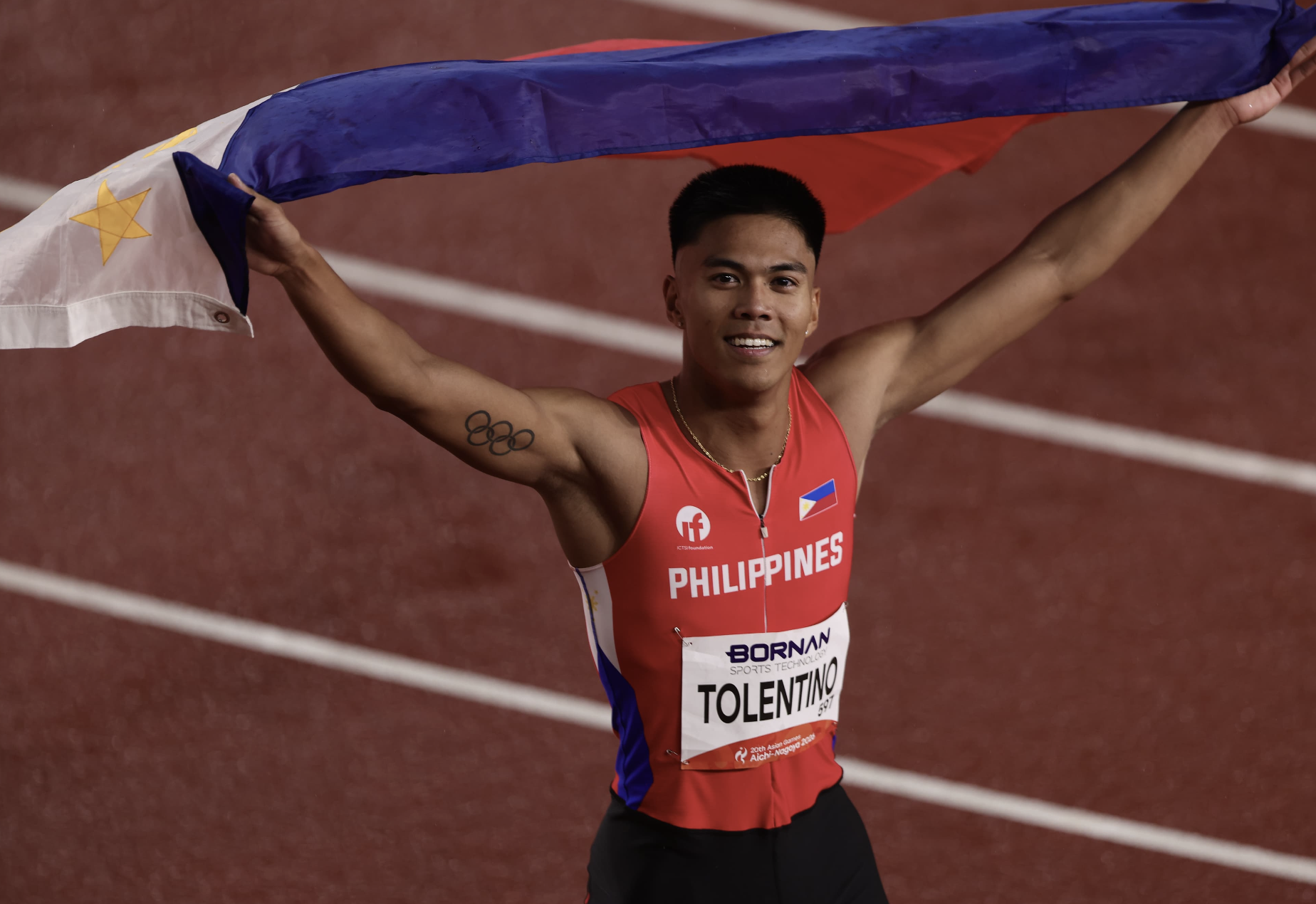
MANILA, Philippines – John Cabang Tolentino found redemption on Sunday, September 27, as he broke through for the Philippine athletics team at the 2026 Asian Games.

The 25-year-old Olympian clinched the bronze medal in the men’s 110m hurdles at the Nagoya City Mizuho Park Athletic Stadium in Japan.

Denied a spot on the podium in the 2023 edition in Hangzhou, China, where he placed fourth, Tolentino bounced back and posted a season-best 13.48 seconds as he won the Philippines’ first athletics medal in this year’s Asian Games.

China’s Chen Yuanjiang clocked 13.15 seconds to capture the gold, while Japan’s Rachid Muratake bagged the silver with 13.29 seconds.

“I’m very happy. It was just a lot of self-pressure and I just did it,” said Tolentino, who was born to Filipino parents in Spain.

“Even in the hard times, I kept pushing … I was always dreaming about this.”

The Asian Games bronze adds to his collection, which includes a Southeast Asian Games gold and an Asian Indoor Athletics Championships bronze.

In December, Tolentino won the SEA Games title in record-breaking fashion in Bangkok, Thailand, shattering the previous mark that stood for a decade.

With an Asian Games medal in the bag, Tolentino eyes a second Olympic stint.

“I’m gonna go for LA Olympics,” he said. – Rappler.com
Similar Posts

  • |

    India reclaim No. 1 T20I ranking after Zimbabwe series win

    HARARE: India have climbed back to the top of the ICC Men’s T20I team rankings after taking an unassailable lead in their three-match series against Zimbabwe, quickly reclaiming the position they had lost earlier this month. The reigning T20 world champions moved to No. 1 after defeating Zimbabwe by 90 runs in the second T20I at Harare on Saturday. The victory gave India a 2-0 lead in the series and pushed them ahead of England in the rankings. India had slipped to second after a difficult tour of England, where they suffered a heavy series defeat. England had subsequently taken over the top spot after India’s long reign at No. 1 came to an end. The return to the summit has come quickly, with India showing a strong response against Zimbabwe. In the second T20I, India posted 219 for five, powered by Ishan Kishan’s 81 from 44 balls and an unbeaten 60 from Tilak Varma. Zimbabwe were then dismissed for 129 in 17.5 overs as India completed a convincing victory. The first match had also gone India’s way. They chased down Zimbabwe’s 125 for seven in just 13.2 overs, winning by seven wickets, with young opener Vaibhav Sooryavanshi hitting a rapid 50 from only 19 deliveries. India’s return to No. 1 underlines the competitiveness at the top of the T20I rankings. Before the Zimbabwe series, England were ranked first with India second, while Australia, New Zealand and South Africa occupied the next three places. Pakistan remain sixth, followed by West Indies, Bangladesh, Sri Lanka and Afghanistan in the top 10. With the series already secured, India entered the third T20I with an opportunity to complete a clean sweep. The result could also prove important in what is currently a closely contested battle for the top ranking. For India, however, the immediate message is clear: “after a brief fall from the summit, the world champions are back at No. 1.”

  • |

    Babar Azam’s England Test return in doubt after hand injury

    LEEDS: Pakistan captain Babar Azam’s participation in the opening Test against England has become uncertain after the star batter suffered a blow to his hand during a practice match against the PCC Select XI. Babar was batting on five in the 39th over when a delivery from fast bowler Manny Lumsden struck his hand. The right-hander immediately appeared uncomfortable and received treatment from the team’s medical staff before retiring hurt. The Pakistan Cricket Board later advised Babar to rest as a precaution, but a final decision on his availability for the first Test has not yet been made. The development comes at a crucial moment for Pakistan, with the three-match Test series against England scheduled to begin on Wednesday at Headingley. Babar had returned as Pakistan’s Test captain earlier this year and was selected to lead the side throughout the England tour. Babar’s possible absence would be a significant concern for Pakistan, particularly given his importance in the middle order and his leadership role. The team management is expected to take no risks with the experienced batter and will assess his condition before confirming the playing XI. Babar briefly took part in a training session at Headingley on Monday, offering some encouragement to Pakistan. However, his availability is expected to be assessed again after Tuesday’s practice session, when the medical team should have a clearer picture of his recovery. Meanwhile, Shan Masood has also resumed training in Leeds and could feature in the opening Test. Shan had been sidelined after fracturing a finger while batting during the first Test against the West Indies in Tarouba. Despite the injury, he returned to the crease in the second innings but was unable to bat in his regular position. Subsequent scans confirmed the fracture, ruling him out of the second Test. Pakistan will hope both senior batters are fit as they prepare for a demanding series in England. The first Test is scheduled for August 19-23 at Headingley, followed by matches at Lord’s and Edgbaston. With the opener only days away, Babar’s fitness has emerged as one of the biggest talking points around Pakistan’s preparations. The team will await medical clearance before deciding whether its captain is ready to take the field. Pakistan squad Babar Azam (c), Aamir Jamal, Ali Usman, Abdullah Shafique, Azan Awais, Imam-ul-Haq, Khurram Shahzad, Mohammad Abbas, Mohammad Ali, Mohammad Rizwan (wk), Mohammad Awais Zafar, Muhammad Ghazi Ghori (wk), Sajid Khan, Salman Ali Agha, Saud Shakeel* (subject to fitness), Shan Masood and Ubaid Shah.

  • |

    Cristiano Ronaldo set to enter acting after World Cup defeat

    Cristiano Ronaldo is preparing for a surprising new chapter away from the football pitch, with the Portugal superstar reportedly set to make his acting debut in an upcoming football drama series. The five-time Ballon d’Or winner is expected to appear in “Day 1s”, a new series centred on the world of football agents. According to British media reports, Ronaldo will make a cameo appearance while also taking on the role of executive producer. The move marks an intriguing expansion of Ronaldo’s already wide-ranging career, as the football icon increasingly explores projects beyond playing the sport that made him a global superstar. Ronaldo moves from football to the screen “Day 1s” is reportedly built around the story of a fictional football agent and the pressures, ambitions and personalities surrounding the modern game. British actor Damian Lewis is set to play the lead role, while British rapper Dave and newcomer actress Carlotta Banat are also part of the cast. Ronaldo’s involvement is expected to add an extra layer of attention to the production, particularly because of his enormous global following and deep connection with football. The series is already in production, with some scenes reportedly filmed at The Hive Stadium, home of English League Two club Barnet. Thierry Henry also joins the cast Ronaldo will not be the only major football name making the jump into the fictional world. Former France and Arsenal star Thierry Henry is also expected to appear in a cameo role. Interestingly, the concept for “Day 1s” was reportedly developed by Darren Dean, Henry’s former agent, who is also involved in the project as an executive producer. The involvement of major football personalities could make the series particularly appealing to fans who want to see what happens behind the scenes of the sport. Streaming battle could be next Reports suggest that several major streaming platforms could show interest in acquiring the rights to “Day 1s”, potentially triggering strong competition for the series. For Ronaldo, the project represents more than just a brief appearance on screen. In addition to his football career, he has expanded into business, media and other entertainment ventures in recent years. His role as both actor and executive producer could therefore signal the beginning of another major chapter in his career. After years of dominating football headlines, Ronaldo may soon have audiences watching him for a completely different reason — not for what he does with a football, but for what he does in front of a camera.

  • |

    FIFA’s $20bn plan shakes football power balance

    FIFA’s plan to bring private equity investment into global football is opening a new chapter in its long-running struggle with Europe over the sport’s power, finances and commercial control. The world football governing body, led by President Gianni Infantino, is considering the creation of a subsidiary valued at around $20 billion. The proposed company would manage the World Cup and other major FIFA events. Under the plan, outside investors could acquire stakes of up to 20% in the new entity. The proposal has already triggered strong opposition from European football authorities. UEFA has criticised the idea and accused FIFA of putting the “soul” of football at risk by allowing private investors greater access to the sport’s most valuable competitions. Infantino has defended the proposal as an effort to make football’s financial system more inclusive. He has described the initiative as a form of “democratisation” that could allow more football nations to benefit from the sport’s growing commercial revenues. The plan could also provide financial incentives to FIFA’s 211 member associations. Under the proposal, each association could receive up to $20 million in immediate funding for special projects. Further grants of $20 million or more could be provided during subsequent four-year cycles. Such funding could prove particularly attractive to smaller and emerging football nations that depend heavily on FIFA for financial support. FIFA already generates billions of dollars through broadcasting rights, sponsorships and other commercial agreements. The organisation had set a revenue target of $13 billion for its previous four-year cycle, which included the latest World Cup and the Club World Cup. However, FIFA’s financial strength remains smaller than the overall commercial value of European football. UEFA reported that Europe’s top club competitions generated around €4.4 billion during the 2024-25 season alone. Football competitions across Europe generated more than €40 billion during the same period, according to Deloitte’s annual football finance review. The continent’s five major domestic leagues — the Premier League, Bundesliga, LaLiga, Serie A and Ligue 1 — accounted for more than half of that revenue. FIFA has spent decades trying to reduce Europe’s dominance over the global game. The organisation’s leadership has repeatedly sought to give greater influence to football associations in Africa, Asia and Latin America. Former FIFA president João Havelange was a major figure in that effort. He expanded the World Cup and built political support among smaller football nations, helping shift the balance of influence within FIFA. Successive FIFA presidents continued that approach. Infantino has expanded the World Cup from 32 teams to 48, increasing opportunities for countries outside Europe’s traditional football powers. The FIFA president has also suggested that a 64-team World Cup could be considered for the 2030 centenary tournament. The idea followed calls from South American football’s governing body CONMEBOL for an expanded competition. The proposal has faced criticism from European football officials. LaLiga president Javier Tebas has accused FIFA of damaging the sport. His criticism reflects wider concerns in Europe about the growing number of international competitions and the commercial expansion of FIFA. FIFA has previously attempted to attract external investment into its competitions. A proposed expansion of the Club World Cup backed by a consortium led by SoftBank in 2018 failed to materialise after strong resistance from UEFA. The latest private equity proposal could face a similar challenge. However, Infantino has a major advantage within FIFA’s political structure. The organisation’s decisions are determined by its global membership rather than European football alone. FIFA has 211 member associations, meaning support from Africa, Asia, Latin America and other regions could allow Infantino to advance the plan despite European opposition. Experts believe the financial incentives could make the proposal attractive to developing football nations. Eric Windholz, an associate professor at Monash University’s law faculty, said countries in the Global South could find the plan appealing because their domestic football competitions generate far less commercial income than major European leagues. The regional football authorities have also reacted cautiously

  • एसियाडमा नेपालले २२ खेलमा १३६ खेलाडी सहभागी गराउने

    काठमाडौँ। जापानको आइची/नागोयामा हुने २०औँ एसियाली खेलकुदमा नेपालबाट २२ खेलमा १३६ खेलाडीले सहभागिता जनाउने भएका छन्। ८० पुरुष र ५६ महिला गरी १३६ खेलाडी सहभागी हुने राष्ट्रिय खेलकुद परिषद्अन्तर्गत खेलकुद विकास विभागका प्रमुख सरोजकुमार पोखरेलले जनाएका छन्। प्रशिक्षक संख्या ३२ छ। नेपालबाट आर्चरीमा १/१ पुरुष/महिला, एथलेटिक्समा ४ पुरुष र २ महिला, ब्याडमिन्टनमा २/२ पुरुष/महिला, बक्सिङमा […]

Leave a Reply

Your email address will not be published. Required fields are marked *