
Europe

  • | | |

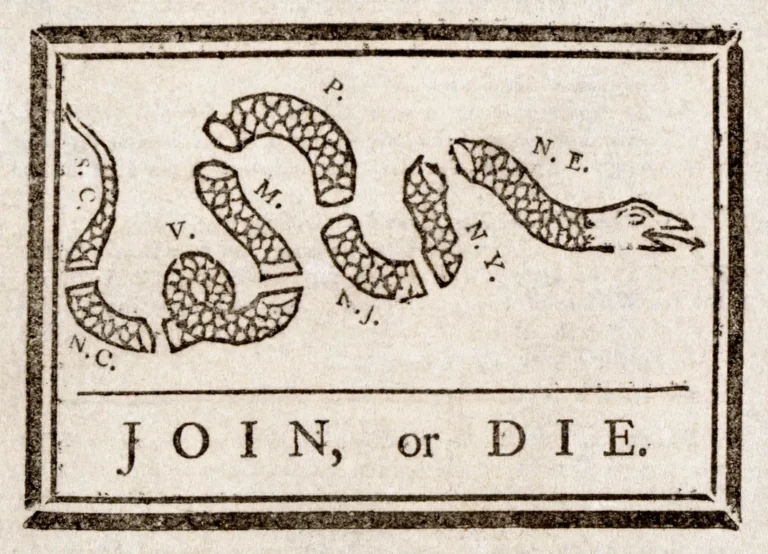
    Benjamin Franklin’s iconic ‘Join, or Die’ cartoon

    In Philadelphia, a new public artwork inspired by Benjamin Franklin’s famous “Join, or Die” woodcut is being installed on Independence Mall. Designed by artist John Collins, the impressive 46-foot-long granite sculpture is slated for its official public unveiling later this autumn on the Liberty Bell Center Block, right in the historic heart of the city. From 18th-Century Print to 21st-Century Granite The original artwork that inspired this modern installation carries significant historical weight. On May 9, 1754, Franklin published the illustration in his newspaper, the Pennsylvania Gazette, as the French and Indian War was breaking out. Created as a woodcut print, the imagery depicted a serpent severed into eight distinct segments, directly above the stark warning “JOIN, or DIE.” A Collection of American Colonies Each section of the snake was carved with initials symbolizing the American colonies of the era. N.E. (New England, grouped as one block) N.Y. (New York) N.J. (New Jersey) P. (Pennsylvania) M. (Maryland) V. (Virginia) N.C. (North Carolina) S.C. (South Carolina) At the moment he published the print, Franklin was preparing for the Albany Congress. This critical meeting brought colonial delegates together to strategize against common external threats and to negotiate a vital alliance treaty with the Iroquois Confederacy. Strength Lies in Solidarity. The cartoon served as an urgent call for collective action, warning that a fragmented collection of colonies would inevitably perish individually. “The confidence of the French in this undertaking seems well-grounded on the present disunited state of the British Colonies, and the extreme difficulty of bringing so many different governments and assemblies to agree in any speedy and effectual measures for our common defence and security,” A Lasting Legacy of American Unity   By translating this historic woodcut into a physical, segmented granite monument, the National Park Service and artist John Collins aim to give visitors an interactive connection to early American history. Set against the backdrop of Independence Hall and the Liberty Bell, the 46-foot sculpture preserves Franklin’s message: strength lies in solidarity.

  • |

    How canvas and color rescued Winston Churchill

    When history pictures Sir Winston Churchill, it summons the same iconic image of the stoic wartime leader. This typical leader with a bulldog scowl possesses cigar clamped between his teeth and a V-for-victory sign raised to a resilient nation. Yet behind the fierce political maneuvers lay a deeply sensitive man fighting severe emotional exhaustion. There’s a major landmark exhibition in London, titled Winston Churchill: The Painter. It has kept Britain’s titan grounded: his lifelong, intense passion for oil painting. The 1915 Catalyst Churchill did not pick up a paintbrush as a youth or a rested pensioner. He was forty years old and engulfed in the darkest catastrophe of his career. Following the disastrous Gallipoli campaign in 1915 during the First World War, Churchill was stripped of his post at the Admiralty. He got abruptly casted into political exile. So, he felt his mind consumed by overwhelming anxiety and listlessness. He had described himself as a deep-sea creature suddenly hauled to the surface. He suffered from a terrifying drop in pressure. In desperation, he picked up a set of children’s paints belonging to his young family members. What began as a tentative experiment to stave off despair quickly blossomed into an obsession. As Churchill would later recall, The Muse of Painting came to my rescue. The canvas provided something his turbulent political career rarely allowed: a realm where he held absolute command over every stroke, texture, and hue. From Cautious Strokes to Bold Expressionism The exhibition traces Churchill’s artistic maturation across five decades and more than fifty rare works, many loaned from private collections where they have remained hidden from public view for generations. Initially guided by artistic mentors such as Sir John Lavery and Sir William Nicholson, Churchill’s early works were cautious and subdued, capturing war-torn landscapes on the Western Front during his subsequent military service in France. However, as his confidence grew, so too did his appetite for vibrant color and energetic compositions. Influenced by French Post-Impressionism, Churchill developed an eye for brilliant light and rich pigment. He famously declared his disdain for muted palettes, writing that he felt genuine pity for poor, timid browns in favor of unapologetic cobalt blues, emerald greens, and fiery terracottas. Whether rendering the lush water garden at Chartwell or capturing the sun-drenched architectural marvels of Marrakech, Churchill painted with the same he brought to the House of Commons. Morocco, in particular, held a magical appeal for him. He returned there six times, captivated by the dramatic contrast between the snow-capped Atlas Mountains and the luminous desert plains. Art as Solace and Soft Diplomacy For Churchill, painting was never a mere hobby to kill time; it was a psychological anchor and a companion through severe personal tragedies. When his three-year-old daughter Marigold tragically died of sepsis in 1921, or when political fortunes ebbed during his wilderness years in the 1930s, Churchill retreated to his studio at Chartwell. Surrounded by paint tubes housed in old cigar humidors, he labored for hours at his easel, finding peace in the disciplined focus required to translate nature onto canvas. Beyond personal healing, his artwork doubled as subtle political allegory and warm diplomacy. Paintings like The Beach at Walmer (1938) depicted a historical cannon watching over innocent swimmers. This artwork hinted at his growing anxiety over looming European conflict long before others acknowledged the threat. Later in life, he frequently gifted canvases to world leaders, bodyguards, and trusted confidants, using his art as a bridge of personal warmth.  A Portrait of the Man Ultimately, exploring Churchill’s canvases fundamentally reframes our understanding of one of history’s most formidable figures. The bold brushstrokes reveal an individual far more vulnerable, contemplative, and joyful than the uncompromising statesman of public memory. By stepping behind his easel, we discover that the stubborn courage that helped save the free world was nurtured, in no small part, by the quiet sanctuary of color and light.