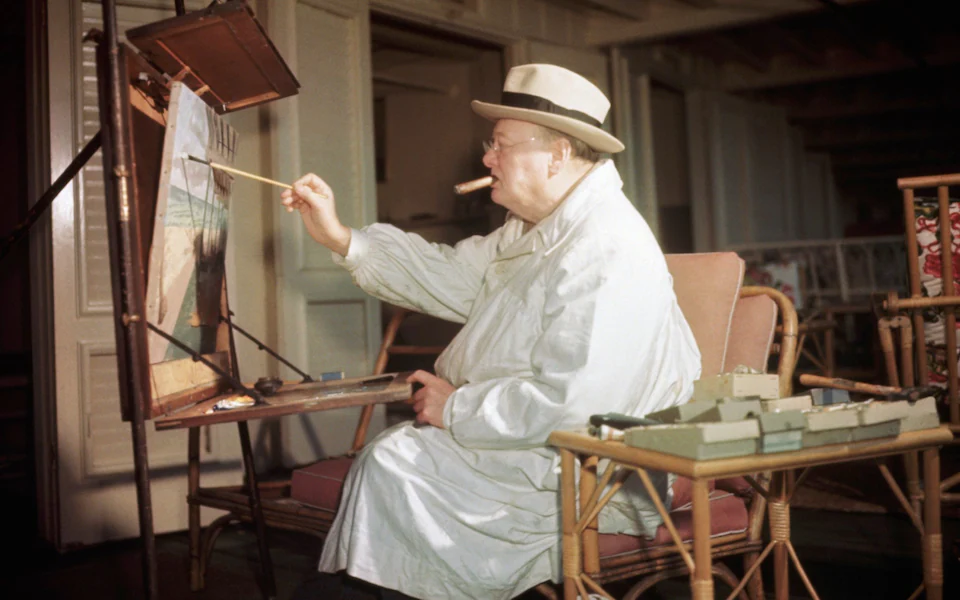
canvas color rescued
|

How canvas and color rescued Winston Churchill

When history pictures Sir Winston Churchill, it summons the same iconic image of the stoic wartime leader. This typical leader with a bulldog scowl possesses cigar clamped between his teeth and a V-for-victory sign raised to a resilient nation. Yet behind the fierce political maneuvers lay a deeply sensitive man fighting severe emotional exhaustion. There’s a major landmark exhibition in London, titled Winston Churchill: The Painter. It has kept Britain’s titan grounded: his lifelong, intense passion for oil painting.

The 1915 Catalyst

Churchill did not pick up a paintbrush as a youth or a rested pensioner. He was forty years old and engulfed in the darkest catastrophe of his career. Following the disastrous Gallipoli campaign in 1915 during the First World War, Churchill was stripped of his post at the Admiralty. He got abruptly casted into political exile. So, he felt his mind consumed by overwhelming anxiety and listlessness. He had described himself as a deep-sea creature suddenly hauled to the surface. He suffered from a terrifying drop in pressure.

In desperation, he picked up a set of children’s paints belonging to his young family members. What began as a tentative experiment to stave off despair quickly blossomed into an obsession. As Churchill would later recall, The Muse of Painting came to my rescue. The canvas provided something his turbulent political career rarely allowed: a realm where he held absolute command over every stroke, texture, and hue.

From Cautious Strokes to Bold Expressionism

The exhibition traces Churchill’s artistic maturation across five decades and more than fifty rare works, many loaned from private collections where they have remained hidden from public view for generations. Initially guided by artistic mentors such as Sir John Lavery and Sir William Nicholson, Churchill’s early works were cautious and subdued, capturing war-torn landscapes on the Western Front during his subsequent military service in France.

However, as his confidence grew, so too did his appetite for vibrant color and energetic compositions. Influenced by French Post-Impressionism, Churchill developed an eye for brilliant light and rich pigment. He famously declared his disdain for muted palettes, writing that he felt genuine pity for poor, timid browns in favor of unapologetic cobalt blues, emerald greens, and fiery terracottas.

Whether rendering the lush water garden at Chartwell or capturing the sun-drenched architectural marvels of Marrakech, Churchill painted with the same he brought to the House of Commons. Morocco, in particular, held a magical appeal for him. He returned there six times, captivated by the dramatic contrast between the snow-capped Atlas Mountains and the luminous desert plains.

Art as Solace and Soft Diplomacy

For Churchill, painting was never a mere hobby to kill time; it was a psychological anchor and a companion through severe personal tragedies. When his three-year-old daughter Marigold tragically died of sepsis in 1921, or when political fortunes ebbed during his wilderness years in the 1930s, Churchill retreated to his studio at Chartwell. Surrounded by paint tubes housed in old cigar humidors, he labored for hours at his easel, finding peace in the disciplined focus required to translate nature onto canvas.

Beyond personal healing, his artwork doubled as subtle political allegory and warm diplomacy. Paintings like The Beach at Walmer (1938) depicted a historical cannon watching over innocent swimmers. This artwork hinted at his growing anxiety over looming European conflict long before others acknowledged the threat. Later in life, he frequently gifted canvases to world leaders, bodyguards, and trusted confidants, using his art as a bridge of personal warmth.

 A Portrait of the Man

Ultimately, exploring Churchill’s canvases fundamentally reframes our understanding of one of history’s most formidable figures. The bold brushstrokes reveal an individual far more vulnerable, contemplative, and joyful than the uncompromising statesman of public memory. By stepping behind his easel, we discover that the stubborn courage that helped save the free world was nurtured, in no small part, by the quiet sanctuary of color and light.


Similar Posts

  • Fuel light on? How far can you drive?

    Running out of fuel while driving can leave you stranded so it is important to pay attention when the fuel warning light appears on your dashboard. Many drivers wonder how far they can travel once this light turns on.  The answer depends on several factors including your car’s model age fuel efficiency driving style road conditions and weather. Experts say the fuel warning light usually comes on when only about 10% to 15% of the fuel tank is left. In most cases small cars can still travel around 20 to 30 miles (32 to 48 km) after the warning light appears. Larger vehicles may be able to drive up to 50 miles (80 km) before running out of fuel. However older vehicles rough roads heavy traffic or cold weather can reduce that distance because the engine uses more fuel in these conditions. Experts also warn that repeatedly driving until the tank is nearly empty may damage the fuel system or engine over time. While driving a few extra miles after the warning light comes on is usually safe it is always best to refill your tank as soon as possible.

  • Plan your weekly meals

    “What should we cook today?” sounds like a simple question but for many women it has become a daily challenge. Preparing a meal that everyone in the family enjoys while also keeping the budget under control is not always easy especially when food prices are high. Food is an important part of daily life but eating the same dishes again and again can become boring. Family members often want something different and tasty every day. The situation can become even more frustrating when someone says “Cook anything you like” but later complains about the food. A simple solution is to plan the meals for the entire week in advance. A seven day meal plan can reduce daily stress save time and make it easier to manage household expenses. Plan different meals for each day A weekly menu can include different types of food to keep meals interesting. For example. Monday: Vegetables Tuesday: Chicken Wednesday: Lentils Thursday: Rice dish Friday: Fish Saturday: Meat Sunday: A family favorite special meal This gives the family more variety and removes the need to decide what to cook every day. Make meals healthy for children When planning meals for children taste and nutrition should both be considered.  If children do not like vegetables they can be added to chicken dishes or other foods they already enjoy. This can make vegetables easier for children to eat while also giving them important nutrients. Add family favorites The weekly menu can also include the favorite foods of other family members.  If someone gets bored with the same type of meal the same basic ingredients can be prepared in different ways. For example meat can be cooked with vegetables lentils rice or different spices to create completely different flavors. Save money and reduce food waste With food prices rising weekly meal planning can also help control household spending.  Once the menu is decided you can make a shopping list and buy only the ingredients you actually need. This can reduce unnecessary shopping prevent food waste and make grocery spending easier to manage. Most importantly planning meals in advance can make daily life less stressful and finally put an end to the never ending question: “What should we cook today?”

  • Best choice 500kg cake covered in 33,000 flower petals

    Spanish pastry chef Marc Suarez has created an extraordinary wedding cake for a Saudi royal family.  The giant cake stands 3.5 meters tall is 1.8 meters wide and weighs around 500 kilograms. Months of planning and work According to reports Suarez spent about six weeks designing the cake and another four months bringing the idea to life. Although he normally works alone this huge project required help from several pastry chef friends their families and other people close to him. Thousands of handmade flowers One of the biggest challenges was creating and coloring around 33,000 flower petals.  Each petal had to be carefully prepared and placed with branches and flowers to create the final design. Friends family members and others also helped with the detailed work. Suarez said the project required around 1,800 hours of work in total. The finished cake looks less like a traditional wedding cake and more like a large piece of art that could be displayed in a museum. A grand wedding in paris The enormous cake was presented at the Paris Opera Garnier during the wedding of a Saudi couple. The bride and groom chose to keep their identities private but their wedding featured a cake that was certainly difficult to forget. The project shows how pastry can go beyond food and become a form of art creativity and craftsmanship.

  • Hair loss causes and prevention

    Hair loss is a common problem that can affect both men and women. For some people it is temporary while for others it may slowly lead to noticeable thinning or baldness. Experts say hair loss can happen for many reasons. These include poor nutrition hormone changes stress certain illnesses inherited factors and frequent use of harsh hair products or chemical treatments. Common causes of hair loss Some of the most common reasons for excessive hair loss include. •Poor or unbalanced diet •Iron and vitamin deficiencies •Hormonal changes •Anemia •Stress •Certain medical conditions •Some medicines or medical treatments Family history of hair loss Women may also experience hair loss because of hormone related conditions. Tips to help reduce hair loss Healthy daily habits may help keep your hair strong and reduce breakage. Eat a balanced diet rich in protein. Ask your doctor about iron or vitamin deficiencies if you think you may have one. Keep your hair and scalp clean. Avoid using too many chemical hair products or treatments. •Do not brush or comb wet hair roughly. •Drink enough water every day. •Get enough sleep and manage stress. Before trying any new hair oil or home remedy do a patch test to check for skin irritation. Onion Juice A popular home remedy onion juice is a well known home remedy that many people use for hair care. It is usually applied to the scalp left on for a short time, and then washed off. However onion juice is not a proven cure for baldness. It may also cause irritation or allergic reactions in people with sensitive skin so it should be used with care. When to see a doctor If your hair is falling out quickly or you notice clear bald patches do not rely only on home remedies. It is best to visit a dermatologist to find the cause and get the right treatment.

  • |

    An alien planet

    Imagine living on a world where the start of the day and the end of the day aren’t just different times, but entirely different environments. On one horizon, morning arrives in a chilly mist where vaporized rocks might condense into glittering, mineral clouds. On the opposite horizon, evening sets in as a roaring, hyper-heated furnace hot enough to shred water molecules into raw hydrogen and oxygen. This isn’t sci-fi world-building, it is the reality of WASP-121 b, an extreme exoplanet located roughly 850 light-years from Earth. Astronomers analyzing data from NASA’s James Webb Space Telescope (JWST) have uncovered unprecedented details about this distant world, proving for the first time that its morning and evening twilight zones are fundamentally different from one another. A World Locked in Perpetual Extremes WASP-121 b belongs to a class of cosmic objects known as hot Jupiters: giant gas planets that orbit extraordinarily close to their parent stars. Because of this extreme proximity, the planet is tidally locked. Just as the Moon always presents the same face to Earth, WASP-121 b always presents the exact same hemisphere to its star. One side endures an unrelenting, eternal day with scorching temperatures topping 2,500 degrees Celsius (4,500 degrees Fahrenheit). The opposite side faces permanent night, staring into cold space. For years, astrophysicists hypothesized that the narrow transition zones between day and night. The planet’s terminators might harbor complex, asymmetrical weather patterns. However, confirming this required measuring subtle variations in starlight as the planet passed in front of its star. How Jet Streams Reshape Alien Skies Using JWST’s Near-Infrared Spectrograph (NIRSpec), researchers tracked how starlight filtered through different parts of WASP-121 b’s atmosphere. The findings revealed a dramatic contrast between the morning transition and the evening transition. The driver behind this strange weather is a planetary-scale jet stream. Superheated air on the dayside doesn’t stay still; it rushes toward the cooler nightside at extreme speeds. Because the planet rotates toward the east, these violent winds carry thermal energy around the globe and dump the bulk of that heat directly into the evening region. As a result, WASP-121 b’s evening atmosphere grows significantly hotter than its morning counterpart. Heat causes gases to expand, puffing up the evening sky like a inflated balloon. When starlight filters through this swollen atmospheric layer, it reveals an environment so fierce that water molecules cannot survive intact. Clouds of Metal and Torn Molecules In the searing furnace of the evening sky, chemical bonds break. Water vapor brought in from the dayside is torn apart by the heat, leaving behind a sky depleted of chemical stability. As those same winds continue their journey around the cold nightside, the atmosphere gradually cools down. By the time the air sweeps around to form the morning twilight, the story flips. Here, temperatures drop enough for chemical compounds to reassemble. Scientists suspect that in this cooler morning zone, minerals such as silicates condense out of the gas phase. Instead of water clouds like those on Earth, WASP-121 b’s morning sky likely features reflective clouds made of liquid rock or iron droplets. These metallic clouds block radiation from deeper layers, making the morning side appear even cooler to space observatories. A New Era of Exoplanet Meteorology Until recently, studying alien worlds meant treating entire planets as single, uniform points of light. This discovery demonstrates that modern space telescopes can resolve climate dynamics across distinct regions of a world hundreds of light-years away.   By capturing the contrast between a planet’s morning and evening, astronomers are moving from simply discovering exoplanets to mapping their active weather systems. WASP-121 b may be far too hostile for life as we know it, but understanding its violent atmospheric currents brings us one step closer to reading the skies of smaller, cooler, and potentially habitable worlds in the future.

  • | |

    The Sham Shaman

    In 1968, a graduate student in anthropology at the University of California, published a book that would reshape the publishing world. Titled The Teachings of Don Juan: A Yaqui Way of Knowledge. The book purported to be a faithful academic field report by Carlos Castaneda detailing his apprenticeship under an elderly Yaqui shaman named Don Juan Matus in the Mexican desert. Castaneda’s account became an overnight sensation as it blended desert mysticism, hallucinogenic plant rituals, and philosophical paradoxes. It sold millions of copies, earning him a doctorate from UCLA. This success made him a guru to icons like Bob Dylan, John Lennon, and Octavio Paz. A Life Built on Fabrications Long before he wrote about desert sorcery, Castaneda had mastered the art of reinventing himself. Born César Carlos Salvador Arana in Peru in 1925—the son of a humble watchmaker—he routinely rewrote his origin story. He claimed to have been born in Brazil, shaved years off his age, and concocted wild tales of fighting as a soldier in North Korea or working as a border spy. In reality, he fled Peru after fathering a child at thirteen, eventually making his way to Los Angeles in the 1950s. Ground-breaking Anthropological Discoveries. Yet beneath the celebrated field notes lay one of the most audacious literary fabrications in modern history. Don Juan Matus was not a real person. The desert apprenticeships never took place. Castaneda was not a devoted field researcher. He was a master illusionist who deceived prestigious academics and eager seekers alike. When Castaneda enrolled at UCLA, he found an academic environment eager for authentic indigenous wisdom and existential insight. Synthesizing disparate ideas into a singular narrative, he assembled Don Juan’s philosophical worldview by freely borrowing from European philosophy, Buddhist theology, ethnomethodology, and popular horror fiction. To his impressionable professors, the resulting texts appeared to be ground-breaking anthropological discoveries. Unraveling the Hoax While Castaneda’s books topped bestseller lists throughout the late 1960s and 1970s, critical cracks in his story soon began to widen into chasms. Skeptical researchers and anthropologists began scrutinizing the timeline and claims in his field notes. Archive Contradictions: UCLA library records revealed that on dates Castaneda claimed to be in the Sonoran desert learning shamanic secrets, he was actually signed into the university library reading room. Botanical and Cultural Errors: Experts on Yaqui culture noted that the spiritual concepts and language attributed to Don Juan bore almost no resemblance to authentic Yaqui traditions or language structures. Philosophical Echoes: Literary sleuths discovered that Don Juan’s most profound dialogues were near-verbatim adaptations of modern academic sociology and Western philosophical texts. Despite being systematically exposed by critics, Castaneda maintained his mystique. He avoided photo shoots, refused interviews, and cultivated an aura of secretive invulnerability. He also assured his devotees that any perceived discrepancies were simply part of a sorcerer’s duty to erase his personal history. The Guru’s Reclusive Cult and Legacy As public acclaim gave way to scholarly embarrassment, Castaneda retreated further into reclusiveness. In the 1990s, he launched a movement called Tensegrity. He promoted a series of physical movements he claimed were ancient Toltec magical passes. Critics quickly noted their striking resemblance to modern martial arts taught by a local Santa Monica instructor. Surrounding himself with a inner circle of devout disciples in Los Angeles, Castaneda governed his group with increasing paranoia until his death from cancer in 1998. Anthropology’s Ultimate Trickster Ultimately, Carlos Castaneda remains a complex figure in cultural history. His anthropological credentials were exposed as entirely fraudulent. His writings captured the yearning of an era desperate for spiritual transcendence beyond traditional structures. He stands as anthropology’s ultimate trickster. He’s a man who turned a fictional thesis into a million-dollar empire and proved that, given the right narrative, millions of people will gladly step through the looking glass.

Leave a Reply

Your email address will not be published. Required fields are marked *