central ruetehilal committee
| |

Central Ruet-e-Hilal Committee meets to sight Rabi…

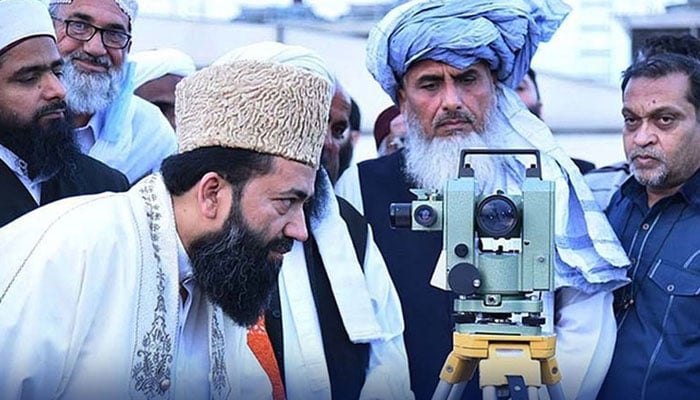
The meeting of the Central Ruet-e-Hilal Committee to sight the moon of Rabi-ul-Awwal 1448 AH is underway in Islamabad.

The meeting is being held at the Ministry of Religious Affairs’ Kohsar Block under the chairmanship of Central Ruet-e-Hilal Committee Chairman Maulana Abdul Khabir Azad.

Meanwhile, the Pakistan Space and Upper Atmosphere Research Commission (SUPARCO) has predicted that the Rabi-ul-Awwal moon is unlikely to be sighted today.

According to SUPARCO, the chances of sighting the moon are very low as it will be approximately 20 hours and 53 minutes old at sunset.

SUPARCO said Rabi-ul-Awwal 1 is likely to fall on Saturday.

However, the Central Ruet-e-Hilal Committee is the competent authority to make the final announcement regarding the sighting or non-sighting of the moon.

Similar Posts

  • |

    PMD issues high flood alert as Head Marala records over 205,000 cusecs inflow

    SIALKOT: The Pakistan Meteorological Department (PMD) has issued a High Flood Level Advisory for the River Chenab, warning that high water flows are expected to persist over the next 6 to 8 hours before gradually receding as rainfall over the upper catchments continues to decrease. According to the latest flood monitoring data, Head Marala has reached a high flood level, with water inflow recorded at 205,488 cusecs and outflow at 187,388 cusecs, indicating sustained high water levels in the Chenab River system. The Flood Forecasting Division (FFD) said the high flood situation has been caused by heavy rainfall across the upper Chenab catchment, as observed through hydro-meteorological data and the Sialkot weather radar. Although rainfall has now weakened across the major sub-catchments, river flows are expected to remain high for the next several hours before gradually declining. The advisory states that the River Chenab at Marala will likely remain at High Flood Level for the next 6 to 8 hours, provided current rainfall trends continue. It further warns that Khanki and Qadirabad are expected to reach High Flood Level within the next 10 to 12 hours. Besides the Chenab, the Jammu Tawi River is currently experiencing a medium-level flood, with a recorded inflow of 11,868 cusecs, while the Manawar Tawi is flowing at a low flood level, carrying 8,123 cusecs of water. The PMD has cautioned that residents living in riverine (Kacha) areas adjacent to the Chenab may face hazardous conditions and should avoid unnecessary movement near riverbanks and flood-prone locations until water levels begin to recede. The advisory also warns that standing crops, fodder fields and livestock in low-lying floodplain areas remain vulnerable to inundation. Low-lying roads, river crossings, embankment approaches and transport routes close to the river may also experience localized disruptions due to the elevated water levels. The Flood Forecasting Division said it will continue to closely monitor hydro-meteorological conditions, river flows and weather radar observations, issuing further updates if the situation changes. Meanwhile, provincial and district administrations, irrigation departments and other concerned agencies have been urged to maintain enhanced monitoring of river conditions and remain fully prepared for any emergency. The PMD noted that decisions regarding rescue, relief and emergency response will be taken by the National Disaster Management Authority (NDMA), the Provincial Disaster Management Authority (PDMA) and the respective district administrations. Authorities have advised residents, particularly those living in riverine and low-lying areas, to stay alert, follow official instructions and avoid unnecessary travel near flood-affected locations until the situation improves.

  • Pakistan Tourism faces tough questions as Senate reviews PTDC’s future

    Islamabad: The Pakistan Tourism Development Corporation (PTDC) came under scrutiny as the Senate Standing Committee on Inter Provincial Coordination raised concerns over its performance, financial situation and the condition of tourism facilities across the country. The Committee questioned the current position of PTDC while reviewing tourism related matters during a meeting held at Parliament House under the chairmanship of Senator Dilawar Khan. Members stressed the need for better management of tourism facilities and demanded a clearer picture of the condition of government owned tourism properties. The meeting focused on development projects and public issues in Chitral, including tourism, roads, electricity, telecommunications and transportation matters. Senator Dilawar Khan chaired the meeting, which was attended by Senator Aimal Wali Khan, Senator Syed Kazim Ali Shah, Senator Zamir Hussain Ghumro, Senator Mohammad Abdul Qadir, Senator Naseema Ehsan, Senator Saifullah Abro and senior officials from relevant departments. During discussions, the Committee reviewed PTDC’s performance and financial situation and examined the condition of tourism facilities and government buildings in Chitral. Members expressed concern over the condition of public properties linked with tourism and requested a detailed report regarding damaged government buildings. The Committee directed the concerned authorities to provide complete information about the damaged properties so that their condition, maintenance requirements and future use could be properly reviewed. Senators emphasized that tourism has significant potential for economic growth, especially in areas like Chitral where natural beauty attracts visitors from across Pakistan and abroad. However, they stressed that proper facilities, better management and timely development work are necessary to increase tourism opportunities. The Committee also reviewed other development challenges affecting Chitral. Officials from the National Highway Authority briefed members about progress on the Lowari Tunnel and nearby road projects. The Committee expressed concern over delays, funding issues and safety arrangements, directing that these important projects should be completed within the required timeframe. NHA officials assured the Committee that details regarding Korean financial assistance for related projects would be presented in the next meeting. The Committee also discussed delays in the feasibility study for the Chakdara Road project and called for early action to improve road safety and reduce future costs. Apart from tourism and roads, the Committee reviewed electricity and telecommunications issues in Chitral. Officials provided updates on the fibre optic project, electricity supply and load shedding problems. The Committee decided to invite officials from the Power Division and Pakistan Telecommunication Authority in the next meeting to discuss solutions for uninterrupted mobile services. The Committee also discussed transportation issues related to wheat supply between Punjab and Khyber Pakhtunkhwa. Members stressed that unnecessary barriers to inter provincial trade should be avoided. The Rawalpindi District Police Officer informed the Committee that police action is only taken against vehicles violating legal requirements. However, the Committee sought records of complaints related to check posts and directed that action should be taken against any officials found involved in corruption. Officials from the Punjab Food Department informed the Committee that there was no ban on the transportation of wheat from Punjab, while the Khyber Pakhtunkhwa Food Department explained the province’s wheat requirements and supply situation. Chairman Senator Dilawar Khan directed all relevant departments to submit progress reports on previous committee decisions before the next meeting. He reaffirmed that public projects must be completed on time with transparency, proper coordination and improved services for citizens.

  • | | | |

    Three powers, one shield? What the pact means

    Pakistan, Saudi Arabia and Türkiye have formalised their long-standing strategic and defence ties through the newly signed Makkah Joint Defence Agreement, establishing a framework for closer military coordination and collective security. The agreement was signed during a trilateral summit in Makkah attended by Prime Minister Shehbaz Sharif, Saudi Crown Prince Mohammed bin Salman and Turkish President Recep Tayyip Erdogan. The pact has attracted comparisons with established military alliances. However, analysts say its stated purpose is not to create a new military bloc or target any particular country. Instead, it provides an institutional structure for defence cooperation that has developed between the three nations over several decades. A formal structure for longstanding ties Pakistan and Türkiye have maintained close political and military relations for decades, while Islamabad and Riyadh have developed extensive defence, diplomatic and economic cooperation. The new agreement is viewed as an attempt to bring these existing relationships under a formal trilateral framework. It is designed to provide a more structured mechanism for consultations, military coordination and strategic cooperation. Why the agreement was signed now The agreement comes amid growing security challenges across the Middle East and wider region. Analysts say conflicts, changing military technologies and emerging security threats have encouraged countries with shared strategic interests to strengthen their defence coordination. The trilateral arrangement is intended to improve collective preparedness and provide a coordinated response to potential threats while supporting regional stability. What the defence pact provides A central element of the agreement is the principle of collective security. Under the framework, aggression against one member is to be treated as a threat to all three countries. The arrangement is expected to encourage greater military coordination, intelligence cooperation, strategic consultations and defence planning. Closer institutional links could also allow the three countries to coordinate their military capabilities and improve their ability to respond to security challenges. Different strengths, shared security interests Each country brings different capabilities to the partnership. Pakistan contributes a large and experienced military, operational expertise and extensive experience in counterterrorism and conventional defence. Saudi Arabia brings significant economic resources, regional influence and political weight. Türkiye adds its growing defence industry, military technology and manufacturing capabilities. Analysts believe these complementary strengths could make the partnership more effective while allowing the three countries to develop greater strategic self-reliance. Pakistan’s diplomatic role The agreement also comes as Pakistan seeks to strengthen its role as a regional diplomatic actor. Islamabad maintains relations with Saudi Arabia, Türkiye, Iran, China and the United States, giving it channels of communication with several major regional and global powers. Analysts argue that Pakistan’s diplomatic engagement, alongside its military capabilities, could help it contribute to regional crisis management and dialogue. What the pact does not mean Despite comparisons with NATO and other military alliances, analysts stress that the agreement is not described as an offensive alliance. It is also not presented as a pact directed against a particular country, a so-called “Muslim NATO”, a nuclear deterrence arrangement or a religious military bloc. Instead, the three countries have presented it as a defensive framework focused on collective security, deterrence, military cooperation and regional stability. The long-term effectiveness of the agreement will depend on sustained political coordination and the willingness of all three governments to implement its commitments.

  • | |

    Security scare in Germany

    German federal authorities and counterterrorism investigators have significantly heightened their security  following alarming revelations. According to confidential police documents cited by major German media outlets—including Süddeutsche Zeitung, NDR, and WDR—a Ukrainian cargo plane parked near an explosive-rigged drone at Leipzig/Halle Airport was actively carrying a shipment of military ammunition. The discovery has transformed what was initially treated as a localized security disruption into a high-stakes counterterrorism investigation into potential state-sponsored sabotage on critical European infrastructure. The Incident at Leipzig/Halle Airport The security breach unfolded late Tuesday night when airport ground personnel spotted a small First-Person View (FPV) drone hovering low to the ground near the tarmac. The unmanned aerial vehicle (UAV) eventually came to rest directly between two massive Antonov An-124 strategic freighters operated by Ukraine’s state-owned Antonov Airlines. Surprise grew among security officials when automated drone-detection systems failed to register the rogue aircraft prior to visual sighting. Specialized bomb disposal technicians from the Saxony State Criminal Police Office (LKA) quickly deployed remote bomb-disposal robots to neutralize the hazard. Forensic teams carefully detached a detonator from a fist-sized package of high-grade military explosives attached to the drone. Subsequent laboratory testing indicated the substance was likely Semtex, a potent explosive widely utilized in military and industrial demolition. Investigative reports from national daily Bild noted that only a technical malfunction in the improvised triggering mechanism prevented the explosive payload from detonating upon contact. High-Stakes Cargo at a Vital Strategic Hub The potential severity of the incident escalated sharply once investigators confirmed the contents of the adjacent aircraft. The Antonov freighter had recently arrived from France laden with military munitions intended for onward transfer. While authorities have not officially disclosed the specific caliber or destination of the military cargo, the presence of volatile munitions alongside a military-grade explosive device drastically raised the potential damage radius had an explosion occurred. Leipzig/Halle Airport serves as a vital artery for international air commerce, but it also holds immense geopolitical importance. It is the primary operational base for NATO’s Strategic Airlift International Solution (SALIS) program, which utilizes heavy transport planes to ferry military equipment across Europe and bolster defense along the alliance’s eastern flank. A Broader Pattern of “Hybrid Attacks” The drone discovery was not the sole disruption recorded at the facility that evening. In a separate and puzzling event during the same operational window, another commercial freight aircraft performing a go-around maneuver reported a mid-air collision with an unidentified flying object near the airfield. The affected jet sustained light damage before diverting to land safely at Hanover Airport. Search teams continue to comb the surrounding countryside for wreckage or debris connected to that mid-air collision. German Interior Minister Alexander Dobrindt characterized the overall event as a classic “hybrid attack scenario,” warning of elevated threat levels against key supply chains and public infrastructure across the nation. While German federal prosecutors have not yet formally named suspects, several European lawmakers have publicly pointed toward foreign state intelligence services seeking to disrupt Western logistics networks and military support routes.   Flight operations at Leipzig/Halle Airport have since returned to normal schedules, but the incident has prompted urgent calls for updated security protocols and enhanced anti-drone defenses across major European transportation infrastructure.

  • | |

    Sharjeel Memon accuses PML-N of holding power thro…

      Senior Sindh Minister and Provincial Information Minister Sharjeel Inam Memon on Tuesday launched a sharp criticism of the Pakistan Muslim League-Nawaz (PML-N), accusing the ruling party of coming to power through a “fake mandate” and challenging it to contest fresh elections in Punjab to prove its public support. Speaking to the media in Islamabad, Sharjeel Memon alleged that the PML-N government lacked genuine electoral legitimacy and was holding office on the basis of what he described as “Form 47.” He claimed that the party did not secure the mandate of the people in the 2024 general elections and questioned its popularity, particularly in Punjab. Addressing recent political developments, Memon alleged that serious electoral irregularities had taken place during the Azad Jammu and Kashmir elections. He claimed that the polls were marred by extensive rigging and criticized the conduct of the electoral process. Referring to Punjab Chief Minister Maryam Nawaz’s recent remarks, he said her statements reflected what he described as “theft followed by defiance,” accusing the ruling party of attempting to justify its actions instead of addressing concerns raised by the opposition. The senior Pakistan Peoples Party (PPP) leader said the PML-N government was surviving on what he termed a “charity mandate” rather than genuine public support. He reiterated his claim that the party’s government was a product of “Form 47,” a reference frequently used by opposition parties in connection with allegations regarding the 2024 general election results. Memon argued that the people of Sindh had clearly expressed their confidence in the Pakistan Peoples Party during the 2024 elections by voting in its favor. He contrasted the PPP’s electoral performance with that of the PML-N, claiming that the ruling party had suffered a significant political setback despite ultimately forming the federal government.   Continuing his criticism, the Sindh minister challenged the PML-N leadership to dissolve the Punjab government and seek a fresh public mandate. He claimed that if elections were held again in the province, the ruling party would fail to secure the support it claims to enjoy. According to Memon, public opinion in Punjab does not reflect the electoral outcome that brought the PML-N to power. He further alleged that the leadership of the PML-N had repeatedly left the country after reaching political agreements, contrasting that with the Pakistan Peoples Party’s political history. Memon maintained that PPP leaders had remained in Pakistan during difficult political periods and continued to face challenges rather than leaving the country. The provincial minister also accused federal ministers belonging to the PML-N of attempting to influence the electoral process in Azad Jammu and Kashmir. He claimed that several federal ministers remained present in Mirpur Division until the morning of polling day and sought to influence the local administration. According to Memon, the actions of the federal ministers amounted to a violation of the Election Commission’s code of conduct. He alleged that government officials were pressured during the election process, raising concerns about the fairness and transparency of the polls. The remarks come amid continuing political tensions between the Pakistan Peoples Party and the Pakistan Muslim League-Nawaz over electoral legitimacy, governance, and recent elections in Azad Jammu and Kashmir. Opposition parties have repeatedly raised concerns regarding the conduct of elections, while the ruling coalition has rejected allegations of irregularities and maintained that the electoral process was conducted in accordance with the law. Sharjeel Memon concluded by reiterating his challenge to the PML-N leadership, insisting that a fresh election in Punjab would provide the true test of the party’s public support and determine whether it genuinely enjoys the confidence of the electorate.

  • |

    Pakistan sweep USA 3-0 in ITF Masters World Team Championship Opener

    Pakistan made a dream start to the ITF Masters World Team Championship by defeating the United States 3-0 in their opening Group match in Lisbon, Portugal. The convincing victory gives Pakistan an early boost in the prestigious men’s 45+ tournament, where more than 300 players from 30 countries are competing for top honours. Led by an experienced squad, Pakistan dominated both the singles and doubles contests to complete a clean sweep against the American side. Former Davis Cup star Aisam-ul-Haq Qureshi set the tone with a composed performance in the opening singles match. The Pakistan Tennis Federation president defeated Wojtek Brytek in straight sets, 6-2, 6-3, handing Pakistan a valuable early lead. The second singles encounter proved to be the highlight of the tie. Pakistan’s top-ranked player Aqeel Khan battled through a tense three-set contest against John Chesworth. After dropping the opening set, Aqeel fought back with determination to claim a hard-earned 2-6, 6-1, 6-4 victory, sealing Pakistan’s overall triumph. The doubles match added even more excitement. Pakistan’s Shehryar Salamat and Hadi Hussain lost the first set but responded brilliantly with an impressive comeback. The pair defeated Jevon West and Guillermo Cosen 1-6, 6-1, 10-6 in the deciding match tiebreak to complete a flawless 3-0 victory. The emphatic win has given Pakistan valuable momentum ahead of the remaining round-robin fixtures. The team’s blend of experience and composure under pressure was evident throughout the contest, raising hopes of a deep run in the championship. Pakistan will now face Canada in a crucial second group match. The winner will secure a place in the knockout stage of the tournament, making it one of the most important fixtures of the campaign. With confidence high after an outstanding opening performance, Pakistan will be aiming to continue its winning run and strengthen its bid for the ITF Masters World Team Championship title. The victory over the United States has already sent a strong message that the Pakistani veterans are ready to challenge the world’s best.

Leave a Reply

Your email address will not be published. Required fields are marked *