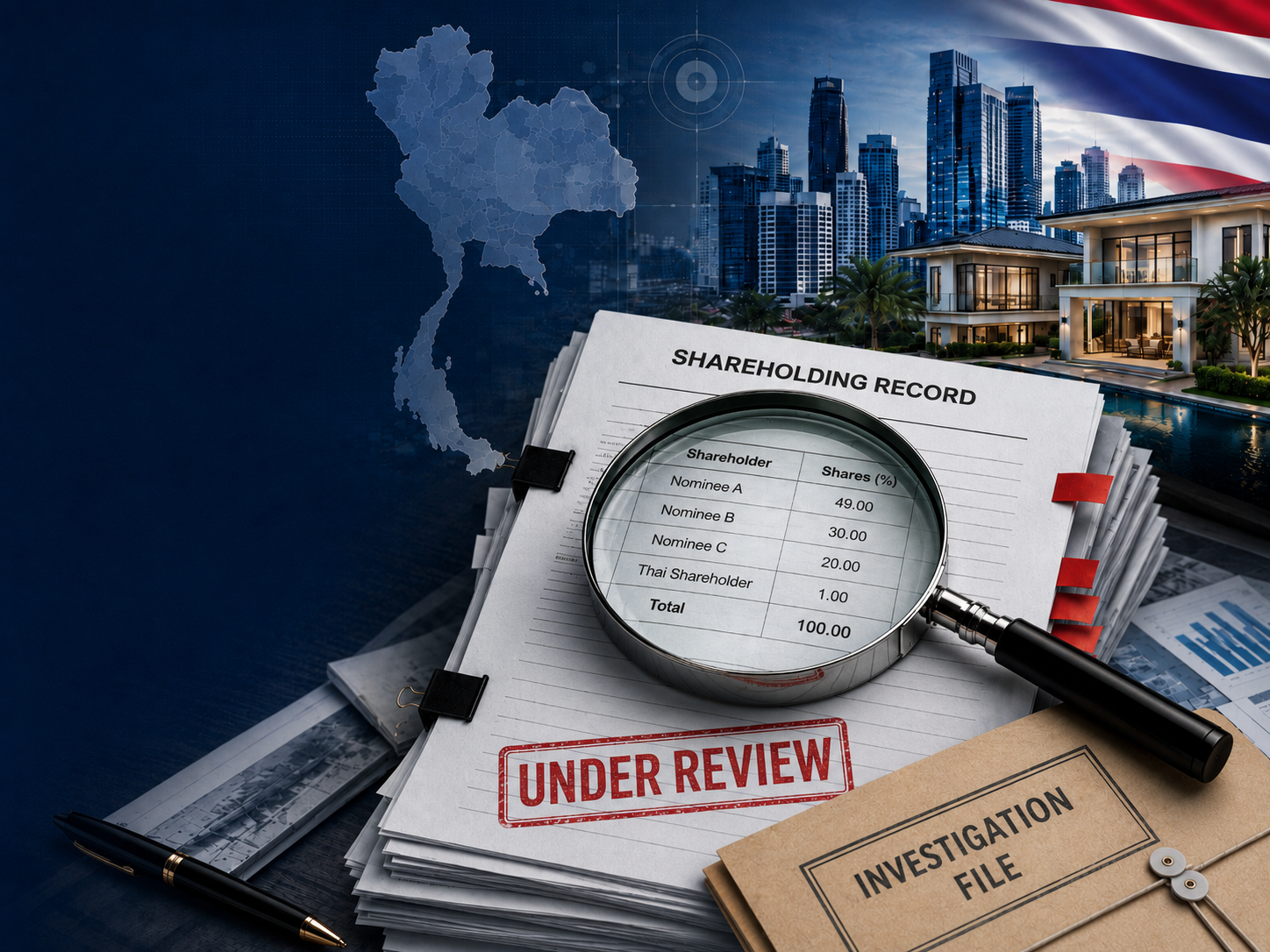
Explainer: Why nominee companies are under scrutiny in Thailand
Thailand is currently undergoing one of its most aggressive and coordinated crackdowns on nominee companies to date.
As of May 2026, the Department of Business Development (DBD) has partnered with the Department of Special Investigation (DSI) and the Anti-Money Laundering Office (AMLO) to actively investigate and dismantle these structures.
Here is a breakdown of what is happening right now and why it matters.
The Issue
Under Thailand’s Foreign Business Act and Land Code, foreign nationals are restricted from majority ownership in specific sectors (like agriculture, tourism, and property trading) and are prohibited from owning land outright.
To bypass these laws, some foreign investors use “nominee” structures. This involves using Thai citizens as proxy shareholders who hold 51% or more of the company on paper, while the foreign investor retains actual financial and operational control. This is illegal in Thailand.
Scope of the 2026 Crackdown
While the Thai government has warned about nominee companies for years, the current enforcement is unprecedented in its scale and technological tracking.
- Massive Audits: Authorities have scanned over 11,000 companies and identified a specific “hit list” of 6,551 legal entities suspected of severe nominee violations.
- Targeting Facilitators: The DSI is specifically going after the accounting and law firms that help set up these proxy structures. In one recent case, they found a single Thai individual listed as a shareholder in 66 different companies sharing the same registered address.
- Asset Seizures: AMLO is pushing to classify nominee offenses as predicate crimes for money laundering. This gives the government the power to track financial trails and completely seize assets, including luxury villas and land.
Key Hotspots and Demographics
The crackdown was heavily triggered by local complaints regarding unfair competition and the monopolization of resources in tourist areas.
- Ground Zero: Koh Samui and Koh Phangan are the initial primary targets. Authorities reported that up to 68% of registered businesses on these islands are foreign-operated, heavily utilizing nominee structures.
- Expansion Zones: The task force is actively expanding investigations to Phuket, Pattaya, Hua Hin, Krabi, and Phang Nga.
- Bangkok: Despite the focus on the islands, Bangkok currently has the highest absolute number of suspected illegal foreign-controlled businesses, with nearly 4,000 companies under investigation.
- Nationalities: The authorities have noted that French, British, Russian, Israeli, and Chinese nationals make up the largest demographics of foreign investors currently under scrutiny in these tourist hubs.
Targeted Sectors
The government is focusing its resources on the industries where nominee structures are most prevalent and damaging to local economies:
Real estate, land trading, and villa development
- Tourism, hotels, and resorts
- E-commerce, logistics, and warehousing
- Agriculture and general construction
Stricter Rules Moving Forward
The days of easily setting up a Thai company with a silent local partner are effectively over. The DBD is now working directly with the Thai Bankers’ Association to enforce strict financial checks.
Before a new company can even be registered, Thai shareholders must provide bank statements proving they have the actual financial capacity to pay for their 51% share of the business, proving they aren’t just a name on a piece of paper.