family discipline national

From Family Discipline to National Defence

After creating man, Allah Almighty included within his nature an administrative structure for the family, whereby he might continue the journey of life according to the needs of his age. With the passage of time this structure was obliged to expand; the family pressed onward and at length arrived at the threshold of the state. In the present family order, while the grandfather yet lives he is acknowledged head of the house, and his permission and consent enter into all the greater affairs thereof. Yet for the practical running of that household he has delegated certain responsibilities and powers to the members of his family, so that each person may be answerable for the work committed to his charge. When this same structure enlarged its scope to the management of the state, successive arrangements were fashioned in the light of varied experience, and the state began to be administered accordingly. In view of the requirements of the present hour further amendments were introduced, and thus the Pakistan Defence Forces Amendment Bill of 2026 was approved by Parliament, that all the affairs of the state might be conducted professionally under their proper jurisdictions.

The Act gives effect to certain provisions of the earlier Twenty-Seventh Constitutional Amendment. It establishes a Defence Forces Headquarters under the Chief of Defence Forces—an office held concurrently by the Chief of Army Staff—as the central headquarters of the armed forces. The Chief of Defence Forces is constituted the principal military adviser to the Prime Minister upon questions of national security, defence and the armed forces; he exercises operational command and control of those forces while remaining responsible to the federal government; and he is vested with authority for multi-domain integration, operational cohesion, joint and tri-service coordination, organisation, training, administration, combat readiness and kindred functions. Broad personnel powers are likewise conferred upon him; he may retire, release, accept or reject resignation, discharge, retain in service, or relax the limits of age and length of service for personnel subject to the laws of the armed forces, excluding only those appointed under Article 243, namely the service chiefs themselves. Amendments to the National Command Authority substitute the former office of Chairman of the Joint Chiefs of Staff Committee with that of the Chief of Defence Forces. The measures are given retrospective effect from November 27, 2025.

These provisions stand partially in line with a global tendency toward unified joint command and a single senior military counsellor. Many countries have created equivalent positions—Chief of Defence Staff, Chief of the Defence Force, Chairman of the Joint Chiefs and the like—in order to improve jointness, diminish service silos and furnish single-point military advice, lessons drawn from the demands of modern multi-domain warfare. In the United States the Chairman of the Joint Chiefs of Staff is the highest-ranking officer and principal military adviser to the President, the National Security Council and the Secretary of Defence. By the Goldwater-Nichols reforms and the provisions of Title 10 he possesses no operational command authority over the armed forces or over the other Joint Chiefs; the chain of command runs from the President through the Secretary of Defence to the combatant commanders. His function is deliberately advisory, concerned with counsel, planning, joint doctrine and the transmission of communications, so that civilian control and a measure of service autonomy in operations may be preserved.

In India the Chief of Defence Staff serves as principal military adviser to the Defence Minister on tri-service matters, permanent Chairman of the Chiefs of Staff Committee, head of the Department of Military Affairs and military adviser to the Nuclear Command Authority. He is charged with promoting jointness in operations, logistics, training, the prioritisation of procurement and the development of theatre commands. Explicitly, however, he does not exercise operational military command over the service chiefs, who retain command of their respective services; he is described as first among equals. The office was created to enhance integration without subordinating the services in the conduct of operations.

In the United Kingdom the Chief of the Defence Staff is the professional head of the Armed Forces and principal military adviser to the Prime Minister and the Secretary of State for Defence. Historically the role centred upon advice and strategy; reforms of recent years have strengthened it so that the Chief commands the service chiefs and heads a Military Strategic Headquarters charged with force design, war planning and the development of an integrated force. Even so, the office continues to operate under strong ministerial and civilian direction through the Defence Council.

Canada, Australia and similar Commonwealth models typically invest the Chief of the Defence Staff or Chief of the Defence Force with command authority over the forces, subject to direction from the government or the minister and ultimate civilian or Crown control. Emphasis is laid upon unified command for both operations and administration, exercised under parliamentary oversight.

The global pattern, therefore, moves toward a senior joint office for better integration and counsel. Pakistan’s law shares the goals of jointness, a central headquarters, multi-domain coordination and a principal advisory role, and is in that respect consistent with prevailing trends. Yet the Pakistani model differs in significant particulars. The concurrent dual role, whereby the Chief of Defence Forces is held by the serving Army Chief, is uncommon; most systems either appoint a separate officer, often rotated among the services, or keep the joint head distinct from day-to-day single-service command. This arrangement produces a clearer Army-centred apex than the more balanced or purely advisory models of the United States, India or the earlier British practice. Moreover, the combination of direct operational command and control of all services with sweeping personnel powers—extending to retirement, discharge, retention and the alteration of service limits across the forces, save only the top service chiefs—exceeds the strictly advisory character of the American and Indian systems. It approaches the stronger command-oriented models found in parts of the Commonwealth and in the recent British reforms, yet remains unusually comprehensive in matters of personnel under a single officer.

In the context of the civilian-military balance, democratic systems commonly embed such roles beneath robust civilian supremacy, parliamentary oversight and legal limits designed to prevent any single military office from dominating appointments or operations. Pakistan’s constitutional and statutory framing places the Chief of Defence Forces as Commander of the Armed Forces with considerable statutory latitude, while the federal government retains the power to frame rules.

 In short, the legislation advances similarity upon the objectives of joint command structures and a senior integrating and advisory office that many nations have adopted for efficiency and the requirements of modern warfare. It is less closely aligned in the degree of concentrated operational and personnel authority vested in a concurrent Army Chief. Whether the arrangement is appropriate depends upon the priorities chosen; enhanced jointness and streamlined decision-making on the one hand, or institutional balance, service equality and civilian oversight on the other. 
Similar Posts

  • Paying tribute to Miskeen Jahan Khan Khoso, a lege…

    Today, is the 45-death anniversary of Miskeen Jahan Khoso, one of the legends of Thar. Miskeen Jahan Khan Khoso was a man who dedicated his life to serving the people of Tharparkar. He was born on July 9, 1909, in a Village Sami Veri near Nangarparkar Taluka Head Quarter. His father’s name was Bijar Khan Khoso. He joined the government job in police department which, he inherited from his father and grandfather. Not tolerating the exploitation of poor, peasants and marginalized in hands of landlords and Patels, rock-hard young yet a passionate Jahan Khan changed his mind other way, he resigned from the police job in 1937. He dedicated rest of his life in serving the humanity, in this way he spent 43 years in rendering a noble work. Not tolerating the exploitation of poor, peasants and marginalized in hands of landlords and Patels, rock-hard young yet a passionate Jahan Khan changed his mind other way, Many times, cases were registered against him to intimidate and punish. He was convicted and jailed for two years under a notorious goonda act. Carrying stakes of newspapers, with trademark cape on head and an iron wrapped baton in the hand, he either walked on foot or travelled through camels, horses and khekhras (GMC trucks 6×6) thousands of miles in his life. He would remain away from family and village for months. He never ever favored nepotism, he equally fought against his brothers while came to know they were illegally occupying the land of poor Kolhi farmers. As usual, he stood with poor farmers and lodged FIR against his own brothers. Miskeen always identified himself as a humble and down-to-earth character. He was known as the social worker of Thar by the poor people of Nagarparkar for his relentless efforts to help them in their times of need. Miskeen’s dedication to his people knew no bounds. He would associate with the Kolhis, Meghwar and Bheels, making them feel at ease, even though he came from an affluent family. He was not just a social worker or philanthropist; he was a true friend to the poor people of Tharparkar. He raised his voice against all forms of oppression and cruelty inflicted upon these communities by local waderas and feudal lords. Miskeen fought against these powerful and influential people through the power of the pen and the spoken word. His unwavering dedication to his people often landed him in trouble. He was imprisoned and jailed for raising his voice against the injustices suffered by the poor people of Tharparkar. Despite facing numerous FIRs and cases, Miskeen never gave up on his cause. He would return to his people after his release from jail, listen to their issues, and take them to the He was nominated for an international award in recognition of his services to the poor, marginalized, and oppressed communities in America. However, due to financial constraints, his son was unable to attend the ceremony. Miskeen did not undertake these social services for any personal gain or consideration. He did everything voluntarily out of his love and concern for his people. That is why he is also known as the Edhi of Thar, named after the late Abdul Sattar Edhi, a legendary Pakistani philanthropist who dedicated his life to serving the underprivileged. Miskeen’s efforts continue to be remembered and appreciated by the people of Tharparkar even after his death. He did great service without having or getting resources from others. He was a true humanistic and poor-friendly and did not believe in conversion of religion. Today, many Non-Government organizations and philanthropists are praised for helping the poor in Thar, but it’s important to remember that Miskeen served the needy purely out of humanitarian concern, without seeking recognition. It is encouraging to see that Miskeen’s legacy lives on in Tharparkar. Many people, such as Mama Vishan Thari, have taken up the mantle of continuing Miskeen’s work in their own way. Mama Vishan Thari, also known as the Edhi of Thar, is a resident of Mithi city. For over a decade, he has run a blood bank near the civil hospital Mithi, providing free blood to those in need and saving hundreds of lives. He does not categorize based on religion, caste, or creed, believing that everyone is equal and deserves help regardless of their background. Miskeen passed away on 23rd July 1980, leaving behind a remarkable legacy in Tharparkar. Majestic and resilient like Karoonjhar itself, his life story is far too vast to be captured in a few words.

  • Pakistan’s ‘battery revolution’ needs market…

    Pakistan’s electricity sector is witnessing a quiet revolution. Between January 2024 and June 2026, the country imported more than 6 GWh of lithium-ion batteries, with monthly imports rising to 652 MWh in April 2026, according to the latest commentary by the Policy Research Institute of Market Economy (PRIME). The data confirms what many consumers already know: battery storage is rapidly becoming an integral component of Pakistan’s emerging distributed energy system. Against this backdrop, the proposal reportedly advanced by the Adviser to the Power Division, Syed Faizan Ali, to introduce Time-of-Use (ToU) net billing with an additional compensation of Rs18–22 per kWh for electricity discharged between 5 pm and 10 pm deserves serious attention. It represents one of the first attempts by policymakers to recognise battery storage as an active participant in the electricity market rather than merely a backup power source. PRIME has welcomed this initiative in its recent Prime Comment #44, “Turning Pakistan’s Battery Boom into a Grid Asset”, arguing that battery storage can transform millions of privately owned batteries into valuable grid resources capable of reducing evening peak demand and improving overall system efficiency. The think tank also reminds readers that in its April 2026 Prime Plus edition, PRIME  had advocated accelerated investment in Battery Energy Storage Systems (BESS) as part of Pakistan’s response to regional geopolitical tensions and growing concerns over energy security. The proposal is intellectually attractive. It recognises a simple economic truth: electricity stored during periods of abundant solar generation becomes considerably more valuable when discharged during the evening peak. Properly designed price signals can therefore encourage consumers to invest in storage while simultaneously reducing pressure on the national grid. The underlying economics are difficult to dispute. The policy conclusions, however, deserve far closer scrutiny. Pakistan’s electricity crisis has never been merely a shortage of technology. It has always been a crisis of institutions. For decades, governments have attempted to resolve structural failures through new incentives while leaving untouched the governance failures that created those problems in the first place. Capacity payments, guaranteed returns, fuel subsidies, cross-subsidies, circular debt financing and administratively determined tariffs all originated as seemingly sensible policy responses. Over time, they evolved into a complex web of distortions that now define Pakistan’s power sector. The battery revolution should not become the latest chapter in this history. The most immediate question concerns the proposed compensation itself. Every additional rupee paid for exported battery electricity ultimately has a source. If the payment is financed through higher consumer tariffs, ordinary electricity users subsidise battery owners. If financed through public resources, taxpayers assume another fiscal obligation. Unless the proposed payment reflects demonstrable savings through lower capacity utilisation, reduced reliance on expensive peaking generation, avoided transmission investments and lower fuel imports, it risks becoming another subsidy disguised as reform. The second issue concerns Pakistan’s peculiar electricity economics. The country simultaneously suffers from surplus installed generation capacity and shortages during particular hours of the day. Consumers continue paying enormous capacity charges even when power plants remain idle. Before introducing payments for battery discharge, policymakers should demonstrate whether distributed storage actually reduces these fixed obligations or merely shifts electricity from one time period to another while capacity payments continue unchanged. This distinction is fundamental. If batteries merely redistribute electricity without lowering total system costs, consumersmay simply end up paying twice: once for idle generating plants and again for battery incentives. PRIME’s analysis correctly highlights the dramatic increase in battery imports. Nevertheless, imports alone cannot determine public policy. Customs statistics reveal the volume of batteries entering Pakistan but not how they are ultimately deployed. Many imported batteries are likely destined for residential solar systems, telecommunications infrastructure, commercial backup systems, electric vehicles and industrial facilities rather than grid-support applications. Policy requires greater precision. Residential battery storage serving a single household differs fundamentally from utility-scale storage capable of providing ancillary grid services. The regulatory treatment, compensation mechanisms and operational obligations cannot be identical. Perhaps the most important omission concerns the electricity market itself. Time-of-Use pricing presupposes the existence of a reasonably competitive electricity market where prices reflect actual system conditions. Pakistan, however, continues to operate largely through administratively determined tariffs, long-term power purchase agreements and regulatory pricing decisions. Introducing another administratively determined premium without competitive price discovery risks creating fresh opportunities for regulatory arbitrage instead of improving market efficiency. The proposal also raises important questions of distributive justice. Battery storage remains concentrated among relatively affluent households and commercial consumers who have already invested in rooftop solar systems. Additional payments for exported electricity may transfer resources from ordinary grid-dependent consumers to wealthier “prosumers” capable of producing electricity themselves. A sound public policy must ask not only whether incentives improve efficiency but also who ultimately pays for them. Fiscal sustainability presents another challenge. Pakistan’s public finances remain under extraordinary pressure. Circular debt continues to impose significant costs upon the national exchequer while electricity subsidies consume scarce fiscal space. Every new incentive introduced into the power sector should be accompanied by transparent estimates of its medium-term fiscal consequences. Without such analysis, even economically desirable policies may produce unsustainable budgetary commitments. The environmental dimension deserves equal attention. Large-scale deployment of lithium-ion batteries inevitably raises questions concerning recycling, disposal, fire safety and hazardous waste management. Pakistan presently lacks a comprehensive legal and regulatory framework governing battery end-of-life management. Encouraging rapid battery adoption without simultaneously addressing environmental responsibilities merely postpones another policy problem for the future. Cybersecurity also enters the equation. As distributed storage becomes increasingly integrated with smart meters, digital communication systems and automated dispatch mechanisms, cybersecurity standards become an essential component of electricity regulation rather than an afterthought. The broader lesson extends beyond batteries. Pakistan’s remarkable solar revolution demonstrates that citizens and businesses are increasingly solving their own energy problems because the formal electricity system has become prohibitively expensive and unreliable. International observers have correctly described this transformation as one of the world’s most significant examples of consumer-led energy transition rather than state-led planning. Public policy should seek to complement—not constrain—this transition. However, complementing it

  • Beyond Public Finance: Towards Constitutional Poli…

    The Part VI of this series argued that Pakistan cannot escape dependency merely by improving tax administration. Better value added taxation, digital integration and fiscal coordination are necessary, but they cannot substitute for constitutional restraints, accountable government and dismantling of systems of privilege. The same intellectual caution must be applied to the history of economic thought. Conventional accounts often move from Greek philosophy to European scholasticism, mercantilism, Adam Smith and modern economics, leaving several centuries of Muslim intellectual activity in an unexplained gap. This omission creates the false impression that systematic thinking about taxation, markets, money, public expenditure, state responsibility and economic justice developed almost exclusively in the West. Muslim scholars did not describe their work as “economics” in the modern sense. Economic questions appeared within jurisprudence, ethics, administration, history and political philosophy. Imposing contemporary categories upon them would be anachronistic. Excluding their contributions from the history of economic ideas is equally indefensible. Modern scholarship has documented a substantial body of Muslim economic thought that conventional textbooks have frequently overlooked. The purpose is not to replace a Western monopoly with a Muslim one. Knowledge has always travelled across cultures as common heritage of mankind. Muslim thinkers drew upon Islamic sources, practical experience and Greek, Persian, Roman and Indian traditions. Their works were subsequently transmitted, debated and transformed in other intellectual settings. The proper objective is to restore missing pages to a shared human history. One of the earliest important works on public revenue was Abu Yusuf’s Kitab al-Kharaj. It did not treat taxation as a ruler’s unrestricted right to maximise extraction. Tax liability had to take account of productive capacity, conditions of the land and the taxpayer’s ability to bear the burden. Abu Yusuf preferred proportional agricultural taxation where a fixed assessment would become oppressive in a poor harvest and unduly favourable during exceptional production. He insisted that collectors should be honest, collection economical and taxpayers treated justly. He opposed arrangements capable of turning revenue collection into tyranny and also emphasised irrigation, transportation and other infrastructure necessary for production. This was more than tax administration. It was an early recognition that revenue depends upon institutions, incentives and the conduct of public officials. A tax may be lawful in form and oppressive in operation. The character of the collector, method of assessment and use of revenue are therefore integral to the legitimacy of taxation. Pakistan’s fiscal debate still struggles to absorb this elementary insight. In the Land of Pure, tax laws are judged by the amounts they collect, while blocked refunds, arbitrary demands, compliance costs and damage to productive capacity are treated as secondary matters. Revenue obtained by weakening the taxpayer is celebrated as administrative success. Abu Yusuf’s approach reverses the perspective: the state must preserve the source from which sustainable revenue arises. Al-Ghazali examined markets, exchange, specialisation, division of labour, money and the interdependence of economic activities. He explained that production of even an ordinary item required the cooperation of numerous workers performing specialised functions. His examples involving bread and needle-making appeared centuries before Adam Smith’s famous pin factory. He also recognised that markets emerge from mutual need and voluntary exchange, while public authority remains necessary to maintain justice and prevent harmful practices. Economic development was not separated from education, security, infrastructure and public welfare. Prosperity, justice and legitimate political authority formed parts of an interdependent social order. This understanding is richer than the artificial contest often presented between state and market. Markets require rules, trust, reliable money and protection against fraud. The state must provide these conditions without converting regulation into a mechanism for distributing arbitrary favours. Ibn Taymiyyah similarly distinguished between price increases produced by changes in supply and demand and those caused by injustice, hoarding or monopoly. Not every increase in price justified administrative interference. Market forces had to be understood before intervention was attempted. Intervention became necessary where concentrated power allowed monopolists to exploit the public. Ibn Taymiyyah therefore combined recognition of market mechanisms with restraint upon abuse—an approach far removed from both indiscriminate price control and unregulated private coercion. Pakistan repeatedly swings between these extremes. Governments interfere through administered prices, selective subsidies and discretionary regulation, while tolerating cartels, protected industries and barriers to competition. The result is not a free market or an effective developmental state. It is a negotiated market in which access to authority frequently determines economic advantage. Al-Maqrizi’s analysis of monetary debasement and inflation provides another striking antecedent. Writing in the context of monetary disorder, scarcity and maladministration, he connected the excessive issue of inferior money with rising prices, disruption of exchange and hardship for the population. Ibn Taymiyyah had also warned that circulation of currencies with different intrinsic values could drive better money out of use. The instruments have changed. Modern states no longer depend upon metallic coins in the same manner. The underlying warning remains relevant: governments cannot conceal fiscal disorder indefinitely through manipulation of money. Inflation transfers resources without transparent legislative approval and imposes its harshest burden upon those least able to protect their savings and incomes. The most comprehensive contribution came from Ibn Khaldun. His Muqaddimah connected taxation with state formation, political authority, incentives, production, public expenditure, urban development, elite luxury and dynastic decline. Ibn Khaldun observed that during the earlier stages of a dynasty, moderate assessments could generate substantial revenue because economic activity remained vigorous. As ruling establishments expanded, expenditure increased and elites became accustomed to luxury, new taxes and higher rates were imposed. Productive incentives weakened, the tax base contracted and larger assessments produced smaller revenues. Arthur Laffer expressly acknowledged this antecedent in 2004, writing: “The Laffer Curve, by the way, was not invented by me”. He immediately referred to Ibn Khaldun’s analysis of high assessments and declining revenue. Laffer also mentioned other predecessors, so historical accuracy requires us to describe Ibn Khaldun as a major antecedent rather than the sole originator of the idea. Reducing Ibn Khaldun to the Laffer Curve would nevertheless diminish his contribution. His argument was not merely that tax cuts

  • The Architect of Conscience: Arif Ali Mir and the …

    Reflecting upon the profound vastness of the cosmos and the acute, unyielding solitude of the human condition, the French philosopher and writer Albert Camus once observed that if even a single lamp were to be kindled within the dark, tempestuous ocean of history, the entire fabric of the universe would transform, tearing asunder the merciless veil of night. The annals of history stand as an unshakeable testament to the truth that whenever the fierce gales of material greed, political expediency, and moral decay have threatened to engulf human societies, certain dervish-souled, deeply conscientious, and granite-willed individuals have emerged from the crowd. Swimming resolutely against the powerful, destructive current of their era, these rare souls have stood guard over the invaluable civilizational trusts bequeathed by antiquity. The fertile, history-drenched soil of Gujrat—where the ancient, meandering waves of the Chenab and Jhelum rivers have whispered civilizational sagas for centuries—has long served as the intellectual cradle and practical domain of precisely such a man of extraordinary mettle. Brushing aside the rigidities of legal codes, the demanding, iron-willed disciplinary training of police service, and the glittering, lucrative allure of high-ranking international postings, he made the monumental choice to dedicate his entire terrestrial existence to books, the retrieval of forgotten history, and uncompromised moral dignity. This towering, unyielding personality is none other than Arif Ali Mir, Advocate, whose entire life has stood like an unshakable monolith against the self-serving, shifting winds of his time. Born on December 28, 1949—corresponding precisely to the 8th of Rabi’ al-Awwal, 1369 AH, on a Wednesday—within the historic, time-honored confines of “Mir Manzil” in Mohalla Khyber, nestled deep in the heart of Gujrat’s historic town of Jalalpur Jattan, Arif Ali Mir’s life is far more than a conventional biographical sketch. It is a profound, sweeping narrative capturing the complex post-colonial socio-political contradictions of the Indian subcontinent, an unwavering, almost sacred custodianship of noble familial heritage, and an extraordinary odyssey of letters where every single chapter serves as a luminous metaphor for absolute sincerity, purity of intellectual purpose, and complete self-sufficiency. His esteemed father, Ghazanfar Hussain Mir, was a legendary, fiercely principled, and seasoned lawyer of his generation. His uncommon nobility, profound legal acumen, and distinguished, intellectual circle of acquaintances infused the deepest foundational layers of Arif Ali Mir’s character with a forged-steel morality that would remain his greatest, most unassailable asset throughout his life. Standing gracefully beside him was his mother, Ruqaiya Begum, an affectionate, deeply dignified woman who silently imprinted the enduring values of selfless sacrifice, patience, and unbreakable resilience upon the rearing of her children. Within this vibrant, intellectually charged household comprising four sisters and three brothers, Arif Ali Mir occupies a unique middle vantage: two elder sisters precede him in age, while all other siblings are younger. Driven eventually by the professional demands and expanding horizons of his father’s legal practice, the family made the permanent transition from Jalalpur Jattan to the bustling city of Gujrat, establishing their permanent domestic and intellectual anchor at “Mir Street” on Bhimber Road—a historic domicile that would organically evolve into a cherished sanctuary for scholars, jurists, and discerning bibliophiles alike. A deep, discerning psychological and biographical study of Mr. Arif Ali Mir’s versatile and multifaceted personality reveals that his arrival on December 28, 1949, was far from a mere statistical coincidence. According to the timeless principles of astrological configuration and character alignment, his zodiac sign, Capricorn, functions as a clear mirror to his intrinsic nature. Ruled by Saturn—the planetary archetype of profound gravity, timeless perseverance, and unyielding adherence to principle—these exact traits form the unmistakable, defining hallmark of Mr. Arif’s entire life. While Capricorns are universally recognized across traditions as grounded earth signs marked by relentless, grinding toil, Arif Sahib uniquely channeled this raw elemental energy into cultivating a veritable forest of arts, letters, and historical preservation upon the plains of Gujrat. The crowning virtue of his astrological archetype is structural discipline combined with penetrating foresight—qualities that naturally laid the bedrock of his early success in the legal arena, where he learned to dissect truth from falsehood with microscopic precision. Yet, the most captivating, transcendent facet of his persona is how he decisively transcended the traditional, narrow materialism often associated with his sign through a profound inner spiritual inclination. Operating as a fiercely devoted bibliophile and patron of learning, he redirected the formidable organizational capacity of the Capricorn psyche away from worldly accumulation and entirely toward the preservation of rare texts and the wide propagation of knowledge. Operating with the quiet, unostentatious efficiency characteristic of his sign, his personal dignity, fierce institutional loyalty, and immense intellectual depth render him a towering, sheltering tree on Gujrat’s literary horizon—its roots gripping ancient tradition, its uppermost branches illuminated by the clear light of universal wisdom. Mr. Arif Ali Mir’s educational journey is a rugged, continuous path strewn with dramatic twists, historical upheavals, and personal sacrifices that ultimately refined his character like crucible-tested gold. At the time of his earliest schooling, his father was stationed as the Chief Sanitary Inspector for the Sialkot Municipality, prompting Arif’s first three formative, sensory years of childhood to unfold within the disciplined, historic halls of the Convent of Jesus and Mary in Sialkot. Upon the family’s return to Jalalpur Jattan, he successfully completed his fifth and sixth grades at Islamia Primary School, subsequently transitioning to Islamia High School. When domestic circumstances necessitated a move to Gujrat, where the family initially settled in a rented house near Mohalla Gyanpura / Muslim Abad , he pursued his seventh and eighth grades at Muslim High School on Court Road. This institution was then under the stellar administrative helm of the eminent headmaster Master Ghulam Abbas. For his matriculation, he moved to Public High School No. 1 in Gujrat—administered with strict discipline by Headmaster Mirza Shaukat Ali and school owner Sheikh Shafqatullah—where he successfully passed his Matriculation examination in the watershed year of 1964. Following this, he completed his intermediate education at Sir Syed College on Railway Road, Gujrat, in 1966, before

  • Beyond Riba: Reconstruction of Just Financial Orde…

    The preceding parts of this series have gradually separated concepts that modern banking has merged. Money used for payments is not the same thing as investment capital. A current account is not economically identical to funds deliberately committed to enterprise. Commercial-bank money creation is not automatically riba, but neither should monetary privilege remain beyond scrutiny. Once these distinctions are accepted, an obvious question arises: how will productive activity actually be financed? No modern economy can function merely by condemning interest. Farmers require seasonal finance. Manufacturers need machinery and working capital. Exporters must bridge the period between production and receipt of foreign proceeds. Families need housing. Governments require infrastructure. Entrepreneurs need capital before their businesses begin earning revenue. A serious alternative to riba must finance all of these activities (see the model of Robobank). The answer is not to replace every conventional loan with musharakah. Nor is it to rename a predetermined financial return as “profit”. Islamic commercial jurisprudence developed several different contractual forms precisely because economic transactions differ. Sale, lease, partnership, advance purchase and manufacturing contracts perform different functions and allocate ownership and risk differently. The real task is to connect financial return with an identifiable economic basis. A useful starting principle is simple: money should not generate a guaranteed return merely because money has been advanced. Return should arise from trade, ownership, service, productive participation or genuine exposure to commercial risk. This does not mean that every legitimate return must fluctuate. A trader may sell an asset for a fixed profit. A landlord may agree a fixed rent. A contractor may charge a predetermined price. A manufacturer may agree in advance to produce goods for a specified consideration. The prohibition of riba does not abolish prices. What matters is what stands behind the price. State Bank of Pakistan itself explains murabaha as a sale rather than a loan: the seller acquires a commodity, discloses its cost and sells it at an agreed profit. SBP similarly recognises mudarabah, musharakah, ijarah, salam and istisna as distinct Islamic financing structures. Accounting and Auditing Organization for Islamic Financial Institutions (AAOIFI) maintains separate Shariah standards for murabaha, ijarah, salam, istisna and musharakah precisely because each represents a different legal and commercial relationship. The distinction is fundamental. Consider machinery required by an industrial enterprise. A conventional bank may lend Rs.100 million and require repayment of principal plus interest. Under a genuine murabaha structure, the financier purchases identified machinery, assumes ownership during the relevant period and subsequently sells it to the customer at an agreed deferred price. The return is then legally attached to a sale. This difference has substance only if the financier actually acquires what it claims to sell. Ownership cannot be reduced to a momentary paper entry while every risk, liability and practical responsibility remains with the customer from beginning to end. The same principle applies to ijarah. A financier that purchases machinery, vehicles or other productive assets and leases them to a business may legitimately earn rent because it owns an asset whose use is being transferred. Ownership, however, carries obligations. Structural ownership risks cannot simply be transferred wholesale to the lessee while the financier retains only the right to receive money. The issue is thus not whether rent happens to resemble an interest payment in amount. Economic prices often converge. The decisive issue is whether a genuine lease exists. Housing illustrates the point particularly well. Diminishing musharakah has become one of the major financing techniques used in Islamic banking. Under its proper conception, the financier and customer acquire a property jointly. The customer pays rent for the financier’s share and progressively purchases units of that share until sole ownership is achieved. State Bank of Pakistan (SBP) has long maintained specific Shariah standards governing Sharikat-ul-Milk and diminishing musharakah. This can provide a defensible alternative to an interest-bearing mortgage. Its legitimacy, however, depends upon genuine co-ownership. If the customer bears every cost and risk from the first day, if the bank’s capital is effectively guaranteed irrespective of what happens to the asset, and if the entire arrangement merely reproduces principal plus benchmarked return, the partnership becomes increasingly formal rather than substantive. The same scrutiny is required in agriculture. Agriculture is ill-suited to rigid debt repayment because its returns depend upon weather, crop disease, market prices, water availability and timing. A farmer may incur losses despite diligence and competence. Classical commercial law contains an instrument remarkably suited to this problem: salam. Under salam, the purchaser pays the price in advance for specified goods to be delivered later. The farmer obtains working capital before harvest. The purchaser acquires a commercial claim to the future crop and assumes the market risk associated with buying it in advance. This is not charity. It is trade. Properly developed agricultural salam markets could provide farmers with liquidity without forcing them into compounding debt when crops fail. Warehousing, quality certification, crop insurance or takaful, commodity exchanges and transparent market information would be necessary to make such financing scalable. Istisna can similarly serve manufacturing, construction and infrastructure. A textile mill, irrigation facility, industrial machine and housing project need not be forced into one universal debt contract. Partnership financing becomes important where future returns are uncertain. Musharakah permits parties to combine capital and share results. Mudarabah separates capital from enterprise: one party provides funds and another skill and management. Return is connected with actual economic performance. Their difficulty is equally obvious. Profit-and-loss sharing cannot work where accounts are unreliable, sales remain hidden, related-party transactions are opaque and litigation takes years. A financier unable to determine actual profit will naturally prefer a fixed receivable. Financial reform requires credible accounts, meaningful audit, digital documentation, effective insolvency laws, reliable registries and quick commercial adjudication. Risk sharing cannot flourish where information itself cannot be trusted. There is, however, another question we rarely ask: why must productive finance remain concentrated in a few large banks? History offers an instructive example. Rabobank did not begin as the international institution known today. Its origins were local Dutch farmers’

  • From War Reconciliation to War Team: Pakistan&#821…

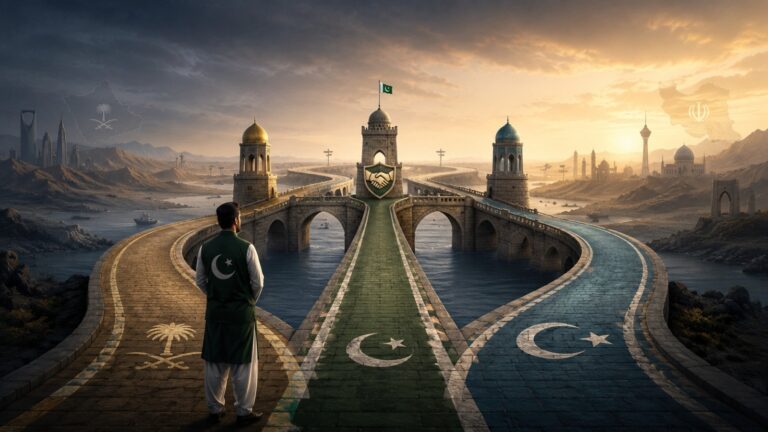
    By Engr. Saqlain Abid Pakistan’s diplomatic position appears to be entering one of its most delicate phases in recent years. What initially seemed to be a conflict limited to the United States and Iran is gradually expanding into a broader regional confrontation, forcing many states to reconsider their strategic choices. After six consecutive days of American bombing inside Iran and the continued military response by the Houthis against Saudi Arabia, Pakistan may find itself moving from the role of mediator toward that of a potential participant in a wider regional security framework. For months, Islamabad attempted to maintain balanced relations with all major actors. Pakistan consistently called for restraint, dialogue, and reconciliation while avoiding direct involvement in the conflict. However, regional defence commitments and strategic partnerships may eventually place Islamabad under increasing pressure. If Saudi Arabia invokes defence cooperation against Houthi attacks, Pakistan could face difficult decisions regarding its military and diplomatic responsibilities. Since the Houthis are widely regarded as being closely aligned with Iran’s Islamic Revolutionary Guard Corps (IRGC), any Pakistani military involvement against them would inevitably carry implications for Pakistan-Iran relations. Such a development would represent more than another military confrontation. It would symbolise the further fragmentation of the Muslim world. If Pakistan, another major Muslim state, enters a conflict involving an Iranian proxy, one must ask whether any meaningful concept of Muslim strategic unity ever truly existed. The divisions that have surfaced during recent crises suggest that political interests, national security calculations, and regional rivalries continue to outweigh religious solidarity. Recent diplomatic developments have also raised important questions. Turkey’s growing regional activism and President Recep Tayyip Erdoğan’s visible engagement alongside President Donald Trump during last week’s summit have been interpreted by many observers as a signal that regional alliances are evolving. Simultaneously, Iran appears to be facing mounting economic constraints, prolonged sanctions, and increasing diplomatic isolation. The question naturally arises: what strategic options remain available to Tehran? Iran still possesses considerable leverage despite its economic difficulties. The Strait of Hormuz remains one of the world’s most critical energy chokepoints, while the Houthis retain the capability to disrupt maritime traffic through the Bab-el-Mandeb Strait. Any prolonged disruption in either corridor would significantly affect global energy markets, increasing oil prices and creating severe economic pressure on Europe and the wider international community. These maritime realities provide Iran with strategic leverage even while under military and economic pressure. This changing environment also raises another possibility. Washington may be attempting to reshape its regional security architecture. The Gulf monarchies, particularly Saudi Arabia and the United Arab Emirates, have invested enormous financial resources over the past decade in regional security arrangements. Yet repeated conflicts have exposed limitations in those frameworks. If confidence in the existing Gulf-centred order continues to weaken, the United States may increasingly look toward countries such as Turkey and Pakistan as more active regional security partners. Pakistan’s strategic importance cannot be ignored. It possesses one of the world’s largest armed forces, nuclear capability, extensive counterterrorism experience, and a unique ability to maintain dialogue with competing regional actors. Together with Turkey, Pakistan could potentially contribute to a new regional security framework. Recent praise directed toward both President Erdoğan and Pakistan’s Chief of Army Staff, Field Marshal Asim Munir, by President Trump has naturally generated speculation regarding future strategic cooperation, although such interpretations remain speculative and should be approached with caution. Nevertheless, Pakistan must carefully evaluate the costs of any deeper military commitment. A defence partnership should never be viewed as a one-sided obligation. If Pakistan were expected to support Saudi Arabia during a regional conflict, an equally important question deserves attention: would Saudi Arabia provide similar military support if Pakistan faced aggression elsewhere, particularly from India? The answer remains uncertain. Defence agreements are strongest when obligations, expectations, and strategic interests are genuinely reciprocal. Pakistan’s greatest contribution may not lie on the battlefield but at the negotiating table. Rather than becoming another participant in an expanding regional war, Islamabad should utilise its diplomatic credibility to encourage a new regional dialogue. Any future Muslim security architecture should emerge through regional consensus, not through external approval or great-power competition. Iran has demonstrated that it remains an influential regional actor whose interests cannot simply be ignored. Sustainable peace will require engagement with Tehran rather than permanent confrontation. Ultimately, Pakistan stands at a strategic crossroads. It can either become another member of an expanding war coalition or position itself as a credible architect of a new regional order built upon diplomacy, mutual security, and South Asian consensus. In an era where wars are becoming increasingly costly and alliances increasingly fragile, Pakistan’s greatest strength may be its ability to build bridges rather than battle lines.

Leave a Reply

Your email address will not be published. Required fields are marked *